

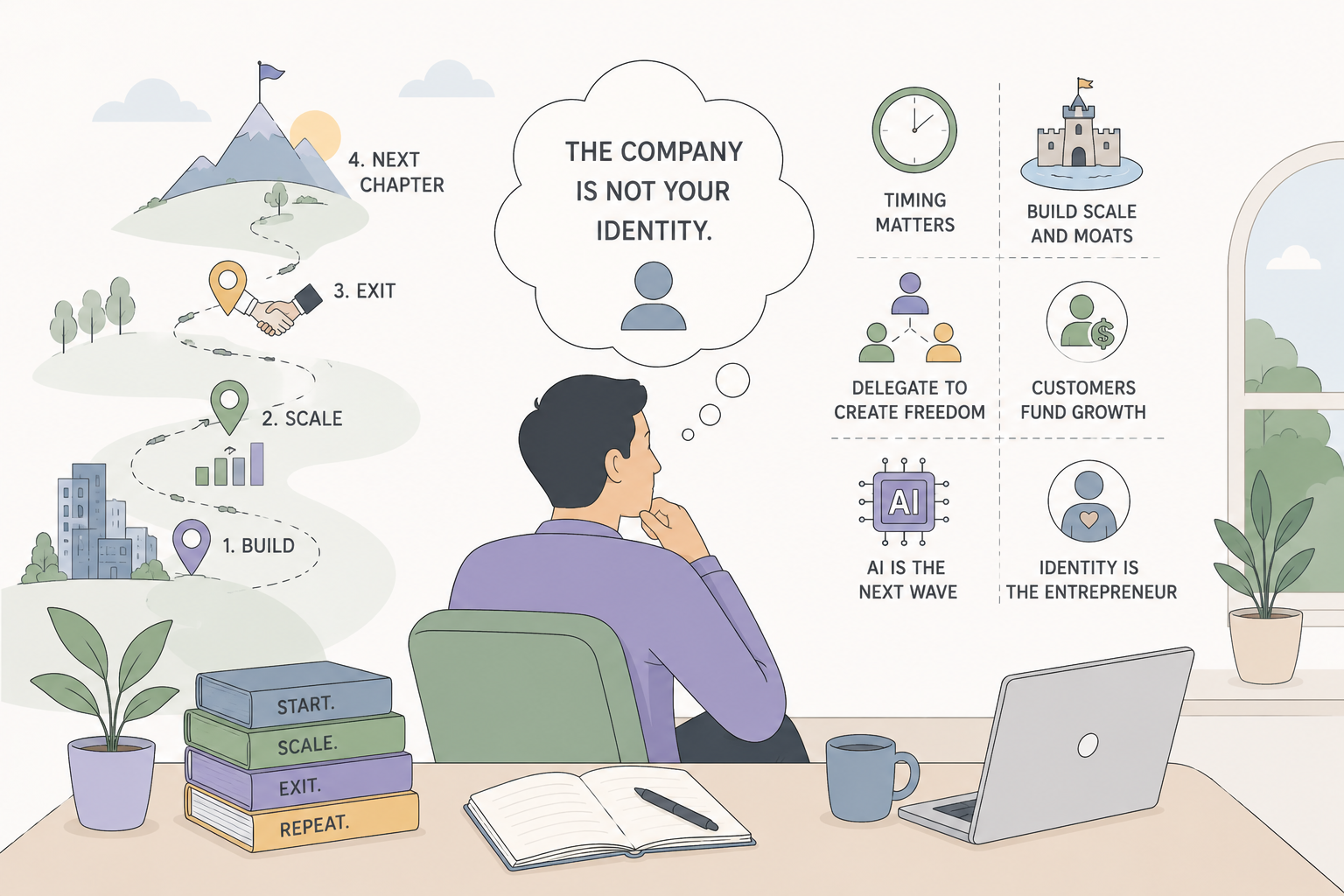

Colin C. Campbell on founder identity, timing the market, and the biggest mistake entrepreneurs make after success
This article is based on a conversation between Lee Benson and Colin C. Campbell on the Show Your Value podcast.
Most entrepreneurs don’t fail because they can’t build a company. They fail because they don’t know who they are without one.
That observation stopped the conversation cold.
During a wide-ranging discussion on entrepreneurship, exits, AI, leadership, and mental health on Lee Benson’s Show Your Value Podcast Colin C. Campbell shared one lesson that has followed him through decades of building and selling companies:
The company is not your identity.
For founders, that sounds simple.
In practice, it’s one of the hardest lessons in entrepreneurship.
Colin knows because he’s lived both sides of it.
He helped build one of Canada’s largest internet service providers during the first internet boom. He watched the company soar in value. Then he watched nearly all of that wealth disappear during the dot-com crash.
Years later, he would go on to build and exit multiple successful companies, documenting the lessons in his bestselling book Start. Scale. Exit. Repeat.
What emerged during his conversation with Lee Benson wasn’t a discussion about startup tactics.
It was a discussion about timing, identity, and how entrepreneurs can build companies that survive beyond the founder.
Timing Matters More Than Most Founders Think
One of Colin’s most painful lessons came from getting the exit wrong.
He spent nearly a decade building a company and only weeks watching the outcome unravel during the dot-com collapse.
That experience permanently changed how he thinks about exits.
Today, Startup Club tracks what Colin calls the “Time to Sell Index,” a measure designed to track liquidity and acquisition conditions across startup markets.
His view is straightforward.
Markets move in cycles.
Liquidity expands.
Liquidity contracts.
Founders who ignore those cycles often mistake favorable market conditions for operational brilliance.
“When things get frothy, it’s time to exit stage left.”
It’s not pessimism.
It’s pattern recognition.
Scale and Moats Beat Great Ideas
Colin believes most founders ask the wrong question when evaluating opportunities.
They ask whether an idea is good.
They should be asking whether it scales.
The second question is equally important.
Can it be protected?
Throughout the discussion, Colin repeatedly returned to two concepts:
Scalability.
Moats.
Without scalability, growth becomes expensive.
Without a moat, success attracts competition.
The strongest businesses combine both.
That’s where outsized exits are created.
Most Founders Never Learn to Let Go
Lee Benson and Colin C. Campbell found common ground around one challenge that stalls almost every growing company.
Delegation.
Early-stage founders naturally delegate tasks.
Scaling founders learn to delegate responsibilities.
Elite founders eventually delegate entire business units.
That shift sounds obvious.
It’s not.
Colin argued that the inability to make this transition is one of the primary reasons so few companies successfully scale.
Founders become the bottleneck.
The company becomes dependent on them.
Growth slows.
The entrepreneur becomes trapped inside the business they built to create freedom.
Customer Money Is Usually Better Than Investor Money
One of the most surprising moments in the conversation came when Colin challenged conventional startup wisdom.
Ninety percent of Inc. 5000 companies never raised venture capital.
Yet founders often obsess over fundraising.
Colin’s preference is simple.
Get customers to fund growth whenever possible.
Customer-funded growth creates discipline.
It avoids dilution.
And it forces founders to solve real market problems instead of investor narratives.
The goal isn’t to avoid capital.
The goal is to understand that capital isn’t validation.
Customers are.
AI Is Creating the Largest Opportunity of Our Lifetime
Colin has lived through multiple technology waves.
The internet.
Broadband.
Social media.
Mobile.
His belief is that AI will dwarf them all.
Throughout the interview, he described how AI agents are already replacing repetitive operational work across his portfolio companies.
But his message wasn’t about replacing people.
It was about changing how entrepreneurs think.
The founders who win over the next decade won’t necessarily be the most technical.
They’ll be the most adaptable.
They’ll develop what Campbell calls an AI mindset.
A constant willingness to ask:
Why am I still doing this manually?
The Company Is Not Your Identity
The conversation ultimately returned to the topic that opened the episode.
Identity.
Colin has seen founders achieve life-changing exits only to struggle afterward.
Not because they lacked money.
Because they lost the role that defined them.
His advice is simple.
Stop identifying as the CEO.
Start identifying as the entrepreneur.
Entrepreneurship is the craft.
The company is just the current project.
That’s a subtle distinction.
But for many founders, it can make the difference between one successful company and a lifetime of creating value.
As Lee noted during the conversation, value creation doesn’t disappear when a business is sold.
The opportunity simply takes a new form.
And for entrepreneurs willing to keep learning, adapting, and building, the next chapter is often the most exciting one yet.