


10 New Lessons for Writing a Best-Selling Business Book in the Age of AI
Two years ago, I wrote an article for Startup Club called “10 Secrets to Writing a Best-Selling Non-Fiction Business Book.”
That article hit #1 on Google for the search term “How to write a best selling business book,” and it has stayed there ever since.
So I thought it was time for Part II.
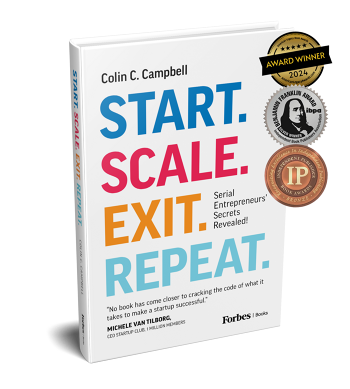
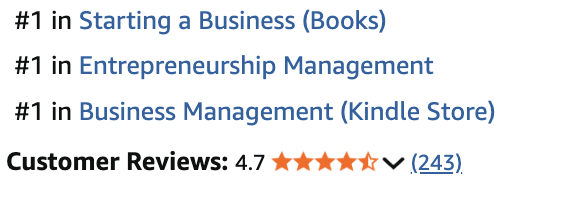
The first article was written after the launch of Start. Scale. Exit. Repeat., my first book. Since then, the book has become a #1 Amazon best seller in 15 categories, won more than 40 global awards and recognitions, and at the time of writing this article we #1 on Amazon in the categories “Starting a Business” and “Entrepreneurship Management” two and a half years after launch.
Not bad for someone whose English teacher would probably still be shocked.
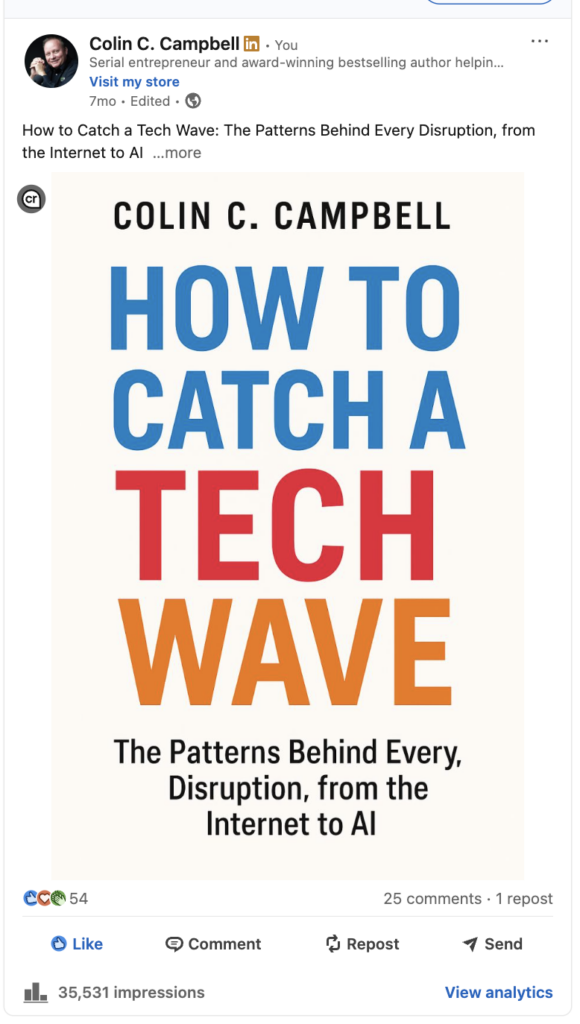
I am now working on my second book, How to Catch the Next Tech Wave: Patterns Behind Every Disruption, From the Internet to AI. As I go through the process again, I am realizing how much more I have learned, especially in a world where artificial intelligence has changed how people write, publish, market, and consume content.
Before I get into the new lessons, here is a quick summary of the first article.
The first article started with the most important question: why are you writing the book?
A great business book is not really about the author. It is about the reader. The reader wants to know how the book will help them, change them, guide them, or give them a framework they can use.
I also talked about the importance of choosing the right publisher, creating a powerful first impression with the cover, designing the inside of the book to match the promise on the outside, and writing in a way that busy people can actually consume.
Short sentences.
Short paragraphs.
Short chapters. In fact, Start. Scale. Exit. Repeat. has 78 chapters.
No walls of text. No lectures disguised as wisdom.
The article also covered the importance of authenticity, a strong launch, ongoing promotion, awards, reviews, and the long-term flywheel that begins after the book is published. Writing the book is not the finish line. It is the starting line. You might want to check this article out first before reading this one.
Two years later, here are 10 more lessons I wish I had known before writing, launching, and promoting a business book.
1. Make the Content Real
AI is tempting.
It can help you brainstorm, critique, organize, tighten, and improve your writing. Used properly, it can make a good idea stronger.
But AI should not replace the soul of the book.
The raw material still must come from you. Your experience. Your failures. Your scars. Your insights. Your content has to be “Raw and Real”. Your strange little stories that somehow make a business lesson unforgettable.
That is the difference between a book that sounds polished and a book that means something.
When I write, I start with my own thoughts first. I get the ideas down in my own voice. Then I may use AI to help critique it. That is a very different thing from asking AI to create the heart of the book. Note: in the case of my book, zero AI was used and thankfully I had great human editors at Forbes Books.
Readers can feel the difference.
A meaningful business book has to come from a real place. It has to reflect something you lived, learned, struggled with, or earned the hard way.
2. Your Name on the Cover Matters More Than You Think
In the first article, I talked about how important the title and cover are.
Since then, I learned something interesting at a publishing conference: do not make your name too small.
Many first-time authors are modest. They shrink their name on the cover because they do not want to look arrogant. I am Canadian and trust me we make an art of modesty. That is not a strategy when writing and launching a new book.
That may feel humble, but it can also send the wrong message.
A larger author name can create confidence. It tells the reader, “This person stands behind this work.” It gives the book a stronger presence. I was pretty modest with my name on the first book, but you can see from the cover draft above that I am not going to hide, but show it off with pride and confidence.
The title still matters. The design still matters. But do not hide from the cover. If you believe in the book, put your name on it like you mean it.
3. Design Your Book for the Real Buyer
At that same conference, I heard something else that caught my attention: women buy a significant majority of books.
NielsenIQ’s UK Books & Consumers data has reported that women bought 59% of all books, 58% of print books, and 65% of ebooks.
That matters.
Too many business books are designed as if the only reader is a man in a navy suit standing in front of a glass office building, holding a coffee and pretending he is not exhausted.
Business books do not have to feel cold, aggressive, or overly masculine.
With Start. Scale. Exit. Repeat., I got lucky. I didn’t plan it but my team included multiple women involved in the project before publication, including work on images, design, and production. The book was built to feel approachable, clear, visual, and useful. And they made certain the book appealed to women.
And it worked.
Based on Google data, almost 50% of our readers appear to be women. For a business book, I think that is meaningful.
Entrepreneurship is not a male category. Startups are not a male category. Business books should not be either.
4. Awards Help, But Not the Way You Think
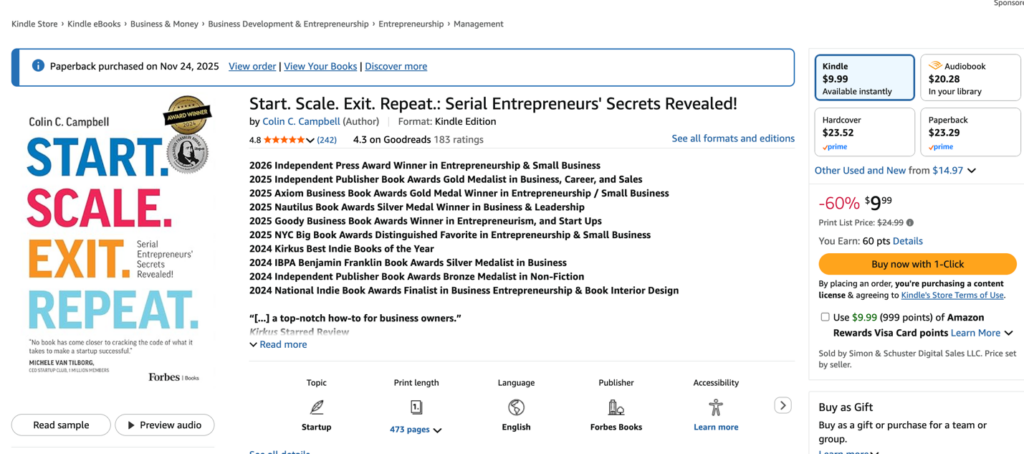
Start. Scale. Exit. Repeat. has now won more than 40 global awards and recognitions. More awards than any other book on entrepreneurship ever.
That sounds impressive.
But here is the truth: awards do not magically open the floodgates.
You do not win an award and suddenly wake up to thousands of orders, a documentary crew on your lawn, and Oprah calling while you are brushing your teeth.
Awards help because they build trust.
They are social proof. They matter on your Amazon listing. They matter when someone is deciding whether your book is credible. They matter when you are pitching yourself for podcasts, speaking events, media, or partnerships.
Awards are not the engine. They are fuel for the engine.
If your book is genuinely strong, apply for awards. But do not expect the award alone to do the work. But let me be clear here….your book has to be great! It has to hit 4.7 or higher on Amazon. Investing in applying for awards will not win you awards…these are real judges with awards that have reputations and some of them are well recognized. They do not hand out awards because you simply pay an application fee. If you have a good book, promote it and apply for every award you can.
5. Reviews Are Still the Currency That Matters
If awards are social proof, reviews are the oxygen.

Getting people to review your book is ridiculously hard. People will read the book, love the book, tell you it changed their thinking, send you a beautiful LinkedIn message, and then somehow vanish into the wilderness the moment you ask for an Amazon review.
Ask anyway.
When you appear on podcasts, ask for reviews.
When you speak at events, ask for reviews.
When readers message you, thank them and ask for a review.
When other authors support you, support them back.
At one recent book awards event, I bought three books from other authors. I read them. Then I reviewed each one on Amazon. Other authors have done the same for me.
That is one of the unexpected things I have learned: independent authors can become a real community. Help them. Review them. Connect with them. Promote the good ones.
The book world works better when authors support each other.
And if you love this article, please buy the book and see what makes it so great. And I would be honored if you reviewed the book.
No, I mean review the book.
Seriously, I am not joking…..review the book.
Ok this is the last time I am asking: will you damn well review the book!
6. BookBub Can Move the Needle
I have been impressed with BookBub.
We have been listed on their site three times over the last three years, and each time, the book popped up on the charts.
That does not mean BookBub is a magic machine. Nothing is. But it can be a powerful promotion tool, especially if your book already has strong reviews, a professional listing, and a clear audience. And they are extremely selective. A Forbes Books person working with me told me that only a handful of books in her career had gotten chosen to be listed on it and we got chosen 3 times. The book has to be great, has to have momentum and reviews…and maybe, just maybe they might list it.
The bigger lesson is this: keep testing channels.
Amazon ads. Podcasts. Newsletters. BookBub. Articles. Speaking events. Guest posts. LinkedIn. Awards. Media. Partnerships.
Not every channel will work. But some will.
And when something works, repeat it.
7. The Biggest Value May Not Come From Book Sales
Most authors do not make their real money from royalties.
That does not mean the book is not valuable.
For me, one of the biggest rewards is when someone sends me a LinkedIn message telling me the book made an impact in their life or business.
Beyond the personal impact, the book has created business opportunities I never expected.
One example came from another author who asked me to pre-read and critique his book. That relationship eventually led to an invitation to his home in Whistler. Today, one of my companies is working with his firm, and that relationship could lead to a major sale of one of my businesses creating millions of dollars in value. You never know where your book will lead you.
That did not happen because of royalties.
It happened because the book created trust.
A strong business book can become a door opener. It can create relationships, credibility, partnerships, speaking opportunities, consulting opportunities, investment opportunities, and even exits.
The book is not just a product.
It is a platform.
8. Podcasts and Articles Still Work
Podcasts are one of the best free marketing tools available to authors.
Most podcast hosts are looking for guests with a clear point of view, a strong story, and something useful for their audience. A good business book gives you all three.
But do not stop at podcasts.
Write articles. Comment on current issues. Share lessons. Build your voice in public.
I joined Forbes Council, which has a small fee, and that has allowed me to comment on business issues and publish my own articles. I also write for Entrepreneur magazine.
And, of course, I write for Startup Club.
If you are an entrepreneur, author, investor, or founder with a useful lesson to share, Startup.club is looking for contributors and guest speakers. Write something real, practical, and specific. That is what performs. And it costs you nothing.
And Startup.club articles can perform very well in SEO, as my first article proved.
Just remember: write something real.
9. Use AI to Launch and Promote, Not to Fake Expertise
Many authors have mixed feelings about AI.
I understand that.
Writers spend years building a voice, a point of view, and a body of knowledge. It took me 10 years to write my book. Thanks to my extensive travel and a lot of late-night flights, we finally got it done.
Then AI arrives and suddenly everyone thinks they can “write a book” in a weekend.
They cannot.
They can generate a manuscript-shaped object. That is not the same thing.
But AI can be incredibly useful if you use it the right way.
You can use AI to help identify awards and application deadlines.
You can use it to compare promotion options.
You can use it to think through Amazon ads, Google ads, podcast outreach, book positioning, audience segments, and launch strategy.
I once had two award ceremonies on the same weekend, one in New York and one in Las Vegas. I used AI to help me think through the decision. It did not make the decision for me, but it helped organize the tradeoffs.
I also use ChatGPT voice in the background when I am doing new things. It is like having a research assistant nearby.
I also created a custom GPT for Start. Scale. Exit. Repeat. by uploading the book and allowing members to ask questions about it. If you go to Startup.club and click on AI…..it’s all about my book and that tool helps readers explore the ideas in the book, and it even helps me quickly find references when I am preparing for a podcast, article, or speech.
That is a smart use of AI.
The goal is not to replace your thinking.
The goal is to extend it.
10. Make the Book Easy for the Reader
The first article started with a simple idea: it is all about the reader, not the author.
I believe that even more now.
Everything in the book should serve the reader and a good book actually changes something in their life. They might get one good idea and run with it that makes them money or changes them for the better.
The structure. The chapter length. The stories. The illustrations. The callouts. The examples. The design. All should be done with the reader in mind.
In Start. Scale. Exit. Repeat., we used very short paragraphs and short chapters. The book has 78 chapters. We included personal stories and interviewed dozens of entrepreneurs about their own experiences. We used more than 60 hand-drawn images and over 100 callouts.
Why?
Because the goal was to make the book easy to consume.
A year after one of my speeches, someone came up to me and said they remembered a story I told about the first night after selling my first company.
They remembered the story.
That is how people learn.
They do not remember lectures. They remember moments. They remember stories. They remember how the lesson made them feel.
Then, if you do your job well, they remember the principle behind the story.
A great business book is not just information.
It is information made memorable.
Final Thought: The Book Is Only the Beginning
Writing a book is personal.
The best authors put something real on the page. They are vulnerable. They share what worked, what failed, and what hurt. They tell the truth in a way that helps someone else move forward.
That is what makes a business book matter.
Not the ranking.
Not the awards.
Not the launch party.
Not even the sales.
Those things matter, but they are not the point.
The point is impact.
If your book helps one entrepreneur avoid a painful mistake, make a better decision, raise capital, build a stronger company, or keep going when they are ready to quit, then the book has value.
If it also builds your credibility, creates opportunities, opens doors, and helps your business, even better.
That is the power of a great business book.
It can help the reader.
It can help the author.
And sometimes, if the book is good enough, it can keep working for years after you write it.
Read the first blog post for more tips on writing an award-winning business book here.