


For the last two years, I’ve had some version of the same conversation with CEOs. What AI tools should we be using? What is everyone else doing with AI?
They’re fair questions, but I think we’re asking the wrong question.
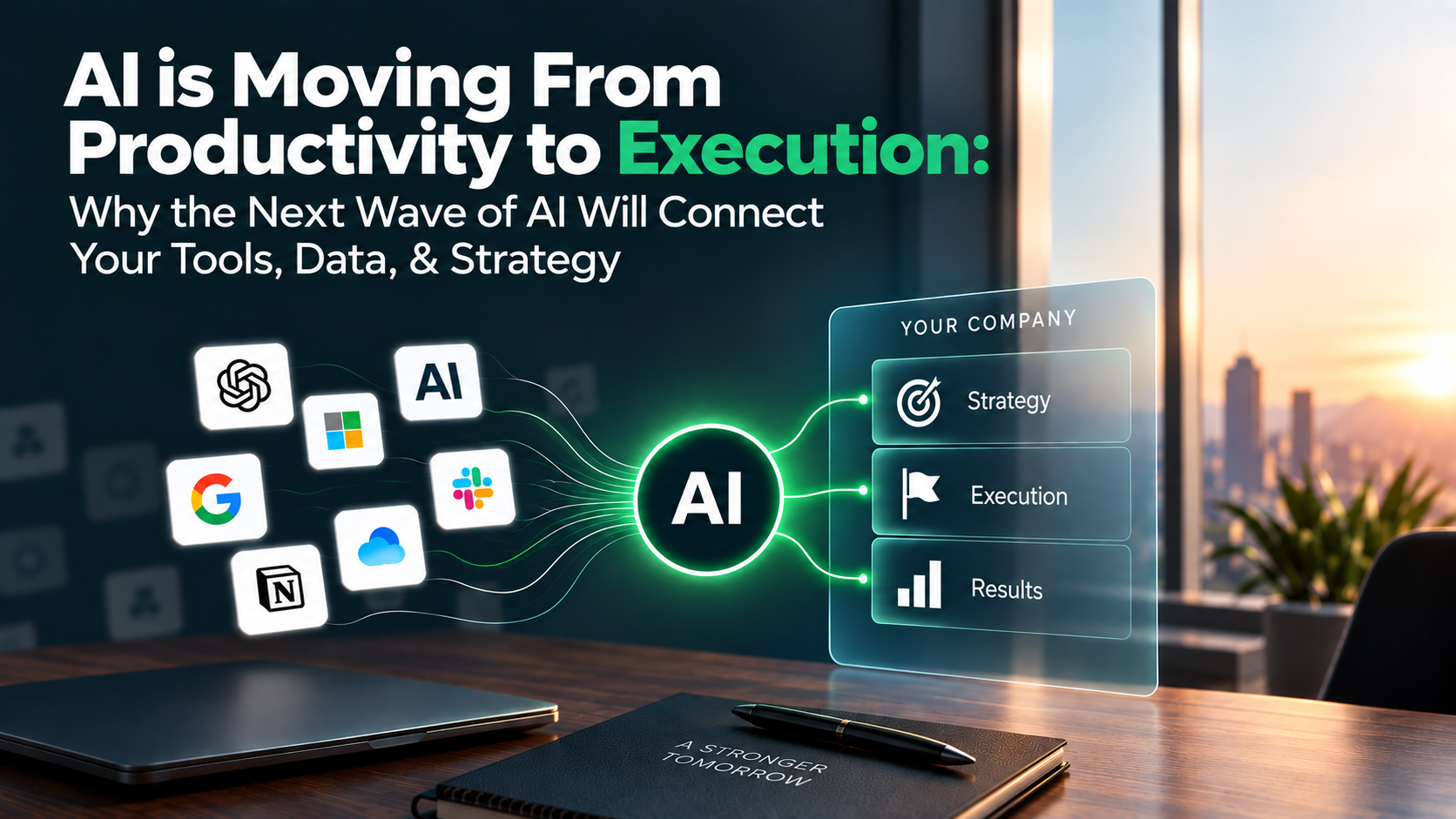
The next phase of AI isn’t about adding more tools. It’s about connecting AI to the way your company actually runs because right now, a lot of companies have AI everywhere, and integrated almost nowhere.
People are experimenting, teams are moving faster, everyone has a favorite tool, but ask AI what your company’s top three priorities are this quarter, which KPI has quietly been red for six weeks, or which strategic initiative has plenty of activity but no measurable progress, and most AI tools can’t tell you.
Not because the AI isn’t smart enough, but because it doesn’t have the context.
AI Doesn’t Need More Intelligence: It Needs More Context
This is the part I think CEOs need to pay attention to. AI is already incredibly capable, and the models will keep getting better, faster, and cheaper, but intelligence without context has limits.
Your AI might know almost everything on the internet and still know almost nothing about how your company is actually performing this quarter. It doesn’t know your strategy, your priorities, your KPIs, or which commitments are quietly slipping.
That’s the gap. The real opportunity begins when AI understands the context of your business well enough to spot patterns, surface risks, and help leaders see what they might be missing.
Stop Thinking About AI as Another App
I think we’re going to look back at this period and realize we spent too much time thinking about AI as a destination: open ChatGPT, Claude, or Copilot, ask a question, close it.
That’s useful, but I don’t think that’s where this ends.
AI shouldn’t become another place your team has to go. It should increasingly become an intelligence layer across the systems where your team already works. That’s why I’m paying so much attention to developments like Model Context Protocol, or MCP.
The technical details matter less to most CEOs than the larger idea behind it: AI can increasingly connect to the systems that contain the context of your business, and that’s where things get interesting.
Imagine asking AI, “What are we most at risk of missing this quarter?”, and it actually knows your priorities, KPIs, strategic initiatives, recent updates, and commitments. Or asking, “Where is execution slowing down?” and having it look across the business to surface patterns that might normally take your leadership team hours to piece together.
Maybe the most interesting question is simply: “What are we not talking about that we should be?”
That’s a very different relationship with AI.
This Is the Shift From Productivity to Execution
Most of the AI conversation so far has centered around productivity. Can I write this faster? Can I summarize this faster? Can I research this faster? Can I automate this task?
Those are good wins; take them, but CEOs should be thinking one level higher: Can AI help my company execute better?
And the research is starting to back this up. McKinsey found that, of 25 factors it studied, redesigning workflows had the biggest effect on whether companies saw bottom-line impact from generative AI. Yet only 21% of organizations using gen AI had fundamentally redesigned even some of their workflows.
That tells me we’re still early. Most companies are putting powerful new technology on top of the way they’ve always worked. The bigger opportunity is to rethink how work happens when AI is connected across the business — to the systems, data, and context it needs to become more than a standalone productivity tool.
The bigger opportunity is what happens when AI can connect across the systems where your business already lives. Your CRM knows what’s happening with customers. Your financial system knows what’s happening with the numbers, and your project management tools know what teams are working on. Your communication platforms hold thousands of conversations and decisions. Your strategy and execution systems know what you said matters most. Today, much of that context lives in separate places.
MCP begins to change that. Instead of AI operating inside one application at a time, it creates the possibility for AI to work across an increasingly connected ecosystem of tools and information. Now you can start asking much bigger questions, not just “Can you summarize this?” but “What’s happening across the business that I need to understand?”
That’s the shift that interests me. AI moves beyond being a tool you visit to becoming an intelligence layer that can connect information, recognize patterns, and bring the right context forward at the right moment. The value isn’t simply doing the same work faster; it’s giving leaders a more connected view of their business than they’ve ever had before.
We’re Testing This in Our Own World
This is one reason we’ve been experimenting with connecting AI directly to the execution data inside Rhythm, not because I think CEOs need another AI product. Actually, I think the opposite.
What interests me is what happens when the AI tools leaders already use can understand the priorities, KPIs, Winning Moves, commitments, and execution signals already happening inside the business.
Can AI spot something before the CEO does? Can it notice a KPI that has been red too long or connect a struggling priority to a larger strategic risk? Can it help a leadership team prepare for a better conversation instead of spending half the meeting figuring out what’s going on?
Those are the questions that interest me because the breakthrough isn’t the connector.
The breakthrough is context.
The Question I’d Put in Front of Your Leadership Team
Don’t spend your next leadership meeting debating which AI tool everyone should use. Ask a bigger question:
If AI actually understood how our company runs, where could it help us make better decisions or execute faster?
Maybe it’s seeing problems earlier, or maybe it’s preparing for leadership meetings, identifying patterns across KPIs, finding disconnects between strategy and execution, or simply helping your leaders ask better questions.
The answer will be different for every company, but the important thing is not to confuse AI adoption with AI integration.
Giving everyone an AI account is adoption. Changing the way information flows, decisions get made, and execution happens? That’s integration.
And I believe that’s where the next real wave of AI value will come from.
The companies that get the most from AI won’t necessarily be the ones with the most tools. They’ll be the ones that figure out how to put AI in the flow of how they actually run the business.
That’s the conversation CEOs should be having now.
—Patrick Thean
Patrick Thean is an award-winning entrepreneur, USA Today bestselling author, CEO coach, and co-founder of Rhythm Systems®. Read more from Patrick Thean or check out his recent article, Winning Moves: The CEO’s Guide to Strategic Focus.