Home Blog Page 143

EP08: Scaling Up with Verne Harnish

0

Award-winning author and successful entrepreneur Verne Harnish shares how to build an industry-dominating business. 

(Recorded live on Clubhouse on April 2, 2021.) 

In this session, Verne Harnish shares his experience as an entrepreneur and consultant, and his methodology to growing a company that works for you, rather than against. Verne is the founder of Entrepreneur Organization (EO), as well as Young Entrepreneurs Organization (YEO). Verne’s methods are from his book, Scaling Upall about driving your business forward and creating momentum for growth. 

Moderators: Colin C. Campbell, Michele Van Tilborg

Speaker: Verne Harnish

Is Your Club a Community or a Business?

This week we talked about clubs, the structure and vision of your club, and whether it is a community or a business. 

Often times “community” and “business” are used interchangeably. Most would say that any business IS a community. We go to restaurants not just for the food, but for the ambiance, the vibe, and hospitality, the community. I go to my CrossFit gym, not just for the service provided by my coaches, but for the community of my gym mates and the camaraderie. 

As Gary Henderson put it, the vision and intention of…  

Listen to the full session above!

EP07: Is Your Club a Community or a Business?

0

Learn about monetizing your business on and off Clubhouse!

(Recorded Live on Clubhouse March 26, 2021) 

Listen in as Clubhouse creators Gary Hendersen, popular influencer coach, and Edna Bibb discuss the structure and vision for their club. They’ll share insights on building a community and business with the Startup.club audience including result-driven methods. We’ll learn how Gary is utilizing time tested marketing strategies to engage and monetize on and off of Clubhouse such as promotional offers for paid classes and coaching using Rally coins while always focusing on helping others. 

Moderators: Colin Campbell, Jeffrey Sass, Michele Van Tilborg, and Rachael Lashbrook
Speakers: Gary Hendersen from Gary.club and Edna Bibb from Solar.club

How To Build and Protect Your Club

We brought Rich Goldstein and Priscilla Nunez on to talk about protecting our clubs and brands in Clubhouse. Before getting started it is imperative that I tell you, what you will read and hear on this session is NOT legal advice, it is an informal conversation with soft suggestions. Anything you hear or read here is for information and entertainment purposes and not legal advice or suggestions of actions you should take. Remember that our club gives to get and we are only offering education here. 

Can You Trademark a Club on Clubhouse?

Most people first think of trademarking their Club on Clubhouse when trying to protect their Club. However, acquiring a trademark requires two distinct properties. Whatever you’re trying to trademark must be distinctive and you must be able to prove that you’re using the trademark in association with a product or service that you’re offering, referred to as a specimen. Both of these requirements can make it difficult to trademark a Club.

Let’s look at the first requirement of the trademark being distinctive. If your Club is only a descriptive name, that’s not considered distinctive. For example, you cannot trademark red licorice because it simply describes a product, but Coca-Cola can be trademarked since it’s a distinctive product and brand. However, if your Club name is distinctive, it may fulfill this requirement. You could also combine a distinctive name with a descriptive name, so you may be able to trademark the distinctive name but still have the descriptive name for SEO purposes.

As for the second requirement, you need to show the Trademark Office that the trademark is used in association with a product or service. This is typically shown by providing the label of a product, or a webpage or advertisement succinctly illustrating that the product or service is for sale. You might be able to fulfill this requirement with a website showing what your Clubs on Clubhouse offer with panel discussions. However, you might need to provide a specimen outside of Clubhouse that’s related to the trademark you’re attempting to acquire.

How Can You Protect Your Clubhouse Content?

Thankfully, protecting your content is far easier. In fact, you really don’t need to do anything to protect your content as it would be protected under copyright instead of a patent or trademark.

You do not need to register a copyright to have protection. Instead, copyright protection automatically occurs when the work is fixed in a tangible form. So, this means that as soon as content is written and fixed, it is under copyright protection. For a Clubhouse session, having the content fixed in a tangible form would mean that the session needs to be recorded in any format. However, if the session is not recorded, it is likely not copyrighted because any content recalled would be considered interpretation of ideas. So, to protect your Clubhouse content, make sure to record your sessions even if you do not upload them or share them. Simply recording it and saving it is usually sufficient for copyright protection.

It’s also important to note that copyright does not protect your ideas, but rather expression. Essentially, it protects how you frame the idea instead of the idea itself. So, the way you frame your ideas and explain them are protected, but the idea itself is not. This circles back around to why it’s recommended that you record your expression of your idea, tangibly. 

We want to thank Rich and Priscilla for their time and contribution in continuing to educate and inspire entrepreneurs globally. We’re also so grateful to our listeners and moderators, for making our sessions on Clubhouse and with Serial Entrepreneur an exciting place to meet and collaborate. Please tune in next week for Scaling UP with best-selling author Vern Harnish, details and link in our Upcoming Events. 

Ep06: How to Build and Protect Your Brand

Hear IP Strategies & Ideas Around When To Consider Investing In Their Protection

(Recorded live from Clubhouse on March 19, 2021)

Our guest speakers Rich Goldstein, Patent Attorney, and Priscilla Nunez, COO AI Leadership Institute help us navigate core legal considerations from a practical point of view, such as scalability and profitability, when deciding when to invest in trademarking and copyrighting. We’ll also learn ways to improve and manage a name defensible plan. Specifically for clubs, we discuss their unique opportunities in conjunction with the use of a .club domain name for a website as a method to brand, grow and connect outside of the app.

Important Notice: This session is NOT legal advice, it is an informal conversation with soft suggestions. Anything you hear or read here is for information and entertainment purposes and not legal advice or suggestions of actions you should take without first consulting your legal advisor.

Moderators: Colin Campbell, Jeffrey Sass, and Rachael Lashbrook
Speakers: Rich Goldstein and Priscilla Nunez

Clubhouse, What Works and What Doesn’t? OpenMic


We shook things up a bit this week and offered an open mic approach in an intentionally smaller, more intimate room. All listeners were invited to speak to a hit and a miss that they’ve encountered during their residency at Clubhouse. We each came prepared with success and a failure to share and elaborate on followed up with a troubleshoot to turn the fail into a win.
 
What Works on Clubhouse
After our open-mic Clubhouse session, we got some great tips on what has been working for our participants to leverage Clubhouse to its fullest extent. Here are a few of the highlights:

Learn from Every Session

When starting out on Clubhouse, the platform can be overwhelming. With such a large platform for interacting with leading industry experts and some of the most brilliant minds, getting started can be tough. We’ve all made mistakes on the platform and so have the people you look up to. But, what’s important is that you learn from those mistakes and take action based on what you learn during your next session. This goes for whether you’re hosting your own Clubhouse session or participating in others.

Utilize Your Bio
As one of the only visuals on the Clubhouse platform, your bio is one of the only ways to draw in potential connections. When someone checks out your bio, you need to make them feel as if they know you personally. This builds genuine connections with like-minded individuals helping you leverage the value Clubhouse has to offer. So, put all of the topics you have an interest in within your bio, even if they’re not related at all. You never know who’s listening in the sessions you speak during as someone listening might also run a separate clubhouse related to one of your other interests further expanding your network.

Also, avoid generic terms like “Entrepreneur” as this does not tell someone anything about you or your interests. Instead, use descriptive language to talk about what interests you, what you already know about, and what you want to learn more about. By keeping the language in your bio descriptive, you draw in anyone who reads your bio making them feel as though they’ve already built a connection with you.
Network with Others

Clubhouse gives everyone an equal opportunity to network with whoever they want. The platform makes it extremely easy for you to get in touch with people who would otherwise be extremely difficult to reach through other platforms like LinkedIn or Facebook. Their unique system of allowing one-on-one sessions and large gatherings gives you the chance to introduce yourself during a large gathering, then build upon that introduction with a one-on-one session. After a one-on-one session with someone, both you and them will feel a strong connection building an organic and honest relationship.

Look at the Profile of Those Who Provide You with Value
Whenever someone speaks during a Clubhouse session you attend and they provided you with value, look up their profile. It might seem obvious, but all too often we get nervous or feel as though we’re intruding when we look up someone’s profile after only hearing them speak once. However, when you do this you can lead to a more genuine connection with that person. Take a look at the other platforms the person utilizes such as LinkedIn. Then, reach out to them and see if they want to connect further to talk about your shared interests. Once you do connect with them, be prepared to provide them with value as well. Providing them with value as well ensures you build a mutually beneficial relationship that lasts.

You Do Not Need to Run Your Own Club
While you may feel as though you need to run your own club to leverage the value of Clubhouse, those feelings are simply not accurate. You can get just as much value out of Clubhouse by being a participant or guest speaker in other clubhouses. Figure out which clubs you can bring value to and reach out to those who run it with your thoughts on how you can help them bring their members value. More often than not, they’ll be happy to have you speak to their audience.

Also, Clubhouse is more than just a platform to get your name out there. Take the time to just attend sessions other people host that interest you and actually learn from them. It becomes an extremely valuable learning resource once you decide to treat it as one.

What Doesn’t Work on Clubhouse
Now that we’ve gone through some ways you can leverage the full value of Clubhouse, let’s talk about a few things you should avoid while using Clubhouse that can actually take away from its potential value.

Spending Too Much or Too Little Time on Clubhouse
Spending too much or too little time on Clubhouse will take away from its value. If you spend too much time in Clubhouse, you’ll end up neglecting your other responsibilities. While it’s easy to get sucked into endless sessions that seem as though they will be valuable to you, if you don’t have the time to act on that value, the time goes to waste. So, balance your time between taking action on what you learn and learning new things.

However, don’t give up on Clubhouse before you give it a chance. It’s unlikely you’ll understand the full value Clubhouse has to offer during your first few days using the platform. You need to give it enough time to find the clubs that interest you and the people you can share connections with.

Following Everyone
It might seem appealing to build your followers by following everyone you see on Clubhouse. While you might gain a few followers this way, you’ll quickly become overwhelmed with notifications and alerts regarding sessions that do not interest you. Once you become overwhelmed with notifications and alerts, you will miss out on sessions you would have otherwise attended simply because you ignored the alert. So, to truly get the most out of Clubhouse, only follow the people that you actually want to interact with. This leads to you only receiving notifications and alerts you care about so when you do receive one, you actually look into it.

Streaming Live Video From Clubhouse

Oftentimes, people stream their Clubhouse sessions to other platforms like LinkedIn. While this does provide a lot of value to those who do not have Clubhouse, it can lead to you being banned on the platform. So, instead of streaming live video, only stream the audio with a picture showing what the session is about. This avoids the potential of being banned on the platform while still allowing you to provide the value of your Clubhouse session to those, not on the platform.

Ep05: What Works and What Doesn’t on Clubhouse

Get Insight On How To Navigate & Harness Clubhouse For Your Benefit
(Recorded live on Clubhouse on March 12, 2021)

Hear what is working on Clubhouse, the new social media audio-only platform, and what does not as we navigate and learn from each other on the newest paradigm shift app. You’ll learn practical advice including the importance of your bio when connecting with others as well as how to make the most of the time spent on Clubhouse and more. 

Moderators: Colin Campbell, Jeffrey Sass, Michele Van Tilborg, and Rachael Lashbrook

SEO Experts Reveal the Secrets!

Wow! What a room this one turned out to be! I walked into it knowing…  nothing about SEO and I walked away from it having learned at least three tips. I really hope my recap brings value to you and your business as you start tackling the World Wide Web and getting the traffic you need for success. 

It comes down to being organic, having a good and strong reputation, and creating quality content. You will get nowhere trying to fool a search engine by stuffing your website with keywords, title tags, and anchor types.

It’s all thanks to our SEO experts Dennis Yu @digitalCEO and Tevin Jackson @searchengine. This was a very informative and educational session. They laid it all out, articulate as ever, to the point and in easy to understand lingo.  Let’s get to it, shall we?

Lead moderator Michele Van Tilborg @vanghost opens up directly with a question for each: 

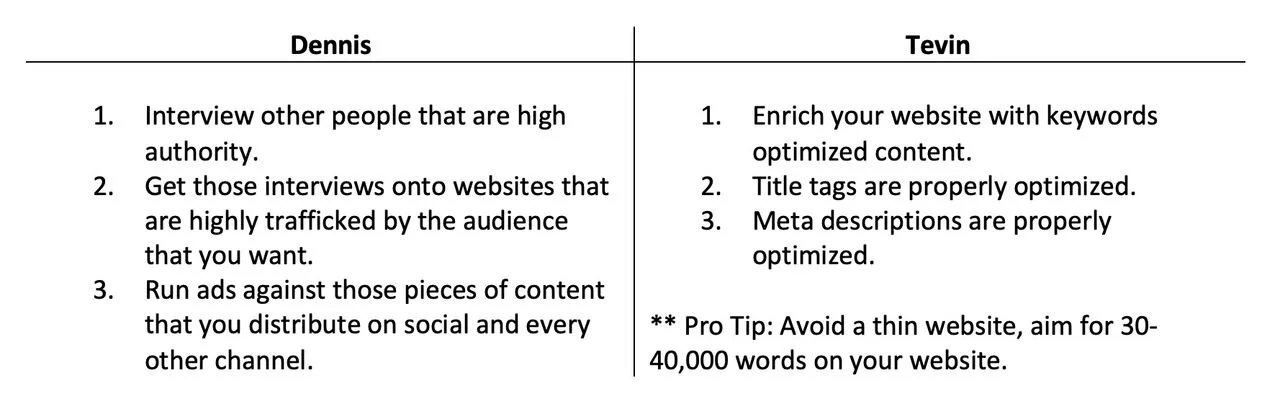
What are the Top 3 SEO Must Do’s

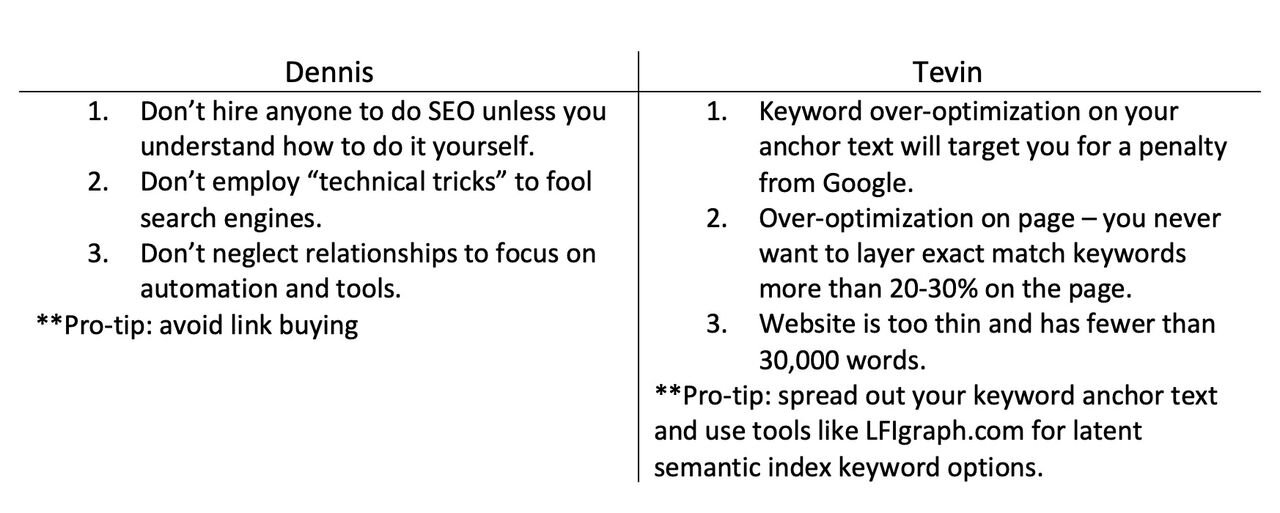
What are the Top 3 SEO Never’s 

These guys couldn’t stress enough that it comes down to being organic, having a good and strong reputation, and creating quality content. You will get nowhere trying to fool a search engine by stuffing your website with keywords, title tags, and anchor types.

If you really want to win the world of SEO, you have to look at it from the search engine’s point of view and stop trying to trick the engines. What are the signals that you can send to the search engine that are strong and in no viable way, do they indicate that it could be a spammer?

The search engines are looking for links from high-powered media. Remember that backlinks compound, so if you go out and get 20 news backlinks or 20 association backlinks and they posted your notable infographic or your notable blog posts, then you use that to go out and get other high-quality blogs to post about you. If the sites are not high-authority, that’s ok, you can run some paid ads for that post to get more traffic, which Google loves. So, keep that tip in your back pocket.

Many sites use Google analytics for their analytics and of course, Google is using that data. They have something called rank brain which basically lets you audition your traffic, they put you on the first page temporarily and what happens from there determines if you stay on the first page or if you get booted to another page at a lower rank. If people search for (your anchor text) and arrive at your page, then click back to the search results and click down to the next result, that will be a penalty because it means that the user didn’t have a good experience. 

Instead of focusing on what you can do for the search engine, focus on what you can do for the user. Create content that actually does deserve to rank for that particular keyword. Look at the other guys to see if your content is objectively better. If it’s not, then it’s not and it’s not going to last because the rank brain is going to temporarily audition you at spot 15 for example, and then push you down the ranking further.

Ultimately, if you don’t take care of the users then you’re going to get pushed down and Google is going to get better and better at anticipating what the user wants. So don’t think of it as you’re trying to fool Google, think of it instead as Google is representing all these other users and what truly works is content that actually gets traffic and creates a natural signature. 

To have true SEO power, high authority is where it’s being said, who’s saying it, and what is it about? And when you do that, there’s no difference between SEO and high-level PR and community building and relationships and social media.

When it’s all said and done, SEO is not an activity, it is a result. The activity is networking or writing articles, creating content and building relationships, taking care of your customers. The result, the prize, is search engine optimization. The heart of what drives SEO is your relationships and your knowledge, which you cannot outsource. 

Gratitude to Dennis and Tevin for coming by and sharing these extremely practical, valuable tips. We’re thankful to be building these relationships, where we can help each other succeed in our enterprises.

Remember to tune into our Clubhouse room every Friday at 2 PM EST for more educational content that empowers you the serial entrepreneur. 

Be kind out there, nurture your relationships and share your knowledge. The rewards will follow.

  • SE CLUB w Dennis Yu and Tevin 

     Let me start by saying this  if there’s a tree that falls in the forest and no one hears it, does it make a sound.

    [00:00:14] And I actually use that, move that to the internet and say, if we, if you have great content on your clubber business and it can’t be found, does it succeed or do people even know it exists? So this session’s all about SEO and how to set your clubs, set your business, that your website, whatever it is you want to get attention for.

    [00:00:38] How do we actually get position on that? This is interesting because serial entrepreneur club hit the top spot on Google number one in about 30 days. And I was just fascinated by that, that that term hadn’t been used by anyone else. And that we were able to launch it a month ago, build a website with serial entrepreneur.club, and we were able to hit the top spot on Google.

    [00:01:07] And I’m so excited because we have Dennis you on, on today and that’s very good. We have Kevin and he is the other genius in the room. And I know George is a genius in his own. Right. So we’ll leave it at that. But we also have. Um, Rachel, who’s our, uh, blogger and co-host we have Joe. Yes. And he is the, um, author of a book around marketing.

    [00:01:35] And he’s also a COO of.club and pod.com. And then we have our lead moderator, Michelle van Tilburg. So I’m going to move it over to Rachel for the Rachel recap. And then Michelle, you take it after that.

    [00:01:48]Hey guys, everyone. Uh, last week we talked to  CEO, our very own Michelle van Tilburg about her 1.4 million following on now intens club. And we also had Edna spawn. We talked to him about his activity here on club house with his various clubs, talk, OJI community, et cetera, and his work with the grand canyons trails association.

    [00:02:25] Check it out. I see.club, serial entrepreneur.club. Remember we’re kind in less club and.

    [00:02:33]No pitching, no plugging, no selling. All right. Thank you. Thank you, Rachel. Thank you so much. All right. Well, I think this is a, an exciting, and it’s going to be a very informative and educational. Session. Um, we’re going to go until three o’clock the top of the hour. So we want to be, you know, very respectful and give our experts time so that we can quickly roll into questions from our audience.

    [00:03:07] So without further ado, I’ll make a brief introduction. We have Dennis Yu. Dennis is the foremost. Yahoo search engineer. So you’re talking to the OJI here, my friends, this gentleman knows SEO, and he’s going to give us the real details on what we need to do for our SEO strategy. We also have the new and very innovative.

    [00:03:33] Kevin, Kevin Johnson. He’s going to tell us what he’s doing now, and what’s actually working for him in that environment. So without further ado, um, I I’d like to do a quick kind of rapid set of questions for our two experts in the room, Kevin and Dennis, and then we can get on to our, um, you know, audience questions.

    [00:04:00] So the first question is this. All right. I think, I think I’m, I’m hoping let’s go with the premise that everyone agrees that SEO is important for anyone, any, or non-profit for that matter. So first let’s start with Dennis, what would you say are the top three? SEO must do. So if you just had to say, do these three things, what would they be?

    [00:04:31] Interview other people that are highest authority, get those interviews onto websites that are highly trafficked by the audience that you want run ads against those pieces of content that you distribute on social and every other channel.

    [00:04:49]I love that, Dennis. Thank you. All right, Kevin Europe, what is your top tips right now that people could do to get STL? Number one would be to enrich your website with keyword optimized content, Google hates thin websites. So I would recommend minimum 30, 40,000 words on your website. If you’re looking to rank.

    [00:05:14] Uh, for, you know, a high niche keyword, uh, two, I would recommend that your title tags are properly optimized and three I’d say, you know, make sure your meta descriptions are properly optimized as well. So three to do’s right out the gate, I’d say focus on your content, focused on your title, tags and focus on your meta descriptions.

    [00:05:36] Great. Excellent. I love this. Okay. So we, we said must dues. All right. So what are the three Keller’s? What are three things that we should not be doing? Dennis? I could this 20, but first off, don’t hire anyone to do SEO unless you understand what you’re doing and how to do it yourself too, is to think that.

    [00:06:02] A technical trick is going to be able to fool someone like me at a search engine, because we can see through a lot of the onsite optimization we can see through link buying. We can see through these exchanges and three is. Just, it’s kind of like the, the thing that you don’t do is the opposite of what you do do, you’ve got to build relationships.

    [00:06:24] The focus is on relationships and not on automation or tools. Tevin is a pro at on-site optimization. Like the things you do at tags and the content that you have on the site, but ultimately in the long run to drive real traffic, I don’t mean just ranking on certain long tail keywords, like low competition keywords, but to rank on high power keywords.

    [00:06:46] You’ve got to generate real links and to do that, you’ve got to focus on relationships. You have to focus on things that are not easily done by robots or tools or spammers. So without going too far into the weeds on detail, when you have high domain authority links. So when I was on CNN and they asked me questions about Mark Zuckerberg and Cambridge Analytica, that is what a Dr.

    [00:07:10] 95 plus link. So whenever you get major media, whenever you get people that are super high authority to link to you, that is a very strong signal. If you want to rank on. Important keywords. If you’re just trying to rank on really niche e-commerce terms that aren’t competitive. If you’re a Kansas city real estate agent, which is medium competition, you don’t need that level of power, but consider who you are competing against.

    [00:07:36] Look at their link profiles and where they’re getting their links from. And we basically just have to follow what’s working for them and don’t do the dumb things. Like buy links, use bad software. We audit so many sites and we’ve got to remove these toxic domains like SEMrush. One of my favorite tools even have a seven day free trial.

    [00:07:56] We’ll show you what those toxic links are. And then you have to do things like submit a disavowal request to Google. So it’s mainly just don’t do dumb things, like understand that SEO is about good content that deserves to rank that lives on sites that Google believes are high authority. You can do that.

    [00:08:13] All this other stuff is going to fall in place for you. That’s amazing, Dennis. Um, I like what you’re saying, and I think I just actually learned something myself about disavow and I hear you reiterating who we keep company with matters. So who’s linking to us and who were linking to us. Makes a big difference.

    [00:08:33] Thank you for that. Now, Kevin, what are the three do nots? The killers. No, Dennis is, it feels like I’m talking to myself when I hear you speak brother. You’re absolutely right. Backlinks are King. Just to make sure they’re evergreen backlinks, like he mentioned, the three killers are definitely going to be keyword over optimization on your anchor text.

    [00:08:53] So if you do go out and get backlinks, just to make sure you’re not over optimizing. Uh, using the exact match anchor types that you’re looking to rank for Google will hit you with an over-optimization penalty. It’s just not organic. So spread out your keyword, anchor text use tools like LFI graph.com paste in your anchor text.

    [00:09:13] I mean, you’re a root keyword that you’re looking to rank for, and it’ll give you a lot of different anchor texts to use long tail keywords. These are called latent semantic index keywords. The algorithm goes crazy over them and it just looks more organic and evergreen nods and Google bot. The second killer is going to be over optimization on page.

    [00:09:34] So you never want to layer in the exact match keyword, you know, 20, 30% on the page. That is an over-optimization penalty. You’ll get hit pretty well. And then the third killer I’d say is just having to then have a website. I mean, I can’t tell you how many clients I analyze and their website is. Under 2000 words and they want to rank against the competitor that has a site of 30, 40,000 words.

    [00:09:56] So, you know, top three killers, I’d say over optimization on your anchor text, when it comes to backlinks over optimization on page, when it comes to keyword density. And then of course having to then have a website.

    [00:10:10]Yeah, dude, that’s a pro speaking right there. For sure. Okay. So just to reset the room, we have two experts amidst us, Kevin Jackson. Who’s the new school he’s telling us about what actually works for SEO best practices without getting overly complicated. He’s giving us some good sound advice around it.

    [00:10:38] Content specifically, not too little, not too much of anything natural. Right? I think Tevin, what I’m hearing is a very natural thing for you in terms of what works for content. Yeah, absolutely. I mean, I’m standing on the shoulders of giants. I didn’t just learn this in the late two thousands. I actually started early 2000 and, and dentists use time.

    [00:11:01] So my uncle is a, he owns the largest lead generation platform for the dumpster rental industry. I’d probably built 30, 40,000 pages and rank them myself. So, you know, a lot of the old school tactics, they still work. It’s just that Google shifted to a more quality over quantity. So it’s better to get 20 of the strongest backlinks you can get versus 200 low grade backlinks.

    [00:11:25] It’s going to have more power. Your domain rank is going to go higher. You know, they’re passing link juice to your website. So think of like a forbes.com. If you get a forbes.com, you’re a notable person. If you can get them to link to your site. It’s going to pass tremendous authority in the eyes of Google bot in being and other search engines.

    [00:11:42] And you will see rank boost because your competition, they don’t have that link. So it is it. SEO is all about reputation. All right. Excellent. Which leads us very nicely to Dennis Dennis, we’re going to call you the OJI. You’re you’re the original, your Yahoo search engine engineer. Um, If I could paraphrase what you’re saying and correct me if I’m wrong is supplement.

    [00:12:06] You’re very strongly, um, bullish. Let’s just say towards authority and making sure that you have other authoritative resources linking to you. Um, if you could comment about that further. Michelle. That’s a good point. Think of it this way. Okay. What most people are doing, what most businesses are doing is they’re trying to trick us.

    [00:12:32] And they’re using these different techniques. You hear people saying, use this kind of anchor text to have this kind of link. Velocity have blog posts that are 750 words a year. All the, and you know, some of this advice is advice is good and whatnot, but if you really want to win at the world of SEO, You have to look at it from the search engines, point of view.

    [00:12:53] You see what I mean? So, instead of trying to trick us, I would go to these conferences and for whatever reason, these SEO people, I’m sure to heaven knows they have this big attitude. They think that they’re really, really sharp and they’d come up and they’d say, well, I bet you didn’t know that I was able to do triangular linking, or I was able to do this particular way of cloaking that you guys couldn’t see.

    [00:13:17] And I’m looking at these guys saying you have no idea. I. I like to have unlimited God power when it comes to SEO, in terms of the amount of resources, we have to be able to see the things that people are doing. And we’re not telling everybody. What all of our IP addresses are. We’re not telling everybody every single technique that we’re looking for.

    [00:13:37] Right? So the way to win an SEO is to look at what are the signals that you can send the search engine that are so strong. That there’s no, that basically say that there’s no way you could be a spammer. So what are those well links from high powered media. Not some fake entrepreneur Forbes article that you can pay for press release distribution for a hundred dollars, but something actual, but it used to be 10 years ago, the number of unique linking domains was key.

    [00:14:09] And if you had over a hundred unique domains that were high authority, not some spam sites that have been around for only a couple of months each, but that’s, that’s a sign. Cause it’s something that is hard for a spammer to be able to do or having content that gets a lot of traffic. And a lot of sites are using Google analytics for their analytics.

    [00:14:28] And of course, Google is using that data. Google has something called rank brain, which a few people sort of know about. And that is when you let’s say make it. Under the first page temporarily for a particular keyword. Google will let you audition that the traffic and see how it’s, you know, whether the users like it or not.

    [00:14:48] If people click back from the search results, you know, click back to the search results and click down to the next result. That’s a penalty for you because it means the user didn’t have a good experience. So it’s not that you’re trying to do things for the search engine. You’re actually trying to do things for the user.

    [00:15:02] And for the old time SEO people in here, you guys know that. Folks like Matt Cutts would say things like, Oh yeah, I try to always do what’s right for the user. Try to create content that actually does deserve to rank for that particular keyword. Right. Look at the other guys and see, is your content objectively better?

    [00:15:18] If it’s not, then it’s not, it’s not going to last because rank brain is going to temporarily audition you at a spot 15 or whatever it doesn’t work. And then push you down to wherever your previous position is. So ultimately if you don’t take care of the users, Then you’re going to get pushed down and it is your Google is getting better and better at approximating what the user wants.

    [00:15:42] So don’t think of it as you’re trying to fool Google, think of it as Google is, is representing all these other users. And what we found with SEO that truly works is content that actually gets traffic and creates a natural signature. So friend of mine, Owns a company called etches and he has these laser engraving machines.

    [00:16:06] And one of the things that became popular was engraving iPods. Now, Apple, if you buy an iPod, they’ll engrave your initials for free or something like that during Christmas, but he did some really cool engraving and he started featuring these engravings. And put them on the site and put them on social.

    [00:16:22] Now, granted, this guy, Scott Zimmerman is a small business owner. He only does a few hundred thousand dollars a year, which is a small business owner, just, you know, him and his wife and this other girl who’s in the shop. He does not know a thing about SEO. He doesn’t know a thing about how do you rank or building websites or all the stuff that Tevin talks about.

    [00:16:41] He has no idea what any of those words are. Yeah. If you do a search for engraved iPods or any search related to that, you’re going to see he’s right there and like number two or number three for it. Uh, medium to high competition term is because he did anything with SEO. No, it’s because he put out some cool things.

    [00:17:03] Like there there’s some important people that wanted their, I, I pods in graded in, uh, engraved in a certain way, and that got some traffic, it got social distribution. He got a few links, not a lot. But a few links here and there in different forums. For example, he has a large community in the Chevy Impala or the, you know, the there’s an Impala committee where they just really, really like modifying their Impalas and getting together and comparing, and this kind of, you know, these enthusiasts, you understand there’s there are these enthusiast clubs and they started getting engravings.

    [00:17:35] They wanted custom things made and they started to share that. Now, if you look at it from the standpoint of the search engine, if you’re Google, you see that traffic, you see it cross between social, you see the anchor text that people are using if they generate links. And it’s not that we’re having these Impala enthusiasts try to craft, or what Tevin talked about when the lop over optimization penalty.

    [00:17:57] It’s not that we’re trying to avoid that. It’s that because it is natural traffic. It’s going to come off as natural, because if all these sites were using the blue anchor text of. Custom engraving shop and they all use that exact same term that would of course look fake. That looks like someone’s trying to trick the search engine.

    [00:18:16] Right. So I wouldn’t worry about those kinds of penalties because you’re not a crook. You’re not a thief. You’re not trying to cheat the search engine. If, so it goes back to building connections with the community, and then the piece about SEO that most people don’t understand. They could be a great business owner.

    [00:18:33] They could be providing a fantastic product or service is look at the domain authority of any of these particular sites and say, if they’re above 20 or 30, that’s pretty awesome. Right. I did a search on serial entrepreneur, which is what we talked about beginning of this room. And I see that entrepreneur.com of course, is there.

    [00:18:54] And some other friends like Gary Henderson, his site, digital marketing.org. Is there, I think a number three, number four. And why is that? There? Because he’s got an article on that because the page level authority of that page is reasonably high and the domain authority is reasonably high and it’s relevant to that particular topic.

    [00:19:15] So it all goes back to those same fundamentals. It’s the same stuff that we’ve been saying for the last 20 years and authority ultimately, is there a lot of people don’t understand this concept of authority and there’s different ways of defining it. But the way I define it from a search engine standpoint is who is saying it.

    [00:19:33] Where is it being said and what is being said? And we have a 30 point authority score. So 10 points on each of these three components of authority to see of all the content we have, which ones are the most powerful, which then we need to amplify and create more content like that. So if I’ve got, for example, I’ve got a number of articles on the Washington post.

    [00:19:58] Right, which is a high power magazine. And they’ve interviewed me multiple times on what is the future of Facebook and should the government regulate them and you know, how did the Russians use ads to try to manipulate the election? And so I saw that was giving me a lot of link power, and thus, I thought, okay, from an SEO standpoint, I want more link juice like that.

    [00:20:19] Right. I want high power sites to link to me. So then that reporter, I would send them some socks with their faces on them. I would text them once in a while and say, Hey, you know, this latest thing happened with Facebook. Are you guys interested in covering it or something like that? And since then, I think I’ve gotten five mentions in the Washington post.

    [00:20:37] Right. Would you consider that an SEO tactic or a smart PR tactic or smart relationship and you know, how, how would you guys look at that? And that’s actually, if you understand that true SEO, not all this spammy, let me use these tools. Try to trick you black magic witchcraft. If you understand that true SEO like actual powerful SEO is about building relationships with other people who talk about you.

    [00:21:03] And post that content on a high authority site. And there’s different ways that you could use  or majestic or Moz or SEMrush. SEMrush is my favorite as an all, all around tool. And Google used to have this thing. They had this thing called page rank, and there was this, they had this tool bar page rank, which they killed unfortunately 10 years ago.

    [00:21:23] And I think my site was a, was a seven, which is off the charts. Powerful, right. Basically a 70. Domain rank or domain authority. I collected all this authority because I was in the media. So often I spoke on stages and that gave me a ton of authority when Facebook launched their ads platform in 2007. And you, if you did a search on Google for Facebook advertising, I was ranked number two.

    [00:21:48] Number one was facebook.com/ads. So I’m not exactly going to beat them on their own. You know, you’re not going to beat Facebook on your own unless you somehow can tunnel into their site and take it over something like that. But let me ask you this because, and then this will reframe this whole idea of what SEO is.

    [00:22:06] Did I do any SEO in parenthesis to rank on the term Facebook advertising, which is super competitive and. Arguably the answer is no, all I did was I shared my best knowledge. Other people thought that was amazing. So then I got on these podcasts and I got on TV and I got on radio and this kind of thing, and other bloggers would link to my stuff and people like social media examiner would reach out to me.

    [00:22:35] So then I’m happy to write articles on. I’ve written tons of articles for them about various sorts of things. And then other people link to those articles that I wrote because they were decent articles. And then those articles that link to the articles I wrote then linked to me. And so I accumulated a ton of link juice, but let me tell you, I never once thought about over-optimization penalties.

    [00:22:55] I never once thought about trying to do SEO to rank for that keyword. All I was doing was focusing on all right, for real estate agents, trying to do stuff with Facebook. What do they need to know? One, two, three, four, five for e-commerce. Where they’re trying to figure out how to do their ads. What kind of content do they need?

    [00:23:13] One, two, three, four, five. So I was literally just putting out this massive library of content and then letting the community share that and create such a strong signal that when the search engine sees that they see Holy crap, this dentist’s guys creating lots and lots of great content around Facebook ads and analytics and.

    [00:23:34] You know, whatever that he probably should deserve to rank. And it wasn’t that my site deserved to rank it was that the content that I put on other this is more of like a pro level thing. The content that I put on other people’s website, I prefer putting content on other people’s. Well, I’m sure Tevin would agree with this.

    [00:23:53] I would rather put content on. You know, digital marketer.com or social media examiner, or fiverr.com. I’d rather put my content on those sites because people are going to more likely see it. Those sites are already ranking better. Cause those, those guys have such high domain authority that even if we, if their content is not quite as good as a blog post on my site, they’re going to win because Google sees those sites as higher authority.

    [00:24:19] So they kind of get an extra bump if you know, If you know what I mean? So you can see that to truly rank, to have true SEO power, high authority is where it’s being said, who’s saying it. And what is it about? And when you do that, there’s no difference between SEO and high-level PR and community building and relationships and social media.

    [00:24:46] Like they’re all the same thing you guys follow me. I want you guys to understand that part, not this technical SEO witchcraft, right. You know, it’s really great. And I love that you’re introducing this, you know, shift and thinking that we should think of PR actually, and the ROI implications specifically linked to SEO.

    [00:25:10] I know a lot of companies struggle with that, so that’s really quite brilliant to wrap those together. Thank you, Dennis. Look at the power that we have in this room is shell, right? Look at Colin and his relationships with folks like George. For example, if you guys interview each other and turn them into blog posts, if you take social content, like what we have here in site clubhouse, which Google can’t see, or most of the Facebook posts or LinkedIn posts, which Google can’t see.

    [00:25:39] And we literally turn those into blog posts and we link between each other in a non spammy kind of way. That’s the easiest, low hanging fruit that the most white white hat means it’s okay. Black hat means you’re trying to cheat Google. It is the most white hat way of driving. Great search results. And thus, if you think about who your relationships are, Try to elevate these folks, not in a fake kind of way, but George Verdugo has done some amazing things for me.

    [00:26:07] He helped out a friend of mine who had a double DUI, had a no place to stay and housed him for a week. Brought him to court, took care of all these different things. And the reason, you know, part of the reason he did that, uh, he did nice things for me. You know, I did some nice things for him where he came out to our three-day workshop.

    [00:26:24] Right. And we helped him with social media and Facebook ads and websites and things like that. And I’m happy to honor him because of what he’s done for me and vice versa. Right? The reason I’m in this room is because George invited me. Right. So I honor that, and we’re doing SEO by honoring my relationships.

    [00:26:43] I’m doing SEO. I want you to reframe what SEO means in that way. It’s fantastic. I love the concept of playing it forward. So Kevin, let’s jump over to you. And then I’d like to, uh, have the audience here, jump up and ask questions as well as those on the stage. So Tevin your, your new school, um, authority here.

    [00:27:06] Like what is the most impactful changes that we can leverage? That have happened in SEL. Let’s just say over the last few years. So I’ve been doing SEO since 2007. So I mean, if that’s new school, I’ll take it. Michelle. You’re an old guy. I, I, I love what, uh, uh, Dennis, you were saying about domain authority, stacking.

    [00:27:31] Uh, one thing we did is we created high level infographics and then our link-building team actually, uh, reached out to news channels. So every news, uh, website has an email for their blog or for their, for their education portion of it. Yeah. Our website. And if you create a really high quality infographic, Wow themed around something that, you know, they’ll want to post a lot of the times you will get them to post it and link back to your website with a branded link.

    [00:27:59] And this is some of the most, you know, some of the highest authority websites out there. I mean, channel nine news, right? Orlando. Very high domain rank. So if I get them to post an infographic about global warming and they link back to my website, I can then use that to get more news websites, to link back to me.

    [00:28:17] And you’re building in a basically, essentially a wall of trust in the eyes of Google. So I love what Dennis said in regards to the evergreen backlinking you should never go out and buy your back links, uh, and think you’re not going to get caught. Uh, you will get caught. If you do it incorrectly, I can promise you that.

    [00:28:34] And you know, at the end of the day, that is black hat, it’s not evergreen focus on the PR side of things and you will get the results you’re looking for. Absolutely. Does that include social media? We hear a lot that social media links in no see social media, you can get unlimited Twitter links, Facebook links, Instagram links.

    [00:28:56] That’s not going to affect you. It’s when you start to manipulate anchor texts. To try to outrank competition. You know, you will, if you do it incorrectly, I mean, I’m talking about the majority of people you will get caught. Google’s constantly progressing their algorithm. I mean, just look at the December algorithm update, tons of websites got crushed during that out.

    [00:29:17] Uh, uh, algorithm update. Look at Panda penguin algorithm update. Um, you know, years back that crushed websites, right. That we’re doing this gray hat, black cat crap. So, you know, really focused on evergreen and, and, and you’ll be there essentially, regardless of the algorithm update, you’re always going to be on the first page.

    [00:29:36] Excellent. So let’s reset the room. Uh, first, everyone, just a reminder that we do this room. Every Friday at 2:00 PM Eastern time. Um, we’re trying to do a format that’s, you know, educational and very informative. So, um, we have two formative experts here, Dennis, uh, Yahoo search engine engineer, expert.

    [00:30:02] Extraordinary. Kevin is our new school person. Who’s an expert on the grounds, figuring out and knowing what works. So let’s like put it to the audience and everyone remembered to follow our speakers and those others in the room so that we can actually help each other rise up in this clubhouse as CEO, so to speak algorithm.

    [00:30:27] So does anyone have a question? I see one question from a J Martin.

    [00:30:33]Hey, we just deed Aja or anyone to state that they agree to the recording. Thank you. How’s the cat. We love cats here. So go ahead. Ha sure. Um, just wanted to see if you all were speaking at all about, um, the Google practice of, uh, your, I can’t remember the exact term of it now, but when you’re. Your page is selected as the one that answers a specific question, except at the top before the rankings and the snippet, Google continuing the snippets and yeah, absolutely.

    [00:31:12] You just have to employ and implement schema. If you implement schema on your website, you have a better chance of getting into the snippet section. If you don’t implement schema on your website, you know, you’re going to have to have a really high rank website. And, uh, typically there. There has to not already be a snippet website there.

    [00:31:32] Otherwise, if you want to take that snippet from them, you better have a schema implement it on your site and have higher quality backlinks. Are there decent, easy tools to create schema? No, it, when we first started, there were not, you can actually go to the actual schema website.

    [00:31:49]Oh, is it schema.org? Yup. Okay,

    [00:31:55]appreciate it, man. I had a question. Um, this is Jeffrey up at the top for either Dennis and Tevin and both of you. Thank you so much for sharing such amazing knowledge. I’ve been making notes and getting lots of tips. And I look forward to a Rachel’s recap next week when she tells us all the things we learned, um, we’re here on a voice platform.

    [00:32:17] We’re talking to each other. What impact, if any, does voice. Have in SEO and what are particular SEO tips when you’re sharing voice, like we’re recording this podcast, et cetera. Um, how, how does this voice impact SEO?

    [00:32:33]Yeah. So I’ll go ahead and start it off. So voice is important. You’re going to want to get your website loaded into a lot of the voice. Um, features out there like Siri, uh, Amazon Alexa, and there’s ways to go about doing this. Um, so definitely, definitely, definitely very important. And moving forward into the future, I mean, you want to have your website into these tools who knows where AI is headed.

    [00:32:58] That’s the best case I’ve actually heard Kevin for enabling Alexa. Thank you for that. Yeah, absolutely. All right. We have Marson. Marsan has a question

    [00:33:13]Marson you’re on mute.

    [00:33:15]Yeah. Also Michelle Saeed, uh, probably had a question too here in the left hand corner.

    [00:33:20]know, well, either of them are, um, getting ready to come on stage to ask their question. I will say that, you know, I’ve done video and voice recordings for the past 10 years or so. And I have consistently provided transcriptions of the voice recordings underneath the voice recording. For SEO purposes primarily.

    [00:33:44] Um, but also for user purposes. So I find that if people don’t have the time to listen to a recording or they don’t want to listen on, you know, one and a half speed to try and get through it faster, they can scan the text a lot faster. And then people’s names specific events. Become searchable by your own site search engine, as well as, uh, Google and Bing and others.

    [00:34:07] So that your results rise to the top of the organic listings faster. Yeah. Thank you, Michael. Can you just state you’re okay with being recorded? Yeah, you bet. And, um, Michael, I think that’s a very good point to make. I, I noticed on these very high performing affiliate type videos, I always have the option for transcripts.

    [00:34:34] So really good piece of advice. Cause we do have a lot of folks here that use voice as their primary. Medium. Thank you. You bet. And one additional tip that I just remembered is usually when I. Take the recording. I like to do my recordings as videos, then I. Upload them to YouTube. YouTube will create the transcription automatically, but then I will go in and update the transcription because they’ll get names and, um, you know, uh, li uh, lingo in your industry wrong.

    [00:35:05] And so I’ll correct. All of that. Usually I’ll just. Upload my entire transcript. If it’s a, um, if I’ve done it for the webpage and then have it sync up on YouTube, that way I know when people go to YouTube to search, which is the number two search engine in the world, they can find that information faster and better as well.

    [00:35:25] Excellent. I say we have SIADH SEO guy in the audience, another SEO expert. Is there anything you want to add to the conversation and tell us if it’s okay if we record you, please? Yes, it’s totally okay, Michelle, I just wanted to add one more thing. Like, uh, Tavis shared somewhere, some really good stuff. So I wanted to talk about the why service.

    [00:35:52] So, like we have been working on a wide search quite quite a while. And, uh, one thing I would like to add to the keyword research or the white search method is that just try to like, just look at it when you put, when you’re searching for something on Google and you’re actually typing it, it’s going to be pretty much different than when you are saying it in an Alexa or a C or something like that.

    [00:36:15] For example, you might type pet your diet. For athletes or athletes, patio died in Google. But when you are just saying it, it might be some more natural language. Like for example, you would say like history. So what is the, uh, uh, what are the paleo diets? Ideal for athletes, uh, uh, in summer, something like that.

    [00:36:34] So, so like it’s it’s so the keyword keyword structure and the length is going to be different. I would probably work more on those long tail keywords. That’s one thing. And then you can actually have a page on your website and FAQ page specifically for why search and hard. How is that going to be different than my other content pieces or other FAQ pages that I would, I would have.

    [00:36:58] A shorter version answers for those natural language keywords. So when I’m searching something, when I was searching something I’m expecting more like a short answer, maybe a paragraph or two paragraph, I won’t probably look for. Maybe a thousand or 2000 words or maybe 5,000 word guide. So these are, these are the two things I would quickly like to add here.

    [00:37:21] And so, and I would end with a question for the panel terrorists and Dennis, and all of these experts that so like VR kind of convinced all us as you as any market that we are kind of knock-on risks that. Link building is a huge factor, but we, we obviously don’t want to do a link building just for the sake of lingual.

    [00:37:41] Instead, we just want to, you probably need to have those high cost high quality, high tardy, some, some links from highly relevant top publication. So let’s, let’s talk a bit about digital PR. So what kind of digital PR strategies are working for you? And I would be happy to chime in as the conversation goes on.

    [00:38:02] Thank you for that. Okay. So are there any more questions in the audience? I have one, um, I am a big proponent of telling my fellow entrepreneurs not to delegate SEO. Now, what do I mean by that? I actually mean that. I actually believe that everyone who runs a business understands their business and they need to work with an expert and they need to work with technical people and they need to get advice from Tevin and Dennis, I absolutely agree with that, but I feel like too many entrepreneurs outsource that or they, they, they delegate it thinking it’s a technical thing, but the fact of the matter is there are so many.

    [00:38:54] Things that an entrepreneur can do to help make SEO successful. And the most basic of all. And I really would like to Dennis and, and Kevin’s feedback on this is even the title tags. What is the space that you want to own? That’s not a technical requirement. That’s really an entrepreneur deciding, okay. I live in Fort Lauderdale and I want to sell flowers.

    [00:39:18] So therefore, I’m going to set the title tag guys. Flowers in Fort Lauderdale delivered free or something like that. And I actually think that that’s a big part of every entrepreneur’s journey to success. It is not a technical thing. Although you need technical people to help you implement it. I want your thoughts on that, Dennis and Kevin.

    [00:39:42] Oh man. Colin. I would take what you said and put it in 72 point bold font. I would broadcast that everywhere. That is so, so smart. Cause SEO, if you boil down what actually happens to rank in search engines requires goals, continent targeting, like you said, the strategy of what is it you want to rank on?

    [00:40:05] What relationships do you have and knowledge do you have to justify you ranking on that in whatever format could be voice search or YouTube, which is a great way. I consider that part of SEO. And so the relationships and the knowledge that you have are something that other people who might be really good technically at SEO.

    [00:40:23] Can’t help you with, they can build your website and make it run faster. They can build it applications and do that kind of stuff. But the actual heart of what drives search engine results is your relationships and your knowledge, which you cannot outsource any more than, you know, if you’re a husband to a beautiful wife, you can’t outsource being a husband.

    [00:40:43] You can’t outsource your weight loss program and have someone else work out for you. Right. You can have a trainer. You have someone like Tevin or me advise you, but you’ve got to, there’s no shortcut to this. And what Colin said is one of the smartest things I’ve heard in SEO in a long time. And I’d also frame it this way.

    [00:41:01] SEO is not an activity. That by the way, when I say this, it pisses off the people that do SEO for a living SEO is not something that you do. Just like an MBA. Isn’t you’re not you, aren’t an MBA. You, you got an MBA because you went to school and that was your degree, right? But that’s not who you are.

    [00:41:18] Search engine optimization is the result, not the activity. The activity is networking or writing articles. Like this room here is going to be turned into an article. I imagine of some sort, right? The activity is creating content, building relationships, taking care of your customers. The results is SEO.

    [00:41:37] You see what I mean?

    [00:41:39]Can I add Michelle, can I quickly, uh, piggyback on when Colin and Danny said, I totally agreed with that. In fact, I see more space in the, in the SEO industry. I see more, more space for the SU advisors at different companies and start off just all sourcing as yours, which by the way I also do. But, but, but that’s what I see going, but I like, like, it, it depends on.

    [00:42:05] It depends a lot on the company too. Like, let’s talk about enterprise, right. Enterprise is having like neutrally Portland and Portland and even millions of pages. Right. And have it just, just, just, just forget about the rest of the website. Just talk, just talk about the page titles. So that’s the skill, uh, beyond that there’s, in my opinion, uh, beyond the scale of an entrepreneur or at least.

    [00:42:29] Even one or two person that that’s probably required a whole thing. And also I have been recently working for a few of your enterprise and I, so that’s exactly what I wanted to do. So I said, instead of like, just bring it all in working and this still as your website is all just physically fixing it. We are just, so one thing they can do is just having, having an SEO SOP for that.

    [00:42:53] Enterprise which taken fall. So, and what I mean by that is having a policy as standard operating procedure for giving all battling internal linking and that kind of stuff. Great advice. Okay. So we are about 12 minutes from finish our, is there anyone in the audience with the question.

    [00:43:15]All right. Let’s restate and reset the room a bit. Um, we have experts, SEO experts in the room, Dennis Yu, who is a Yahoo search engine engineer, expert and Tevin Jackson. Uh, new, new, all newer on the scene. Expert making things happen on a day-to-day basis. So three things I’m hearing themes of is quality over quantity.

    [00:43:46] Yeah. Quality over quantity and a penguin. You always want to have quality backlinks, evergreen backlinks, via organic routes, and they could be outreach. It’s just, you’re going to provide them with content that is it’s such high quality that they’re going to want to post it. Right. That’s what you want to go after.

    [00:44:05] And backlinks compounds. So if you go out and get 20 news back links or 20 association backlinks, they posted your notable infographic or your notable blog posts. You can then use that to go out and get other high quality. Uh, blogs to post about you. Uh, and you know, each website has a different webmaster.

    [00:44:23] You’re not paying for the links. They love the content you’re providing value to their site. And you’re building a orb of influence. And the link juice that is being passed to your site is indisputable. Those websites rank. They have lots of traffic coming to their sites. So you’re going to get some traffic from their site.

    [00:44:40] And like Dennis mentioned take, if it’s not a really high authority website, run some paid ads for that post. Yes, some more traffic. Google loves that. I love that I’m going to do that myself. Um, it, one of the companies I work with Meow intense. We do a lot of blogs. We’re always at the top up Shopify blog posts, like always in the top 10%.

    [00:45:03] And I, you know, it had not occurred to me to run some search ads into that. So I love that idea. I’m going to actually try that good practical tip and that can be on Facebook and LinkedIn. Inbound lead sources were really good. Love the idea. Okay. And Dennis, um, you know, we’re hearing from you, you know, leverage your meaningful conversations off your site and on your site via blog posts, transcriptions, et cetera.

    [00:45:36] Did we understand you correctly? Well, just make it even simpler. All of these websites. Have a certain amount of juice, if you will. Right. And whatever tool you use, SEMrush, majestic H refs MAs. They calculate. And approximation of how much juice is being passed from these different links. So all else equal more links is more juice, but to Kevin’s point higher quality links, pass more juice.

    [00:46:06] I’d rather have a few really high quality links than lots and lots of spammy links that aren’t really on topic that comes from questionable sites. That have a Roundup of random sorts of things like directories. And when I think about the real power of SEO, I’d go back to what Colin had just said a couple of minutes ago, which is when you’re clear on your strategy and your networking or knowledge you make, when you create that this kind of content like recording this room and taking some of these top tips and turning them to articles, taking your videos and transcribing them and turning it into blog posts.

    [00:46:38] I’ll take my Facebook posts. And turn them into blog posts to put on my site, which generates another 30 blog posts per month. That’s legit. That’s not, that’s not duplicate content, but it’s something that’s being seen by Google. I generated an extra 15,000 visits to my own personal site last month, just from doing this one piece of repurposing content or another thing, I’ll offer this to our audience here.

    [00:47:04] Anyone who has a step by step process of where they’ve achieved the result. And wants to share that on my blog, as it relates to digital marketing, I’m happy to share that for them and give them a Dr. 63 link. So for anyone who does SEO, you know what that’s worth, right? Wow. I would challenge Colin or George or Tevin to spill the beans on something that has worked for them.

    [00:47:28] That it’s not just some auto-generated, you know, 10 ways on how to be a successful entrepreneur, vague nonsense, but something very specific where. We’re showing behind the scenes screenshots of our data or pictures of us doing particular things, something that’s so helpful that it deserves to rank on that particular niche.

    [00:47:48] And then as that niche fits into digital marketing, I would be happy to share that because a, it gives my audience great content. Because I always want to be a collector of great digital marketing content and that’s just the power of it, clubhouse. I mean, I’m getting, I’m getting dyes with Dr. 63 websites wanting to link out to us.

    [00:48:07] It’s, it’s very easy for my American based content development team to get, you know, some notable, you know, um, you know, information for him to post based on our backend for our shoulder view. So, absolutely. I appreciate that though. So Tevin for other people that don’t, that don’t know what that means.

    [00:48:23] What is the permanent high-quality in text link from a D R 63 site worth monetarily? Or are we, yeah. Yeah, just, just as just roughly estimate what you believe that’s worth, not a paid link, let legit one and a, and a whole blog post that’s that’s based on whatever topic it is that you want. That’s well done.

    [00:48:46] That is only one or two links away from the homepage. Well, I could use that to rank for keywords that will make millions a year. So I’d say it’s priceless. I’d say it’s worth millions. Yeah. And all it takes is one link. Although obviously you want to have more and we’ve done this time and time again, website like yourself is I’ll do tiered linking right.

    [00:49:06] Domain authorities. So instead of sending more backlinks to my site, I’ll send back links to your posts. So I can rank that article in Google for. That’s what pros do. This is great. Yeah, this is I’m learning so much myself, but I just want to introduce someone who just came on the stage. Michael Gilmore is out of Australia.

    [00:49:31] He is one of the world’s top domain monetization companies. He specializes literally. And, uh, rev shares a monetization, Michael, like, you know, I’m just pulling you up here. Unexpectedly is what is it? Dr.  site, uh, link that they’re, you know, posing like, w w how does that make you feel in your business? Yeah, that’s, that’s a really interesting question.

    [00:49:59] Um, because, uh, we, we deal with SEI. Um, we really don’t because all of our traffic comes from domain name. So, um, uh, it with domain names, you’re looking at for natural type in traffic and things like that, and, um, possibly linking and everything. And then when you monetize that traffic, so. What we don’t do is worry about SEO because any domains that are pack and not actually in Google anyway.

    [00:50:30] So a heavier, a page rank of that is like meaningless in terms of, um, the, for me is it’s, it’s incredibly valuable for other people. For pack logic. Usually question was once again as well, is that, uh, we, we typically know the sort of clients we want to do, be dealing with. We know who they are. So, um, we’re not after volumes of clients we’re after specific clients.

    [00:50:55] Which is a different strategy again. Yeah. So it’s, um, uh, in terms of, uh, a regular business, as Steven said, it’s worth a huge amount of money, um, having, having a link like that. But for us, it’s, we’re very different to be a very different scenario in. All right. Excellent. To make these practical. I know we’re almost out of time in this room and we could talk generically and theoretically about SEO, but I want everyone to get real benefit here.

    [00:51:27] Think about someone, you know, that has expertise that you can get on a five minute zoom call. Which only takes you five minutes, you interview them or 10 minutes, right? Run that through the script or otter.ai or the YouTube API. Turn that thing into a blog post, put it on your site or their site. And you’ve already done something fantastic to SEO on whatever keywords you want to rank on.

    [00:51:50] I see down in the audience, my buddy, Robert Craven, who is down there like seven or eight rows, he’s got a black and white. Oh, there he is. And he I’ll give you an example. So he runs grow your digital agency. He spoken on these all, all these other stages. He knows a lot. I’ve interviewed him. He’s interviewed me.

    [00:52:06] We turn these things into blog posts, and that helps us rank on niche keywords, not just on growing your digital agency, but how do you hire staff and how do you train up a VA? And how do you set up PPC campaigns and how do you do this and how do you do that? That’s how we’re doing. SEO is literally maximizing our relationships, pulling knowledge out of their brains, right?

    [00:52:28] That guy, Robert knows a lot about digital agencies. So I’m pulling knowledge out of his brain featuring it. And then I get the benefit of showing that to my community and he gets the benefit of a nice link from me. You see how that works? Amazing. Very reciprocal. Okay. We only have a few minutes, but I’d like to give Edna Edna.

    [00:52:48] If you have a few parting thoughts on our conversation, we’d love to hear them. Hi, Michelle. Thank you for having me. Thank you, Colin for the invite. Great topic. And I know so many people ask the question, you know, SEO really does make a difference in how you do. It makes a difference whether you’re going to be ranking with your website and getting that traffic.

    [00:53:12] But one of the biggest questions that follows that is. Cost, right. Like the cost of doing SEO and then the time that it takes for you to start seeing those results. And so I think it, one of the, one of the key things would be maybe to give a, an overview of what that looks like, so that people have a realistic expectation and, um, see if that can, can help some folks that have those questions.

    [00:53:43] Well, what’s the cost of building relationships. What’s the cost of content marketing. What’s the cost of interviewing other people and transcribing those videos. That’s the way I’d look at it. What are the activities that you would need to do to share your knowledge? It’s, there’s no cost of SEO, right?

    [00:53:57] Because SEO is ranking that that’s the result. You see what I mean? So break it down into the activities, brother. It’s a sliding scale. It could be six figures a month. It could be thousands thousand a month. So you’re saying that if you take the activities that you’re currently doing on across your social media platforms and turn those into blogs and then put them on your site, then the cost of doing SEO is really your time and energy and effort put into the work that you’re already trying to do anyway.

    [00:54:32] So it would be organic in a sense. Hey man, 100%. So you’re going to be creating content anyway, you’re going to be sharing it. You’re building relationships. You’re flying out to other cities to have dinner with important people that is, I guess, your SEO costs, but that’s what you would do as a business owner.

    [00:54:48] Right? George Verdugo. And I have hung out in cities all over the place. Is that SEO costs not really, but I’m building relationships. Cause I liked the guy.

    [00:54:57]And some great practical advice. I know I’ve picked up some, I think, amazing points that I’m going to immediately act on. As you’ve said, Dennis and Tevin, um, you know, great practical advice. One thing I think of sometimes everyone it’s like the easiest job, but yet it’s the hardest. It does take a commitment from, um, what we found on some of our websites.

    [00:55:23] But it’s well worth it as Dennis and Tevin have explained. So without further ado, Um, let’s talk about next week. So again, thank you for everyone who’s attended. We’re immensely grateful that you’re taking your valuable time to follow us. We’re here every Friday at 2:00 PM Eastern time and next week, our topic is going to be clubhouse.

    [00:55:50] What is working for you? And what is not working for you. So it’s going to be a very open forum. So everyone who is interested in speaking as welcome, just be prepared to talk about what’s working and what’s not so that we can all learn and grow together. So, again, thank you so much for your time. Um, we’ll be publishing our blog as, as folks have recommended George and Kevin here, and look forward to seeing you next week.

    [00:56:19] You can find out more about the topics and the transcripts and blog by going to S e.club. Have a wonderful weekend. Thank you so much. Thanks, bye bye. 

Building a ComMeownity

We brought in Meowingtons CEO Michele Van Tilborg to let us in on the secret, how she built a company attracting 1.4 million Facebook followers and over 600,000 followers on Instagram. I mean, we all know that we’re in it for the kitties but there is definitely strategy at play here. 

‘You Shop, We Give, They Purr.’

Meowingtons

Michele breaks it down for us with her Top 5 Tips. 

1. The Social Good – The motto at Meowingtons is ‘You Shop, We Give, They Purr.’ Michele is dedicated to the welfare and well-being of our feline friends. Every purchase generates revenue donated to cat rescues and cat causes to help cats live healthy lives.  

2. Audience – Meowingtons is totally tapped into their core audience and they understand and deliver content and products that address those passions. They are extremely diligent on content delivery through Meowingtons social media channels and websites. As a member of Meowingtons Community, you can expect to see a new comic and four social media posts every day, free of charge! There is an artful balance between adding value and selling, so Meowingtons does very little selling because the core objective is to build an audience by offering entertaining and educational content. 

3. Content Strategy – The strategy in content creation is focused on a blend of humor and what Michele calls ‘edutainment knowledge’, with humor making up about 80-85% of the content. You’ll find edutainment and knowledge components in the blogs mostly, with topics ranging from health, welfare, and just general education. On social media, you’ll see adorable and hilarious posts and photos, with puns, tips and tricks, and more! And, super important here, all of this is based on fan feedback, which Meowingtons takes very seriously. Growing this following has taken years of dedication, it’s all organic because they do not buy followers or influencers. The fans arrive and Meowingtons listens closely when they speak, just like when our kitties at home have something to say. 

4. Team – Pay attention to who is building your content, are they in alignment with your goals and brand? It is obvious when your team is “with you” because the rewards are the followers. Without a team collaborating and generating content and value, the community would have no ground to stand and meet on. Michele is grateful to her team at Meowingtons, they are extremely passionate about cats and their dedication shines through in the content. 

5. Monetization – This isn’t always at the top of the priorities but it is important because it is the way that Meowingtons can pull off paying for the website, creation of quality content, AND of course for the cats who need homes and assistance. Having an inventory of quality products that support Meowingtons passions and motto, is what makes it all possible, for donations, foster homes, cat rescues, and more. The team is always developing their product line and was able to introduce what many have said are the world’s best cat trees.

We want to thank Michele for coming onto the show and sharing a glimpse of her journey and some tips Meowingtons has implemented into their business to build a massively engaged community. If you’re interested in more you can fine-tune into a Meow Club room on Clubhouse every Saturday at 3:00 PM EST.

  • TRANSCRIPT: Building a ComMeownity

    Colin: [00:00:00]  Uh, all right. Welcome to our sixth session of serial entrepreneur club.

    [00:00:09] Very excited to be doing this on the great startup club on clubhouse. Uh, today, it’s all about building a community for your business, and we want it to take from two, two different perspectives. One from, uh, someone who is very successful at it outside of clubhouse on Facebook, Instagram, and another, uh, person who’s been very successful on clubhouse.

    [00:00:35] And the first person I will mention here is Michelle van Tilburg. She’s actually the president of.club and also the CEO and the largest shareholder of Meow Arrington’s. Next we have the great hiker himself, ed Nussbaum, who has created talk club, community club, OJI club, and startup club. And I think there’s a few more there.

    [00:00:55] Sorry, ed. If I missed a few and of course we have Rachel our co-hosts and she’s, she’s the one recording today for the first time, she’s actually, she’s actually filling that role. And she’s also the blogger of serial entrepreneur club. I brought Karen where’s Karen, I’ll get you on stage in a minute.

    [00:01:11] Karen Karen’s head of the EO chapter and so Florida, and she’s our moderator in training for new sessions. Um, and also of course we have our lead moderate today, Jeffrey SaaS. So over to you, Rachel, for the Rachel recap and then to Jeff to moderate. 

    [00:01:28] Ed: [00:01:28] Thank you Colin. Hey everybody. We’re having a very happy day over here at serial entrepreneur club.

    [00:01:34] So far every session with se club has been dynamic full of knowledge and value and featuring exceptional guests and speakers. We’re so grateful to you. Our listeners and contributors to recap our session from last week was indu CEO, Lil Roberts. We focused on using clubhouse to scale your business. Here are six tips for exactly that.

    [00:01:55] One get a hot domain name and web extension that aligns your business and messaging use engaging on brand titles in your rooms, feature your clients in a big way to talk to the topic and to speak to testimony about your business 

    [00:02:11] Michele: [00:02:11] amplify. 

    [00:02:12] What 

    [00:02:12] Ed: [00:02:12] you’re doing outside of clubhouse on clubhouse, uh, invite influencers into your rooms and embrace monetization on this platform.

    [00:02:23] For the knit Ingrid details. I’ve written up a tidy blog for you all hop on over to serial entrepreneur thought club or S e.club for short, to get the scoop and to check out our upcoming sessions. Remember to follow me here on clubhouse to receive invitations to our regularly scheduled sessions every Friday at two.

    [00:02:42] And finally, just a reminder for this room, practice kindness with one another avoid interruptions. Our philosophy at SC club is that we give to get. So please no pitching, no plugging, no selling with that. I’ll hand it off to our lead moderator today. The one and only extremely talented. Jeff 

    [00:03:00] Michele: [00:03:00] sass. 

    [00:03:01]Jeff: [00:03:01] Thank you, Rachel.

    [00:03:02] Clearly my reputation exceeds me, but I thank you for that anyway. Well, thank you everyone for joining us. Um, for those who are listening, you’ll notice the you’ll notice that the, um, Uh, hand raising is off at the moment, but about halfway through this session and we go until 3:00 PM. So at around two 30, we will open up the hand raising and invite people up on stage to ask questions.

    [00:03:23] But the first half we’re going to hear from Michelle and ed and talk to them directly on stage. Uh, and remember, if you do come up to ask a question, please acknowledge that you’re okay with being recorded. So today we’re really going to focus on. Uh, how clubhouse is both a conversation starter and a community builder.

    [00:03:41] And we’re excited to hear from both Michelle and ed, we’ll start with Michelle and I’ll ask Michelle to tell us a little bit about, um, the Ellingtons and the community you have and how you got it. And then we’ll go on to ed and then we’ll take some questions from the panelists. So thanks very much.

    [00:03:55] Thank you all for coming today and joining us and Michelle, I’ll leave it to you. 

    [00:03:59] Michele: [00:03:59] Thanks so much, Jeff, and thanks to everyone who’s listening today. So yes, we’re going to, you know, at least tell you our five top tips. We’re here at Meow Lincoln, stuck, calm, which now we actually have me al.club. And Melton the cat duck club, how we’ve grown our audience to be over 1.4 million Facebook followers and over 600,000 Instagram followers.

    [00:04:28] So just diving into it, we’re all about cats. We’re all about the welfare of cats and the cats. Uh, and, and, and our cats people. We don’t like to say we’re owners. We’re actually, uh, we’re owned by our cat pet. So without further ado, just diving into what we see as the top five things that, um, folks can do to generate a community.

    [00:04:56] So our first tip is this the social good for us? We take this extremely seriously. It is what we, you know, live and die by. Um, basically we have a motto at our, you know, on our business. That’s basically you shop. We give, they pur everything that we do. Um, we do it in a very authentic way. Um, we sponsor cat rescues.

    [00:05:23] We donate, donate to cat causes and everything to make and help the cats live healthy. So it’s, it’s a really big deal with us. Um, are, you know, everybody on the team, everything they do is all around that motto and it’s all for the social. Good. Um, number two, what we like to do is we like to be totally tapped in to where our core audiences and understand and deliver content and products that address those passions.

    [00:05:59] So for example, Um, we’re extremely diligent on content over here, um, on to our social media channels, as well as on the website, um, things that we do, our articles, we do, um, at least one comic a day. Everybody can check that out. If they like it, it’s completely free of charge. It’s. You know, also shown on our Facebook channel as well as Instagram and on our website.

    [00:06:29] Um, you can sign up for that. If you’re interested in checking it out at Milton, the cat.club. We also do at least four social media posts today. Um, the interesting thing for us as we really try to keep a balance between adding, you know, value and selling. So we do very little selling because for us, our core objective is to really build the audience.

    [00:06:57] Um, by offering entertaining content. So that leads me to the second point, which is our content strategy, our content strategy. Um, and this is after years of experimentation is focused around Umer. And what I would call, you know, edutainment knowledge. So our Umer comes in the majority, I would say about 75, probably closer to 85% of our content.

    [00:07:26] And then the knowledge component comes around our blogs, where we still have a very, you know, friendly town, um, to help people, help cats as well as, you know, um, In anything around like health and welfare and just general education, then moving on to our next point. You know, all this sounds like it might be easy, but it actually takes an extreme amount of time.

    [00:07:56] Um, if you want to really grow organically, which for us has been always our notion. We don’t buy followers, we don’t buy influencers, et cetera. So it’s taking us. You know, well over five years to get to the point where we have this many followers and we are very careful to listen to our followers, they give us lots of good feedback and we actually take the majority of it.

    [00:08:25] And then last. Not last, but the next, but not least is our, is our team. And I would just say, you know, to everybody out there, this is, you know, uh, you know, the, probably the most important component for us. We have a team that’s extremely passionate around cats. We haven’t changed. That’s very dedicated and it really comes through in the content.

    [00:08:49] And I honestly don’t believe that we would have. Ben as successful at building community, if we didn’t have this. So I strongly suggest to anyone who is really serious about building a community, whether it be on or off clubhouse that you really pay attention to, you know, who is building your content. Um, and that they’re really, you know, in alignment with what your goals are.

    [00:09:16] It it’s very obvious if they’re not, and it’s very obvious because your rewards are followers if they are, and then last but not least, um, for us, it is important to monetize. It’s not always at the top of the teams, um, PR you know, priorities, but it’s the way that we pay for. This website is a way that we pay for all this quality content.

    [00:09:41] Um, for us, it’s an ever evolving, you know, strategy for us. Um, we’ve been able to start to. Introduce, you know, new products, we’re always looking for quality products. Like we said, that support our passion and our motto, which is the health and wellbeing of cats. Um, we’ve fortunately, we were able to introduce what you know, many of set are the world’s best cat trees.

    [00:10:09] Last holiday, Susan, and we continue to iterate and build out products. So that’s it at a high level, um, you know, just sharing with you, our journey and some tips that we’ve, you know, implemented into our business to build this massively engaged community. If you’re interested and checking us out, you know, you can, you can come to me out club, you know, um, we’re starting to start some rooms every Saturday.

    [00:10:37] Jeff: [00:10:37] Thanks Michelle, Michelle. Michelle, thank you. Before I go to ed, just real quick, can you give us a sense of the size of the  community outside of 

    [00:10:46] Michele: [00:10:46] clubhouse? Yes. So we have about 1.4 million Facebook followers, and it’s growing all the time and we have over 600,000 Instagram followers. 

    [00:11:01] Jeff: [00:11:01] Great. Thank you very much.

    [00:11:02] I just wanted to put that in perspective. And now ed, first of all, thank you so much for joining us here today. We appreciate it. And going from a fairly large community outside of clubhouse, I’d like to turn the floor over to you to tell us more about building these great communities inside. And for those of you who don’t know ed, um, he was an O G.

    [00:11:22] Uh, clubhouse member. And in fact has the OG club as well as talk club, community club and the club. We’re all here in today, startup club. So ed, thank you so much for joining us and I’ll turn the floor over to 

    [00:11:34] Ed: [00:11:34] you. Hey, I’ll uh, first thanks for, uh, sharing some of the stories of other communities and in the end, uh, Everyone has a different approach.

    [00:11:43] And mine has always been as long as I’m spending time with clubhouse. Why don’t I try to make it a little better place for myself and others and SU the clubs are really just there as a catalyst and infrastructure layer. To make it easier for people to find each other connect and do things together, which the club house is already get at and just trying to help it further along.

    [00:12:00] And so startup club was really just the club for people to make a club, to make it easy for people to find each other who were doing different things in the startup ecosystem and to make it easier for them to find each other, learn from one another work together. And so it’s been kind of inspiring to kind of put that infrastructure there in place.

    [00:12:20] So as ClearPass grows more and more people are finding value out of startup club because now they can more easily find one another. Uh, and it’s worked tremendously. Well. I mean, just the. The just from a one metric alone. I think there’s probably well over $50 million of venture venture and angel investing has come through people who’ve met through startup club.

    [00:12:42] So that’s kind of inspiring and all the other clubs that I’ve started kind of the similar type of theme of, you know, as long as I’m spending time on clubhouse, what con what can I do to, from like infrastructure there to help support other people. And so community club has 30 amazing admins who are.

    [00:12:58] You’re doing your best to welcome new members to help people find a way on clubhouse. And so, and a lot of these people were out there doing things on their own. And so a lot of it was just going spotting with people who were supporting the community and then community club was supporting the people to support in the community.

    [00:13:14] So instead of doing rooms of 10 people, they could be doing rooms, a hundred people. So the people spending their time hoping they could help more all at the same time by. Big organized in that club and all that other clubs or of similar theme. And so it was more just trying to make that difference, trying to be that catalyst, trying to provide that infrastructure layer.

    [00:13:33] And, uh, so it’s kind of a different take on community because it was more just trying to be that catalyst of a social help with community self assemble and, and work together and learn from one another.

    [00:13:45]Jeff: [00:13:45] Great. And, and you’ve been involved in building communities in different areas and industries long before, uh, clubhouse existed.

    [00:13:53] Are there things that are unique to clubhouse that you’ve found that you do differently or, or things that make creating a community, a unique experience within clubhouse versus outside of clubhouse? 

    [00:14:06] Ed: [00:14:06] Uh, yeah, there’s always differences, but I think the similarities are at least my approach, like a proud of this.

    [00:14:13] I hope run some really big, uh, groups, two pages on Facebook and those were centered mainly around the grand Canyon. And so grand hikers group I think, is around. 50 some thousand people now, uh, the, how the, a group is I think around a hundred thousand and all those groups were just designed as community support forums to help everyone learn from one another.

    [00:14:36] So it’s kind of a similar theme of you get, you find that find existing tools, put a little effort into kind of being like catalyst, building the structure. So people can help one another. And so that principle is kind of the same on clubhouse, uh, but of course, different medium and, uh, different things.

    [00:14:55] And so clubhouse, it feels like a fundamentally new and unique animal in the world, uh, being, uh, you know, femoral being an audio. And it’s just been kind of fun trying to figure out how to. Adapt, you know, things from other platforms, you know, things that do apply and don’t apply over here and the general themes and principles do, and the kind of the details slightly differ.

    [00:15:16]Jeff: [00:15:16] That’s great. And thank you. Uh, and just to reset the room quickly, for those of you who are just joining us now, um, this is serial entrepreneur club within startup club today, and we’re talking about building a community on and off clubhouse. And we’re hearing from. Michelle van Tilburg. Who’s the CEO of Meow LinkedIn’s dot com, a very large cat community.

    [00:15:36] And of course, ed Nussbaum of startup club and OG club and community club. Uh, and I’d like to see if anyone who’s on stage. We’ve got some great panelists with us, Paul and Gary and norm. And if any of you have any questions for either ed or Michelle? 

    [00:15:51] Ed: [00:15:51] I have 

    [00:15:52] Paul: [00:15:52] more of a have question and I don’t know, maybe potential value add for Michelle.

    [00:15:57] Um, since you guys are posting four times a day, I mean, that’s a ton, um, one of the things you had mentioned, I think it was the last point. I should have written it down, but I was walking around. So I apologize. Um, you’d said making sure that like people that are posting are posting on brand, like we do a time with nano influencers and getting content, like, like user generated content, like.

    [00:16:19] Do you see that as a, as a crucial partion of your strategy or in general, just user generated content. Like I just, I’m always intrigued to see how other brands are doing that and working with, um, you know, their community to just to start getting like UDC. 

    [00:16:36] Michele: [00:16:36] Yeah. It’s a great question. Um, for us, we do have an ambassador program where we.

    [00:16:45] We leverage and work together with our ambassadors to create content. Typically it’s a photos, not so much of posts, but you bring up a really great point, Paul. I mean, this is an area that I really do want to move further into. Uh, it sounds like you’re like you do as well over the next year here because clearly the community, especially ours have been engaged for so long is so deeply.

    [00:17:12] I know they’re, they will really, you know, help us kind of like increase the frequency and I would think the quality. 

    [00:17:20] Jeff: [00:17:20] Yeah. 

    [00:17:21] Paul: [00:17:21] Um, yeah, I’m always just intrigued to hear what other people are like, what we’ve done in our. In our business. Like we do not have one where you have 600,000, um, on mountains. For instance, I think it was like 14 for us.

    [00:17:34] Um, but I was able to track. Some story views like that our, our network has done and we’ve had in the past 18 months, 9.8 million views on stories just from our nano influencers. And so I’m always intrigued to hear like how people are doing what they’re doing. I feel like we have a good program in place, but I’m always looking to up level.

    [00:17:56] So, I mean, we could connect on that too. Just I want to pick your brain and, you know, I can, I’m sure we can give you some value on our end, too. 

    [00:18:04]Jeff: [00:18:04] Thanks. Thanks for that, Paul. Well, and as a reminder, I do see a lot of party hats in the audience. So if you’re new to clubhouse, you know, one of the greatest ways to improve your experience is if you hear someone speaking, if you hear someone on stage and you like what they’re saying, you should definitely tap on their profile and follow them.

    [00:18:22] And that’s how you start to curate a better group of followers for yourself by following people whose information and input you appreciate. And speaking of that, Paul, you brought up, um, Um, UGC. It’s kind of interesting because you know, in other platforms, people struggle to get people to contribute, uh, user generated content in clubhouse, the interaction we do, all of this, what we’re doing right now, arguably is user-generated content, right?

    [00:18:48] We’re opening up rooms and, and everyone who contributes to that room is contributing to the content. Um, ed, what do you think about that in terms of content and clubhouse? 

    [00:18:57]Ed: [00:18:57] Uh, well, it’s another unique nature of clubhouse. The group discussion dynamic is as I think most of us discovered kind of a different thing, just the, in the very subtle interface things within clubhouse promote a whole different type of conversation where in the real world, if you’ve discerned people on stage or trying to be in the same conversation, fiscally kind of difficult, we’re probably.

    [00:19:20] Know, break off into maybe two different discussions, just like physical proximity. So that alone is unique, especially when you have stages like 30 people. That’d be really hard to do have everyone in a single conversation. We’re rolling, but it’s possible. And clip outs similar with the mute button where, you know, in terms speaking, that’s, doesn’t always happen in the real world.

    [00:19:39] So there’s a lot of small things like that, that, that make it easier to create. The the, the, the content together, uh, in a way that the world doesn’t really, uh, enable despite the bare physics, how the, how close you are to hear someone speak, uh, the, uh, the dynamics of the taking turns. But also it’s one of the things that I think a lot of people are.

    [00:20:03] Maybe more comfortable speaking than trying to oppose a perfect tweet or compose a perfect photo. And so all of a sudden you have a lot of people participating who might not otherwise have, and other social media, because clubhouse doesn’t feel like social media, it feels it’s social in a good way for the most part.

    [00:20:20] And so that there’s a lot of unique dynamics that make a different where people, where people can participate. And then the other interesting thing about clubhouse is it seems to give extroverts the energy they need. But introverts don’t feel overwhelmed in most cases. So it’s kind of an odd level playing field between extroverts and introverts, but also might not happen in the world world.

    [00:20:40] So there’s a whole host of different things like that. They kind of add up to be, uh, something special and usually dinner content in the terms of you described is something kind of different because of all those dynamics. 

    [00:20:51]Jeff: [00:20:51] Yeah. I think those are, those are great points and, and, and this notion of, of, um, Surely I’ve witnessed some of the most orderly conversations I’ve ever participated in within clubhouse.

    [00:21:02] Definitely not how it is in person. And I agree with you a hundred percent. There are people I know who are not very comfortable speaking on a stage, you know, in front of an audience of people in the real world who have come to be very comfortable and very good at speaking in front of rooms here within clubhouse.

    [00:21:20] So it’s a very different experience. Um, those are great points. You brought up. Thank you. Uh, anyone else on the panel have some questions for Michelle or ed? Yep. I do. 

    [00:21:29] Colin: [00:21:29] Jeff, uh, Michelle, I understand how you took the community. You built it up and you were able to monetize it and hopefully I’m not putting you on the spot, ed, but how does an entrepreneur.

    [00:21:44] Like yourself, build such a large community. How do you monetize that community and what are you allowed to do within the guidelines of clubhouse? 

    [00:21:54] Paul: [00:21:54] Can I ask a clarifying question on top of that call on. Of course. So on monetization, was this the plan from the start or was it not an organic thing that just happened?

    [00:22:06] Because like, I guess some of the planning behind it, cause there are communities that start and it’s all just about organically helping. It sounds like ed, you run a bunch of those in like, you know, the grand Canyon heifers and all that stuff. And then there’s people that, then they say, well, I can monetize this.

    [00:22:21] So was it like a organic thing where you just all cat lovers and then you decided to monetize it or was it an intentional from the start. Um, we’re going to start a cat community and monetize it. 

    [00:22:31] Michele: [00:22:31] Yeah, it’s a great question for us. We always did want to monetize and we always believed that we should take the very community philanthropic approach, which is actually true for us.

    [00:22:49] Um, we believe. That the best way that we can help the cat community is by donation. And we didn’t have deep pockets by any means, so that, so we knew we needed to build up the e-commerce portion of the business so that we could donate. And I think I might’ve mentioned it if I didn’t, I will. Um, our, our, our main mantra is you shop.

    [00:23:15] We give the pur and it really is true for us. Um, We sponsor cat rescues. We sponsor cats, you know, donation fees, et cetera. Um, so it really wasn’t means to the, to an ENT. And it’s just worked out very well because of the passion that we have. And we try to contribute, you know, by offering content on and off, you know, the platforms.

    [00:23:40] So I think I mentioned, we have me Ellington’s dot com, which is the e-commerce site. We have, um, Melton the cat.club where we. Um, take signups, you know, free signups. People can get our daily comic via email. Of course they can see it on social media as well. And we actually just launched meow.club, um, as a means to start to, you know, see if there is any interest from the clubhouse community and talks specifically not commercial, but specifically around welfare for cats and wellbeing.

    [00:24:17]So it’s great. 

    [00:24:17]Jeff: [00:24:17] And Colin, when did you get your question answered there? 

    [00:24:20] Colin: [00:24:20] No, no, we got ed on the ropes. Now he’s going to answer it. 

    [00:24:24]Ed: [00:24:24] Yeah, all the communities that I’ve helped spark or catalyze, it’s always about, you know, connecting everyone with everyone else so they can learn from each other, which is a benefit to me and everyone else.

    [00:24:34] And so to me, you know, there’s way more than more than one way of getting value out of the community. Money is one of them. But ultimately to me, it’s always, if you, if you do a good job of. Thinking about catalysts for bonding of a structure, for people to connect with one another. The magic happens for you and everyone else.

    [00:24:50] And so grandkid hikers were never directly monetized, but that led to a great business opportunity, which, uh, sparked my last business. And so, you know, by being present by, by helping other people connect, you know, that I also got that same benefit. And so a lot of it just kind of. Being being the catalyst, being the change.

    [00:25:10] I want to see, to be able to run into people that, that I want to talk to more and usually great things come out of that for myself and others. So no explicit, uh, you know, plans to monetize any of those communities, but usually opportunity comes out of that. And, uh, So it’s not necessarily traditional approach, but as can go back to use your content, you know, where it sounds like, you know, ma you know, some communities already scrubbed the room.

    [00:25:36] It’s very much like, yes, you know, you are actively creating content to me. I am kind of possibly creating infrastructure and making it available to everyone else. And that benefits me and everyone else. And so, you know, along the way, you know, how the opportunity to, uh, be, you know, some of, you know, start started club meet some of the people that I’ve always been fans of.

    [00:25:56] And watch their businesses and, you know, startups succeed. And, uh, so that’s a huge one for me to be able to say, Hey, would you like to come and speak the startup club? We have, you know, a huge audience that would like to hear from you. And so getting sure, you know, stage with some heroes, um, and a column used to made an introduction to one of those as well.

    [00:26:16] So getting extreme benefit out of club clubhouse and startup club, just from the people I’ve had an opportunity to meet and the people that the people opportunities Lezlie too. 

    [00:26:26] Colin: [00:26:26] That’s pretty amazing. I know from the nineties, when we launched two cows, two cows, by the way, it was a software download site.

    [00:26:32] I know now it’s considered to be more of a, a domain name and telecomm, but back in the nineties, Well, we will watch two cows. We made it free and believe in our bandwidth was very expensive. We just believed in sharing software globally. And we launched that. And then the opportunities came three, four years later.

    [00:26:51] You know, if someone came along and said, this is a really great service and we want to buy it and we were able to sell it for, for, uh, a very nice profit. 

    [00:27:01] Paul: [00:27:01] And are you at Liberty to talk about that path that you took? You said that an opportunity arose and it, and it spawned your. Your recent business, are you, are you at Liberty to dive into that a little bit?

    [00:27:11] And Jeff, if you have something else in mind, feel free to take it, take it away, but I’m intrigued. And I feel like that would be valuable for the, for the audience as well as, I mean, me as a speaker here too. 

    [00:27:23] Ed: [00:27:23] Yeah. Really long story to do justice, but I’ll try to do a short version of it. Um, that, uh, the, what most people think of the grand Canyon is I should grand Canyon national park.

    [00:27:38] What’s now grand Cantrel park was actually a home to a lot of native peoples that Teddy Roosevelt gently kicked out. Uh, and most of those peoples are still in the grand Canyon region and the grand Canyon is a big place. Uh, the park is only small part of it. So East of the grand Canyon is Napa nation, uh, and the whole Hopi Hopi reservation, uh, And just on the South from the grand Canyon, uh, West of green canister park is to have the  tribe.

    [00:28:09] And what’s allowed is Walapai, which is better known as grand Canyon West. And so through grandkids huggers group, which originally started as we’ll miss things centered around grand Canyon, national park, you know, I got to know a lot of the native peoples around the Canyon and, uh, The how the Supai people, uh, were the ones that were primary living.

    [00:28:31] What is now a grandkid national. And they, uh, as well, many native peoples, the, the, they were very mistreated by our, the federal, the us federal government and the, they were seasonal people. They would live in the camp. They would live and farm in the Canyon during the summer and go up on the room to hunt during the winter.

    [00:28:52] Uh, and when. The creative, the park, they got trapped in a side Canyon, just West of grandkid national park, which was one of their seasonal villages where they would farm during the summer. But it wasn’t an area that was had enough agricultural land to really support the tribe. It was subject to flush floods, uh, and they weren’t allowed to go up on the remedy anymore.

    [00:29:12] So it almost literally killed the tribe. And, uh, but it turns out as with many things, uh, the unintended side effects. The second you gotseen photos or video of have a Supai, how Sioux falls, uh, it is like Hawaii. dropped in is. One of the most beautiful spots on earth. Uh, and most people would probably 

    [00:29:34] Blue-green Hawaiians to how waterfalls in Sedona, red rock in the grand Canyon. And so it had always been kind of like a hiking swimming hole, summer weekend destination for people in Arizona who kind of knew about it. But as social media took off. Uh, and people started sharing photos of have a soup halls, meaty falls, Beaver falls.

    [00:29:55] It just, you know, any one of those falls will be a destination center. Right. And a demand started going up and, uh, The, the village is whole tribes may be about me, about 900 people now, uh, about half live in the village of  in the grand Canyon, which is one of the most remote spots on, in the U S it’s. Uh, the village is eight miles from nursery road.

    [00:30:16] Uh, and to get there, it’s basically the elevation change about to empire state buildings, uh, you know, over the eight mile hike. And that where the road ends, that’s like 67 miles from even the nearest gas station, which is on Walpole land. Uh, so it’s really remote, but social media, how to take off. And the, uh, the whole tourism office was basically.

    [00:30:40] Like two to four people answering phones, taking reservations, and back in, uh, 2017 last time they did phone phone reservations. The, the point system, the whole village collapsed people were dolling thousand times for like weeks just trying to get through. And, uh, so. Because of the grandkid Hydrus group.

    [00:31:01] And because we had done a group trip down there with a bunch of people from the Facebook group, I got to know the tourism office manager and seeing issues both from their side of it was cast and office, trying to deal with that kind of demand. And then seeing it from the customer side, through the Facebook groups of people, just utter frustration, trying to reach and snicker reservation.

    [00:31:23] And there were a lot of inefficiencies, a lot of problems, but, and. Uh, I actually had been working, pulled a team together to work on a complete different startup. And we saw the struggles that visitors were having. The tribe was having the tourism I was having. It’s like, Hey guys, happy to help. And so that became the beginning of my last business, uh, of.

    [00:31:45] Basically applying technology and social media to kind of help solve that. W was originally just the unique problems of the Havasupai tribe and the tourism department. And so it was essentially building what was equivalent of a ticket master scale system for the, the tribes reservation system and the, to put in context, like we had no idea what the demand was.

    [00:32:10] We just knew that it was big. And so, uh, when we first went live on February 1st, 8:00 AM, uh, 2018, uh, per second, we had a half million people hit the servers and, uh, and, and, uh, we sold the tire you’re out and about an hour, uh, and the significance LA was huge on so many levels. One was that, uh, For the first time ever the tribe actually get an inventory management.

    [00:32:43] Oh, the context is that the product is two things there. One is that actually three, they have a campground and the campground is between how Sioux falls and beautiful falls, how this falls. Is this beautiful, a hundred foot, a hundred foot high waterfall meaningful is this Epic 200 foot waterfall. And in between those two waterfalls, you have this nice meandering blue-green water along the Creek, and each side of that Creek from how long is it?

    [00:33:07] The campground. It turns out that is the highest demand campground in the world for very good reasons. It’s epically beautiful. Uh, and so we put in a solution to make campground reservations and also have a little 20 small 20 room lodge in the village. And so, uh, as of this year, that lodge is now online as well, because both of those.

    [00:33:27] And so both of those now we’ve managed to basically cut out like probably 99% of the phone calls so that one, so people can actually get through on the phone lines to act as customer support and service. So there are solutions based in the camper vendor, customer support, and, uh, became a way for people to actually not have to dial.

    [00:33:47] Yeah, thousands of times for weeks on end, trying to reach, reach it, and also allow the tribe finally, to have kind of more better inventory control, which changed a whole bunch of things, because it used to be like have a thousand people now in the campground over the weekend and said, no one during the week.

    [00:34:02] And so just simple tools that, that kind of re-engineering helping to, re-engineer like the whole process of the tourism industry. So that’s kind of where the loss of business started from. And that started from just being, being more tuned to the Canyon, being more aware of it, uh, because of the grand Cain hikers group.

    [00:34:17] And because we had facilitated a group trip from people from the face group down to have the Supai. So that gave me a lot of insight to both the product, the. The P the, the, the problem that was neat, that could be solved by technology and social media, both on trucks and on the customer end and happened to have the team that could do it.

    [00:34:35] And so we wanted did it, and there’s a lot of fun and made a big difference. And, uh, And then, you know, each year we kind of respond, the system made it better for visitors and for the tribe. And then there was a whole host of other things, which makes it a longer story, but that’s probably enough for the intro to what it was, but so it wasn’t really monetizing it directly, but because we had that big base of group, we then also had a communication channel to help get the word out about the new systems to help get customers, get, get customer feedback.

    [00:35:07] As an ongoing focus group of what people wanted the system to do while we were also talking to the tourism office and trying to understand their needs. And so we were able to see the full, full set of the problem and really put a good solution in place for everyone. 

    [00:35:19] Jeff: [00:35:19] Well, that’s a great, great, uh, story of entrepreneurship that, because you know, we’re talking about syrup, serial entrepreneurs and startups, and there’s a lot of serendipity in being an entrepreneur and you were the right.

    [00:35:30] People at the right place at the right time to be able to create those solutions for the location. And I think you touched on it earlier. I had to in, in clubhouse, one of the appeals is the serendipity opportunity to come across and meet people that you wouldn’t ordinarily get to speak to. And also, I think as you pointed out ed with the creation of your clubs, there’s also an opportunity for sort of.

    [00:35:54] Planned serendipity, where almost you can influence some serendipitous things, serendipitous things to happen by joining rooms of people you’d like to meet by contributing as a speaker. And so you have this unusual combination of collisions and serendipity, but also the opportunity, if you’re smart, right.

    [00:36:12] To try to manipulate and plan those stairs for this moment. So I think that’s one of the appeals of clubhouse. So before we open up it up for questions, I just want to see if norm or Karen, anyone else on the panel have any final questions for Michelle or ed. And then I’m going to open up now for everyone to raise their hand.

    [00:36:29] If they’d like to ask a question and remember, please, when you come on stage to ask you a question, we are recording this session. So please state your name and acknowledge that you’re okay with being recorded. Before you ask a 

    [00:36:40] Ed: [00:36:40] question. Yeah, just, just a quick additional thought to what I was saying earlier abuse.

    [00:36:44] That’s I haven’t really tried to tell that story, but so it could probably came out on kind of did a little disjointed, but in the spirit of like, you know, building community and the topic of this room, one of the things we did was we started working with the tribe is. Yeah, basically created that. How the Superman house, who Paul’s group of Facebook with are referred to, and that was kind of similar thing that we’re doing with grand Canyon hikers group of community support so that everyone could learn from each other, keep moderate, keep, keep each other out of trouble, uh, you know, make the most of their adventure because oftentimes this was people flying across the world, hiking into the program at region and, and so on.

    [00:37:18] But, but everything we did with that too, is kind of developed community, uh, and including creating monthly groups. So like, you know, we have to have a , uh, falls, may groups. So people who were going in may could get to know each other even before the trip. And there was a lot of friendships at belt on that.

    [00:37:35] So it was a way to have a community. On Facebook and enhance the actual world experience. So people felt more comfortable. They knew other people going, they could hike in together. They often shared Kent, you know, campsites together. And so all those things by adding a layer of community to the existing business often made a huge difference.

    [00:37:54] And so, yeah. The initial community led to that business opportunity. And that business opportunity always kind of viewed through the lens of community. So we of, we kind of helped community build among visitors to the visitors to, uh, have the soup, which made a big, positive difference for them and also for the tribe, because then people were more likely to stay out of trouble or because they had, you know, they knew other people going on the trip that were also down there.

    [00:38:18] So all those things add up to be something way greater than the sum of its parts. Yeah, the 

    [00:38:23] Jeff: [00:38:23] community’s fed off of each other, almost like a symbiotic relationship. That’s great. Um, Norma, Karen, do you have any questions that anyone in the audience, if you’d like to raise your hand now, I believe, uh, hand raising is open and you’re welcome to ask questions for ed and Michelle or anyone else on the panel.

    [00:38:38]I’ve got a norm for, 

    [00:38:40] Norm: [00:38:40] um, Michelle it’s norm. Uh, you’ve got, uh, a ton of followers on Instagram, and I also know that you publish a, um, uh, a cartoon of Milton every day. 

    [00:38:54] Jeff: [00:38:54] Do you ever 

    [00:38:54] Norm: [00:38:54] utilize those cartoons? Uh, so that it points over to clubhouse. Can you incorporate sort of a clubhouse, uh, event into those Ana uh, cartoons?

    [00:39:07] Michele: [00:39:07] Yeah, that’s a great question. I don’t know the answer to, um, we are going to start some rooms around cat focus, wellbeing topics. Um, I hadn’t thought about incorporating the comic con it, I’d be interested to hear your, your thoughts on that. They are popular. Well, 

    [00:39:31] Norm: [00:39:31] if I like looking over it, just that your icon right now with Milton and the, uh, the podcast, Mike, uh, I mean, that’s hilarious by itself.

    [00:39:40] And then, you know, people, you’ve got a huge following, w I’m not sure a million. People on Instagram and I’m not sure how many downloads. I know Milton itself has downloaded about 2 billion downloads, but, uh, I you’ve got leverage there. And I think there’s, uh, an incredible way to leverage that. Get the people, not every, not all the time, but once in a while, just kind of feed them, clubhouse, feed them the podcast.

    [00:40:07] And then on the, I’m not sure. I don’t think you guys are doing a podcast yet, but I’m sure that’ll end up happening. I know with our podcast of what we’ve done is we do a podcast on the Monday, Wednesday, and Friday, and then we get everybody together on the Monday and we bring the guests on and then we create a.

    [00:40:25] Clubhouse a room and we get them to answer the questions. And, uh, that’s something that, you know, we’ve been able to find very interactive. Uh, there’s a lot of shy people that, you know, they, they it’s okay to type. Um, but they don’t want to come onto a podcast, especially if it’s a video going live on Facebook, but this is such an incredible, um, platform.

    [00:40:50] That’s so many people will come up that would never talk, um, on a podcast that will come on here and ask questions. So again, that’s kind of a long-winded approach of kind of what we, what we’re doing, but if I had the, the huge following that you have and the niche, because that’s the other thing that. It has to be looked at here.

    [00:41:10] You’ve got a brand and, you know, being able to grow that micro brand on clubhouse is something that I think is a hundred percent achievable, especially with this new sort of paradigm shift. So, uh, I think it’s really cool. And I just, I got to say it again. 

    [00:41:28] Jeff: [00:41:28] I really love that little icon 

    [00:41:30] Norm: [00:41:30] of Milton with the, with I’m going to call it the Yeti mic.

    [00:41:35] Michele: [00:41:35] Okay. No, that’s a great idea. You know, people do have lots of conversations about every little nuance of the comics. Um, I liked your idea about having the community come on and chat about it. It would be fun. 

    [00:41:54] Paul: [00:41:54] I love it. And I mean, I want to know too, like the evolution of Milton, like when did, was he integrated as a, as a strategy?

    [00:42:02] Like we’re going to do this funny comic about cats. Like, was that from the start or did that just evolve as mountains group?

    [00:42:10] Michele: [00:42:10] Yes. Um, great question. He evolved naturally. And actually this past year we gave him a friend Millie. Um, actually she came about during, you know, the isolation due to COVID, but it really was a natural progression.

    [00:42:27] Um, because you know, we wanted content that people would enjoy. And what we find in our persona is that. You know, cap people really, it’s not just like buying things for your cat. It’s really being really active in discussion and enjoying each other’s stories. 

    [00:42:47]Jeff: [00:42:47] I love that. 

    [00:42:48]Paul: [00:42:48] I was just in it. I was just going to say, like, on that point, like norm told me about this, I don’t know, probably two months ago, norm Milton and ever since then, I’ve been thinking through for, for our brand, um, bone littles.

    [00:43:00] We. We are like hyper niche. We sell reusable, swim diapers. And so we’re super seasonal, but we are, are people generally speaking, are, are your busy moms between, you know, mid thirties, ish have two or three kids. And I’ve just been thinking for ever since then, like, I want to do something like that. Um, start a comic and maybe have feature baby or, or a busy mom or something like that.

    [00:43:25] I’m, I’m rambling at this point, but I just want to say that I’m 

    [00:43:28] Jeff: [00:43:28] inspired. 

    [00:43:29] Michele: [00:43:29] Thank you. 

    [00:43:30] Jeff: [00:43:30] Thank you. Thank you, Paul. Um, yeah, I think that, um, just to reset the room, we are here at serial entrepreneur club on startup club today, and we’re talking about building a community on and off clubhouse with Michelle van Tilburg of B Ellington’s and ed Nussbaum of.

    [00:43:46] Startup club. And, uh, there are, raise your hand if you’re interested in a question and I see someone now and I’ll bring you up on stage and just a moment, uh, Jillian, and I just want to mention, when you think about the comic now, the comic is a visual, a visual. Item, uh, and we’re in an audio platform, but I think it’s inevitable that we will have character voices and people in character hosting rooms and speaking on clubhouse.

    [00:44:12] So if you had a voice behind Milton, uh, you could have Milton appearing and talking, and I actually wish I was a, a voice actor right now because I think there’ll be a lot of work for talented voice actors on clubhouse in the coming months. Uh, so I think that’s inevitable to happen. Uh, So I’d like to welcome Jillian to the stage.

    [00:44:32] And Gillian as mentioned, we are recording this, so please state your name and that you’re okay to be recording. And then go ahead and ask your question. 

    [00:44:38] Gillian: [00:44:38] So my name is Joanne and, um, yes, it was okay to record me. So, um, anyhow, I got invited to club. I was sure a friend and I’m in the process of building a FinTech platform for her remittance platform, for the Caribbean and Latin America, for the immigrant and refugee community to send money back and forth and to receive payments.

    [00:45:00] So when I got into clubhouse, I was thinking, Oh my God, well, I’m not saying my friend wanted me to take. To, you know, to join him. So I joined and the moment I joined, it tells you how many people, you know, on this platform. And then it was like 200 and something people I’m like, what on earth is this? This must be a cult.

    [00:45:16] So I saw a lot of VCs that I know on here. So I call him, I’m like, what are you doing on this app? So I started joining in different different rooms and it was really amazing, but in the process, we are working with the world bank and they’re supporting us on this frontier. And we had a question about. A week before we started the club out before I started club house.

    [00:45:37] So how will we going to do like a test market with the product for the immigrant community in America? So while I, my clubhouse, I go on, I see there was all these Caribbean, um, you know, clubs. That’s why went in and I started to speak and I said, Oh my God, would you be interested in being part of a test community for the product?

    [00:46:00] And within 48 hours, I had about 500 people signed up to test the product. I could not even believe it. So then I towards, okay, let’s create the community are wrong because. Every immigrant ha Oh, I want to cry. I’ve every immigrant has a story about why they’re sending money back and forth to their families.

    [00:46:22] And I thought, wow, why didn’t I take the people who reach out to me and create a community office? Clubhouse went to Woodbine can be create a community of stories, of personal stories of why they’re sending money back and forth. And what’s the reason for the money back and forth. And so I started sharing this sort of VC and then I shared it with a UN DP and then were completely blown away.

    [00:46:47] So I got them on to clubhouse. I just did a talk with a hundred women in Davos. And I shared about clubhouse. I shared about the power of all of these startup clubs. And I’m telling you, since I’ve been in cup house during the course of the. The pandemic. I was really depressed about, you know, how we are going to really make the startup work during the course of being locked down.

    [00:47:13] And what I got out to, I was in Aspen with some friends and I said, you know what? I’m just going to shut down this. Um, start up, give the people back the money who invested and be done. I got onto clubhouse and in 48 hours, when I started checking into the rooms and meeting people in product, the UX and UI people, I got really reinspired again, I’ve connected with the most amazing people to help this product really happened in a very big way.

    [00:47:41] And I think if it wasn’t a club house, we would not be where we are today. So I just wanted to share this. I want to share it by the community off the club house, which you’re working on right now. It has really empowered me and, you know, really energized me and reinspired me about what I’m doing, because I’m about to change a lot of people’s lives in the Caribbean.

    [00:48:00] So I just wanted to share this and I sent you an email and you have not responded. So I am requesting that. Give me as well to my email. Thank you very much. 

    [00:48:10] Ed: [00:48:10] Well, thank you for sharing what you shared, that’s inspiring, but which email address did you send it to? The, the, the club email address or my personal one?

    [00:48:18] The club 

    [00:48:18] Gillian: [00:48:18] email address. I’m not looking for my canvas looking to have a talk at the club. 

    [00:48:23] Ed: [00:48:23] Yeah, yeah, I’ll get, yeah, I don’t, that’s not me running that, but, uh, I will, I will I’ll follow up on it. So thanks for giving me that. 

    [00:48:30] Jeff: [00:48:30] Thanks guys. Thank you, Jillian. And that was an example of planned spontaneity, right?

    [00:48:35] It’s right there. Right, right, right on stage in life. But also what Jillian pointed out is. The diversity of communities and discussions and topics that you can find in clubhouse are, is truly amazing. And so if you’re smart about it, you could find people to talk to about virtually any topic. You may have an interest in whether that’s a personal interest or a business interest.

    [00:48:57] So there’s real opportunities there. Um, again, if anyone has questions from the audience, please raise your hand. We’re happy to bring you up. We’ve got about nine minutes left. Before the top of the hour. Um, and here we have a hand 

    [00:49:08] Ed: [00:49:08] raised, so I will bring it. I was going to ask 

    [00:49:10] Colin: [00:49:10] Karen, Karen, you have, uh, you, you have run a community of entrepreneurs in the, and you’ve often said it’s like herding cats.

    [00:49:17] And I just wanted to sort of get your thoughts on that. 

    [00:49:21] Michele: [00:49:21] Yeah. So, hi 

    [00:49:21] Ed: [00:49:21] everybody. I want you to know first and foremost, this is my very first time on stage. I’ve been in many club house rooms. Um, 

    [00:49:30] Michele: [00:49:30] And I came on this one at the behest of Collin and he promptly 

    [00:49:35] Ed: [00:49:35] asked me to come on stage and I said, 

    [00:49:37] Michele: [00:49:37] okay, that seems going on here.

    [00:49:39] So, um, and Karen you’re okay to be recorded, correct? Oh, yes, I’m fine with that. 

    [00:49:44] Ed: [00:49:44] Of course. So, um, I work in an organization called entrepreneurs organization and it is an international organization in about 61 countries. And I run to the South part of chapter, one of the biggest. Um, chapters in the world made a made up of over 250 members.

    [00:50:04] So, um, I’ve been working with EO for probably about 13 years. And Colin is still running, is like herding cats. She’s thinking about a lot of high value entrepreneurs whose businesses are over a million dollars or more in revenue annually. And just trying to get them all together to plan for events. Um, for get togethers, just to be a community and deduce it, do things.

    [00:50:28] Yeah, it is a little bit like herding cats, but you know what, I’ve been doing it for 13 years, 13 years. So obviously I love it. And I’m, I’ve made them a lot of amazing friends. We have a lot 

    [00:50:39] Michele: [00:50:39] of 

    [00:50:40] Ed: [00:50:40] wonderful, wonderful entrepreneurs in the group who have, uh, been just doing great things. Colin is one of them, as a matter of fact, So I’ve known calling now for about 13 years and an employer with his several businesses that he’s, um, he’s exited from and he’s, I’m working on right now.

    [00:50:56] So 

    [00:50:57] Gillian: [00:50:57] yeah, that’s that’s Karen 

    [00:50:58] Michele: [00:50:58] and I’m done speaking. 

    [00:50:59]Jeff: [00:50:59] Thank you, Karen. And thank you for sharing that. And thank you for saying you were done. Speaking. People will hear that, um, that actually started for those of you who are new to clubhouse. There are actually people who are. Um, listening to clubhouse who are actually, um, deaf and they use, uh, transcription.

    [00:51:15] So they’re reading things on a screen when they’re listening to rooms. And one way of them knowing when someone is done speaking is when someone States that. So we just have a few minutes left. So I want to give, um, re pool if I’m pronouncing it correctly and Francis a chance for a quick question. And then we’ll go to Collin and Rachel for our wrap-up.

    [00:51:33] So ripple, go ahead. 

    [00:51:35] Ed: [00:51:35] Thank you so much for having me on the stage. So, uh, let me quickly introduce myself. So my name is rappel and, uh, I have over 16 years of it experience in building website, web applications and mobile applications. And, uh, over these years, I’ve got chance to work for few fortune 500 companies like Sony, Hitachi, Dell technology 

    [00:52:00] Jeff: [00:52:00] ripple.

    [00:52:00] Did you have a question for Michelle or ed or any of the panelists? 

    [00:52:04] Ed: [00:52:04] Yeah, the question for, uh, the moderators here is I’m planning to start the community and I’m new to clubhouse. So, uh, what would you advise me on this thing,

    [00:52:15]Jeff: [00:52:15] Michelle or ed, would you like to answer that or any of the other panelists? 

    [00:52:18]Colin: [00:52:18] Well, I think we need to understand, like, what is your, what is your idea first around the community? 

    [00:52:22]Gillian: [00:52:22] So I’m 

    [00:52:23] Ed: [00:52:23] planning to build a community for people who want to start up, or they are solopreneurs who are looking to build e-commerce or online marketplaces so that I can help them to achieve their minimum viable 

    [00:52:38] Jeff: [00:52:38] product.

    [00:52:39]So probably this club, the startup club, uh, that ed created, if you follow, uh, and become a member of that club and then follow the rooms that are being scheduled within that club, probably a lot of the people that you want to eventually reach are going to be showing up and having discussions in many of those rooms there.

    [00:52:56] And if you’re new to clubhouse, the best way to get started is to start by listening. Get a sense of what’s going on in the room. And then when you have something to contribute, raise your hand to become a part of the conversation, and then you’ll get to be known amongst that 

    [00:53:10] Ed: [00:53:10] community. 

    [00:53:12] Paul: [00:53:12] Yeah. That’s the, in addition that I would just say, make sure that, like Jeff said earlier too, you’re going to get your hallway curated based on who you follow.

    [00:53:21] So if you’re wanting to build more in the tech and the startup space, them, I mean, excellent advice, make sure that you’re following, it’d be a part of the startup club. You know, see what you can do. Basically, clubhouse that I’ve seen. My experience is all about. Who gives the most value, just giving as much as you can.

    [00:53:38] And ed explained it perfectly. I mean, this, obviously it was a Facebook thing, but if you just continue to give and give and give the law of reciprocity is going to kick into effect. And then eventually if you’re looking for business, people are going to find their way to you. Um, so I would say, you know, follow people.

    [00:53:54] That you know, that you can, you can gel rhe gel with. And what I’ve seen is I’ve created true friendships on this app that I, and now following people in the rooms like calling, I’ve never met in person I’d plan on one day meeting, um, But then you developed this affinity. When you see, when they’re speaking, they get to know you, they know that you have good advice and that’s one of the best ways to start building your, I guess, following if you’re wanting to make an impact and helping people do startups is, is, uh, they’re giving and following.

    [00:54:25] Jeff: [00:54:25] Yeah, thank you, Paul. And that’s great advice. So we just have a few moments less left. So Francis, if you can be our last question and make it quick, if you can, cause I want to give time for ed and Michelle to give final remarks. And then we wrap up with Colin and Rachel. So Francis welcome. And please state your name and that you’re okay with being recorded.

    [00:54:41]Francis. If you’re there on mute yourself and ask your question. 

    [00:54:45] Michele: [00:54:45] Oh, thank you so much, 

    [00:54:46] Ed: [00:54:46] Dr. Francis Richard’s here. Yes, I am fine with being recorded. Just want to say thank you for this amazing community. I’m a newbie less than a week on, um, clubhouse. And my question would be if, um, one person, cause I know we’re limited on time.

    [00:55:01] Could you share an amazing story from being on club house?

    [00:55:06]Paul: [00:55:06] I can do a quick one. 

    [00:55:09] Ed: [00:55:09] No 

    [00:55:10] Norm: [00:55:10] mine was just a, it’s something very simple, but it, it shocked me how many people, uh, once I think I don’t, I’m not sure if it was Paul or if it was Jeff, somebody said about sharing and so. I speak in the e-comm space. People, you know, follow me in e-com I come into these rooms. I listen, sometimes I get called up and I started talking.

    [00:55:34] One of the things that absolutely shocked me was how many people actually checked out and started following Instagram. And, you know, I might’ve got the odd person here or there you’d be on, you know, talking and all of a sudden you have 30 people just click on your name. Now that might not be a lot for.

    [00:55:52] For some of you out there, but to get 30 or 40 or 50, right. Instagram followers. Um, and I was wondering what, like I was talking to my son, Kelsey, who does my social media, but what is going on? And we kind of tracked it back to any time that you were talking on Instagram, people were following. If they checked out your profile, Uh, it had to be that, and that that’s exactly what it was.

    [00:56:15] So there’s a lot of things that happen. Uh, and that’s one thing. The other thing is one of the Paul, Paula and I are partners. And one of the things that we talk about is before you do anything, You have to become an authority before once you have authority, there has to be trust. And if you want to make sales, uh, you have to have both of those authority and trust equals sales.

    [00:56:42] And with clubhouse. You become an authority so you can talk. Now there’s not a lot of people talking about brand right now. And I think that is something that will happen in the future. People will start talking more and more about their brand. Um, you know, we don’t know where this is going to go, but I think that’s going to happen.

    [00:57:00] And people are going to be like, if you’ve got a kitchen knife and you’ve got that brand, you can have a, you know, talk about kitchen tips, benefits, features, whatever it is. And. I, I am really, I’m quite interested to see what’s going to happen and I’m seeing it happen just in my e-comm space. So if I’m, if all of a sudden I’m on and I’m talking like I am now, I’ll get some questions.

    [00:57:28] I’ll get questions on e-com. I know Paul’s got business. He doesn’t pitch at all. I don’t pitch at all. And all of a sudden people are contacting us because we’re an authority in something that. Just because of clubhouse, which is just an amazing, it’s absolutely amazing to me. 

    [00:57:43] Jeff: [00:57:43] It’s a great place to share your knowledge.

    [00:57:45] Thank you, norm. So just before we go, ed, do you have any final statements and thank you again, ed, for taking the time to join us today, we really appreciate it. And it was great to hear your backstory about what you’ve done with the hiking too. 

    [00:57:57]Ed: [00:57:57] Yeah, no, just so I’ll get thank you for the room. Uh, thank you for the questions and, uh, Personally, uh, sort of back to you.

    [00:58:06] Jeff: [00:58:06] Great. And Michelle, any final comments from you and thanks for sharing the Meow LinkedIn story as well. 

    [00:58:11]Michele: [00:58:11] Um, just thank everyone who’s attending and contributing. You know, I continue to be amazed with the quality of engagement and audience on clubhouse. Um, I’ve kind of coined it, you know, where the connect to go to connect.

    [00:58:27] I’m. You know, just astonished at the level of, um, giving that people do and how accessible people are to each other. So it’s a great place to hang out. 

    [00:58:39] Jeff: [00:58:39] Thank you, Michelle. So before I hand it off to Colin and Rachel for final remarks, I just want to thank everyone for coming and remind you that if you like.

    [00:58:47] When you heard on stage, please follow the people on stage. Uh, also look around you in the room, see people who are near you and consider following them. Because if they’re in this room, it means they’re also interested in this topic just as you are. So with that, thank you very much. And Colin, I’ll turn it over to you for your final role.

    [00:59:03] Colin: [00:59:03] All right. That’s that’s awesome. And you know, cats, diapers, hiking, Caribbean. It. They’re all about creating clubs and communities. And it’s, it’s amazing to see in this session. I learned a lot, you know, when I talk about websites, I say it’s all about the content stupid. When we talk about communities, now I’m going to say it’s all about the value stupid.

    [00:59:26] Uh, next week we have another session on Friday at two. O’clock how to promote yourself on your club, outside of clubhouse. We’re so excited because we had an experience here with serial entrepreneur club, where we registered serial entrepreneur.club and Google picked us up. And we’re now number one on Google for the term serial entrepreneur club.

    [00:59:50] And that’s pretty cool. It happened after five weeks. I cannot underestimate how important is to have a website for your club. And last week we saw the good time show.club launched. So that was pretty cool, really excited to see that happening. We’ve had such great sessions and you could listen to them all on our website@serialentrepreneur.club.

    [01:00:10] And for those who cannot spell www.se.club, have a great day. Thank you.

Ep04: SEO Experts Reveal Their Secrets

Learn Practical and Valuable SEO Pro Tips and Pitfalls

(Recorded live from Clubhouse on March 5, 2021)

Dennis Yu, Blitzmetrics CTO (formerly of Yahoo Search), and Tevin Jackson, president of the OrganicRank agency give us enlightening insights on how to rank in the ever-changing world of SEO. You’ll hear proven content creation and amplification methods to rank that can be done quickly and economically from Dennis along with what not to do. While Tevin discusses the time-tested SEO techniques to remember and manage.

Moderators: Michele Van Tilborg, Jeffrey Sass, Rachael Lashbrook
Speakers: Dennis Yu and Tevin Jackson