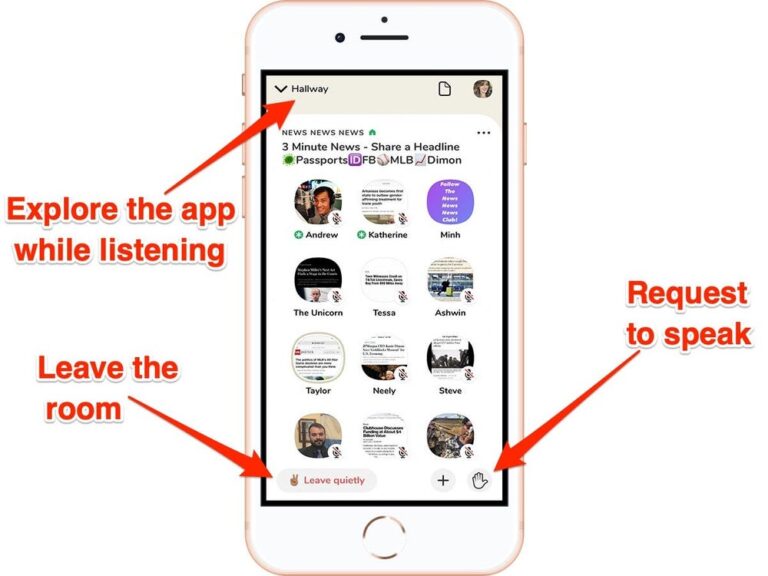
When I finally decided to give it a try, I was surprised to find that it was strangely comforting to be peripherally part of a community while I was working and going about my day — and absent of a physical office with actual coworkers.
If you’re unfamiliar with the app like I was, here’s a basic rundown of what it’s like.
This is what your main “timeline” looks like in the Clubhouse app
The Clubhouse main timeline.
It’s populated by rooms, or conversations, associated with the the people and clubs that you follow. Some of the topics I followed to inform the app of the kind of rooms I’d like were: television, storytelling, movies, current events, photography, wellness, meditation, AI, and startups.
I made sure to join one of the largest clubs on the app, Startup Club, with almost 450,000 members and followers.
The explore tab in the app.
There were rooms about NFTs, bitcoin, news, meditation, founder advice, coding, Reiki healings, startups, wellness, history, and more than I would think possible. There’s also a button at the bottom of the screen to start …
This week’s show continues our focus on the bestselling business author and last week’s guest, Verne Harnish. He is the author of Mastering the Rockefeller Habits and Scaling Up among others that you should definitely check out.
Even though many entrepreneurs achieve their success based on “gut instincts”, it’s still important early on to put systems in place that can help the business to focus, maintain and grow in a way that’s measurable and actionable.
Accountability
The scaling-up process involves yearly and quarterly meetings as well as weekly meetings and daily huddles to monitor and direct progress as well as give employees the chance to get help and direction when facing obstacles.
Oftentimes startup entrepreneurs with small staff look at long-term processes as something that needs to be done later on, but that’s not really the case. Even if the staff is small, having measurable goals and strategies gives you the opportunity to meet and assess whether you are meeting, exceeding, or missing your goals. And as the company grows, this type of format can be used by teams and divisions to set their goals within a larger company setting.
The weekly meeting and daily huddle can be very powerful tools because it makes people accountable. There are goals and objectives assigned to people, those people are then responsible and take ownership of those tasks and those tasks are then assessed.
Delegation
At the beginning of a company, an entrepreneur may find themselves getting involved in all of the little details that it takes for a company to be successful. But at some point, an entrepreneur needs to start to let go and actually delegate responsibilities to other people on the team, which is great for the leader and it is also how you scale a company. You cannot scale a company as a solo entrepreneur, you will learn quickly that it takes a confident team who can take ownership of responsibilities and spearhead tasks.
Also, a company’s core values grow and mature over time, but they should always be an important part of the decision-making process. Keeping core values aligned with your brand and business will maintain the health and integrity of your business overtime. By delegating responsibilities and tasks, you create leaders that can look at the company’s core values and feel confident in making decisions based on those values.
Leadership
In order for an entrepreneur to be able to delegate items to a team, it’s really important early on to find managers that complement your weaknesses. You cannot do everything yourself. You have to learn to hire and build a team of people who are capable and trust them to do the jobs you’ve hired them to do.
You can listen to the full session above! Happy Reading & Happy Listening!
Hear the three crucial components needed to grow your business from entrepreneurial icon and EO founder Verne Harnish.
(Recorded live on Clubhouse on April 6, 2021.)
Today, we’re picking it back up with Verne Harnish to highlight the three important foundation steps to put in place to support a business: accountability, delegation, and leadership. What to do when your “gut instinct” fails you, and the importance of having core values, getting internal influencers on board, and keeping it simple.
Moderators: Colin C. Campbell, Jeff Sass, Michele Van Tilborg
This week we welcomed Verne Harnish to the stage to talk about your business, scaling it up, and how to make it.
From what I’ve gathered, just by listening to Verne speak and also from my observations here in the office with my team and CEO implementing Verne’s methodology, this man is next level pro. He’s kept it simple, made smart maneuvers, and probably most important for anyone and any business, he has kept it consistent. In my opinion, consistency is what makes or breaks most endeavors.
If you have not yet experienced a presentation, video, or talk with Verne, then hopefully you glean from the recording that he is a seasoned and talented speaker. He is truly lovely to listen to and talk with, bringing a level of camaraderie, humanity, and relatability to his podium. I can’t help but to just nod enthusiastically in agreement as he offers incredible insight, pro-maneuvers, and hot tips along with just good ol’ practical and sage advice. Let’s dive in!
Listen to the full session above!
ProTips
1. Acquire or buy a company rather than build from scratch
2. Balance feminine + masculine approach to business, especially in terminology and implementation
3. Own the word
4. Get influencers on board
5. Core Values – create a level playing field so that your team can make decisions and defend that decision against the core values.
And so much more! We’re getting back in there next week with an OpenMic to talk with YOU our readers and listeners, about how you implement Scaling Up in your enterprise or how Verne’s methodologies have helped you along the way.
Award-winning author and successful entrepreneur Verne Harnish shares how to build an industry-dominating business.
(Recorded live on Clubhouse on April 2, 2021.)
In this session, Verne Harnish shares his experience as an entrepreneur and consultant, and his methodology to growing a company that works for you, rather than against. Verne is the founder of Entrepreneur Organization (EO), as well as Young Entrepreneurs Organization (YEO). Verne’s methods are from his book, ScalingUp, all about driving your business forward and creating momentum for growth.
Moderators: Colin C. Campbell, Michele Van Tilborg
This week we talked about clubs, the structure and vision of your club, and whether it is a community or a business.
Often times “community” and “business” are used interchangeably. Most would say that any business IS a community. We go to restaurants not just for the food, but for the ambiance, the vibe, and hospitality, the community. I go to my CrossFit gym, not just for the service provided by my coaches, but for the community of my gym mates and the camaraderie.
As Gary Henderson put it, the vision and intention of…
Learn about monetizing your business on and off Clubhouse!
(Recorded Live on Clubhouse March 26, 2021)
Listen in as Clubhouse creators Gary Hendersen, popular influencer coach, and Edna Bibb discuss the structure and vision for their club. They’ll share insights on building a community and business with the Startup.club audience including result-driven methods. We’ll learn how Gary is utilizing time tested marketing strategies to engage and monetize on and off of Clubhouse such as promotional offers for paid classes and coaching using Rally coins while always focusing on helping others.
Moderators: Colin Campbell, Jeffrey Sass, Michele Van Tilborg, and Rachael Lashbrook Speakers: Gary Hendersen from Gary.club and Edna Bibb from Solar.club
We brought Rich Goldstein and Priscilla Nunez on to talk about protecting our clubs and brands in Clubhouse. Before getting started it is imperative that I tell you, what you will read and hear on this session is NOT legal advice, it is an informal conversation with soft suggestions. Anything you hear or read here is for information and entertainment purposes and not legal advice or suggestions of actions you should take. Remember that our club gives to get and we are only offering education here.
Can You Trademark a Club on Clubhouse?
Most people first think of trademarking their Club on Clubhouse when trying to protect their Club. However, acquiring a trademark requires two distinct properties. Whatever you’re trying to trademark must be distinctive and you must be able to prove that you’re using the trademark in association with a product or service that you’re offering, referred to as a specimen. Both of these requirements can make it difficult to trademark a Club.
Let’s look at the first requirement of the trademark being distinctive. If your Club is only a descriptive name, that’s not considered distinctive. For example, you cannot trademark red licorice because it simply describes a product, but Coca-Cola can be trademarked since it’s a distinctive product and brand. However, if your Club name is distinctive, it may fulfill this requirement. You could also combine a distinctive name with a descriptive name, so you may be able to trademark the distinctive name but still have the descriptive name for SEO purposes.
As for the second requirement, you need to show the Trademark Office that the trademark is used in association with a product or service. This is typically shown by providing the label of a product, or a webpage or advertisement succinctly illustrating that the product or service is for sale. You might be able to fulfill this requirement with a website showing what your Clubs on Clubhouse offer with panel discussions. However, you might need to provide a specimen outside of Clubhouse that’s related to the trademark you’re attempting to acquire.
How Can You Protect Your Clubhouse Content?
Thankfully, protecting your content is far easier. In fact, you really don’t need to do anything to protect your content as it would be protected under copyright instead of a patent or trademark.
You do not need to register a copyright to have protection. Instead, copyright protection automatically occurs when the work is fixed in a tangible form. So, this means that as soon as content is written and fixed, it is under copyright protection. For a Clubhouse session, having the content fixed in a tangible form would mean that the session needs to be recorded in any format. However, if the session is not recorded, it is likely not copyrighted because any content recalled would be considered interpretation of ideas. So, to protect your Clubhouse content, make sure to record your sessions even if you do not upload them or share them. Simply recording it and saving it is usually sufficient for copyright protection.
It’s also important to note that copyright does not protect your ideas, but rather expression. Essentially, it protects how you frame the idea instead of the idea itself. So, the way you frame your ideas and explain them are protected, but the idea itself is not. This circles back around to why it’s recommended that you record your expression of your idea, tangibly.
We want to thank Rich and Priscilla for their time and contribution in continuing to educate and inspire entrepreneurs globally. We’re also so grateful to our listeners and moderators, for making our sessions on Clubhouse and with Serial Entrepreneur an exciting place to meet and collaborate. Please tune in next week for Scaling UP with best-selling author Vern Harnish, details and link in our Upcoming Events.
Hear IP Strategies & Ideas Around When To Consider Investing In Their Protection
(Recorded live from Clubhouse on March 19, 2021)
Our guest speakers Rich Goldstein, Patent Attorney, and Priscilla Nunez, COO AI Leadership Institute help us navigate core legal considerations from a practical point of view, such as scalability and profitability, when deciding when to invest in trademarking and copyrighting. We’ll also learn ways to improve and manage a name defensible plan. Specifically for clubs, we discuss their unique opportunities in conjunction with the use of a .club domain name for a website as a method to brand, grow and connect outside of the app.
Important Notice: This session is NOT legal advice, it is an informal conversation with soft suggestions. Anything you hear or read here is for information and entertainment purposes and not legal advice or suggestions of actions you should take without first consulting your legal advisor.
Moderators: Colin Campbell, Jeffrey Sass, and Rachael Lashbrook Speakers: Rich Goldstein and Priscilla Nunez
We shook things up a bit this week and offered an open mic approach in an intentionally smaller, more intimate room. All listeners were invited to speak to a hit and a miss that they’ve encountered during their residency at Clubhouse. We each came prepared with success and a failure to share and elaborate on followed up with a troubleshoot to turn the fail into a win.
What Works on Clubhouse After our open-mic Clubhouse session, we got some great tips on what has been working for our participants to leverage Clubhouse to its fullest extent. Here are a few of the highlights: Learn from Every Session When starting out on Clubhouse, the platform can be overwhelming. With such a large platform for interacting with leading industry experts and some of the most brilliant minds, getting started can be tough. We’ve all made mistakes on the platform and so have the people you look up to. But, what’s important is that you learn from those mistakes and take action based on what you learn during your next session. This goes for whether you’re hosting your own Clubhouse session or participating in others.
Utilize Your Bio As one of the only visuals on the Clubhouse platform, your bio is one of the only ways to draw in potential connections. When someone checks out your bio, you need to make them feel as if they know you personally. This builds genuine connections with like-minded individuals helping you leverage the value Clubhouse has to offer. So, put all of the topics you have an interest in within your bio, even if they’re not related at all. You never know who’s listening in the sessions you speak during as someone listening might also run a separate clubhouse related to one of your other interests further expanding your network.
Also, avoid generic terms like “Entrepreneur” as this does not tell someone anything about you or your interests. Instead, use descriptive language to talk about what interests you, what you already know about, and what you want to learn more about. By keeping the language in your bio descriptive, you draw in anyone who reads your bio making them feel as though they’ve already built a connection with you. Network with Others
Clubhouse gives everyone an equal opportunity to network with whoever they want. The platform makes it extremely easy for you to get in touch with people who would otherwise be extremely difficult to reach through other platforms like LinkedIn or Facebook. Their unique system of allowing one-on-one sessions and large gatherings gives you the chance to introduce yourself during a large gathering, then build upon that introduction with a one-on-one session. After a one-on-one session with someone, both you and them will feel a strong connection building an organic and honest relationship.
Look at the Profile of Those Who Provide You with Value Whenever someone speaks during a Clubhouse session you attend and they provided you with value, look up their profile. It might seem obvious, but all too often we get nervous or feel as though we’re intruding when we look up someone’s profile after only hearing them speak once. However, when you do this you can lead to a more genuine connection with that person. Take a look at the other platforms the person utilizes such as LinkedIn. Then, reach out to them and see if they want to connect further to talk about your shared interests. Once you do connect with them, be prepared to provide them with value as well. Providing them with value as well ensures you build a mutually beneficial relationship that lasts.
You Do Not Need to Run Your Own Club While you may feel as though you need to run your own club to leverage the value of Clubhouse, those feelings are simply not accurate. You can get just as much value out of Clubhouse by being a participant or guest speaker in other clubhouses. Figure out which clubs you can bring value to and reach out to those who run it with your thoughts on how you can help them bring their members value. More often than not, they’ll be happy to have you speak to their audience.
Also, Clubhouse is more than just a platform to get your name out there. Take the time to just attend sessions other people host that interest you and actually learn from them. It becomes an extremely valuable learning resource once you decide to treat it as one.
What Doesn’t Work on Clubhouse Now that we’ve gone through some ways you can leverage the full value of Clubhouse, let’s talk about a few things you should avoid while using Clubhouse that can actually take away from its potential value.
Spending Too Much or Too Little Time on Clubhouse Spending too much or too little time on Clubhouse will take away from its value. If you spend too much time in Clubhouse, you’ll end up neglecting your other responsibilities. While it’s easy to get sucked into endless sessions that seem as though they will be valuable to you, if you don’t have the time to act on that value, the time goes to waste. So, balance your time between taking action on what you learn and learning new things.
However, don’t give up on Clubhouse before you give it a chance. It’s unlikely you’ll understand the full value Clubhouse has to offer during your first few days using the platform. You need to give it enough time to find the clubs that interest you and the people you can share connections with.
Following Everyone It might seem appealing to build your followers by following everyone you see on Clubhouse. While you might gain a few followers this way, you’ll quickly become overwhelmed with notifications and alerts regarding sessions that do not interest you. Once you become overwhelmed with notifications and alerts, you will miss out on sessions you would have otherwise attended simply because you ignored the alert. So, to truly get the most out of Clubhouse, only follow the people that you actually want to interact with. This leads to you only receiving notifications and alerts you care about so when you do receive one, you actually look into it. Streaming Live Video From Clubhouse Oftentimes, people stream their Clubhouse sessions to other platforms like LinkedIn. While this does provide a lot of value to those who do not have Clubhouse, it can lead to you being banned on the platform. So, instead of streaming live video, only stream the audio with a picture showing what the session is about. This avoids the potential of being banned on the platform while still allowing you to provide the value of your Clubhouse session to those, not on the platform.
This site uses functional cookies and external scripts to improve your experience.
Privacy settings
Privacy Settings
This site uses functional cookies and external scripts to improve your experience. Which cookies and scripts are used and how they impact your visit is specified on the left. You may change your settings at any time. Your choices will not impact your visit.
NOTE: These settings will only apply to the browser and device you are currently using.