


Last week, I used Anthropic’s Fable 5 AI model to accomplish something that would have cost me thousands of dollars just a few years ago.
In 2012, when I launched .CLUB, I paid approximately $17,500 to have a private placement memorandum (PPM) prepared for investors. It was a necessary expense and, at the time, there were few alternatives.
Last week, I created a new PPM for another startup using Fable 5.
I uploaded eleven legal documents, worked collaboratively with the AI through multiple rounds of analysis and refinement, and produced a final investor-ready PPM that was not only completed for a fraction of the cost, but was substantially better than what I received from traditional providers more than a decade ago.
The difference was remarkable.
What once required a team of expensive professionals and weeks of back-and-forth work was completed with a handful of AI credits and my own expertise as a founder.
For entrepreneurs, that is transformational.
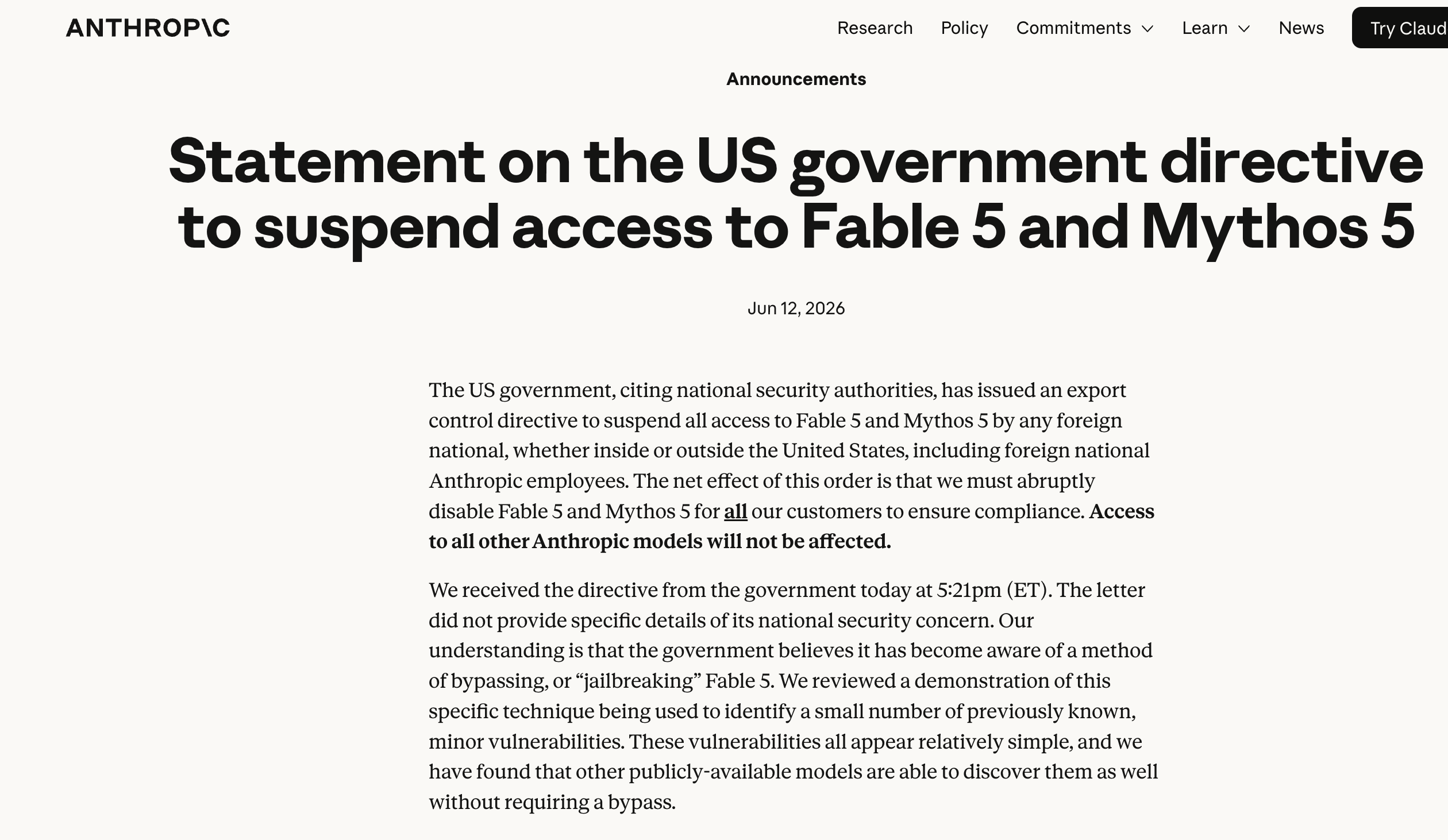
Which is why the recent suspension of Anthropic’s Fable 5 and Mythos 5 models should concern every startup founder in America.
A Tool Built for Builders
According to Anthropic, Fable 5 represents one of the most capable AI systems ever made available to the public. The company highlighted major advances in software engineering, scientific analysis, research, reasoning, and complex knowledge work.
For startup founders, these aren’t abstract technical improvements.
These capabilities directly reduce the cost of building companies.
They help entrepreneurs draft legal documents, analyze markets, write code, conduct research, prepare investor materials, and solve problems that previously required teams of specialists.
In other words, they level the playing field.
A first-time founder with a great idea but limited capital can now access capabilities that were previously available only to well-funded companies.
That is exactly the kind of democratization of opportunity that has historically fueled American entrepreneurship.
The Most Concerning Part: Even Anthropic Says the Response Is Excessive
Anthropic’s recent statement regarding the suspension raises important questions.
According to the company, the decision was driven by government concerns related to national security and export controls. Anthropic stated that it is actively working with government officials to restore access and emphasized that the issue involved a specific vulnerability rather than a broad failure of the model itself.
The company noted that Fable 5 underwent extensive safety testing before release and that it remains committed to making the technology available again as quickly as possible.
This distinction matters.
There is a significant difference between addressing a specific security concern and removing an entire class of technology from entrepreneurs, startups, researchers, and businesses.
Imagine discovering a security flaw in a new operating system and responding by shutting down access to computers altogether.
Most people would consider that an overreaction.
Yet that is effectively what has happened here.
The startup community had only begun to explore what Fable 5 could do before access disappeared.
The Dangerous Precedent
The real issue is not simply the loss of one AI model.
The real issue is the precedent.
Throughout American history, innovation has often arrived before society fully understood its implications.
The automobile disrupted transportation.
The airplane transformed travel.
The personal computer changed how we work.
The internet reshaped the global economy.
Each breakthrough created legitimate concerns and risks.
Yet America became the world’s innovation leader because we chose to adapt, compete, and improve rather than prohibit.
For more than 250 years, our nation’s success has been built on encouraging inventors, entrepreneurs, and builders to push boundaries.
That tradition made America the global leader in technology.
When government agencies move quickly to restrict access to breakthrough technologies, they risk undermining the very system that created our technological advantage in the first place.
Innovation requires experimentation.
Experimentation requires access.
Without access, there can be no innovation.
Startups Will Pay the Price
Large corporations can absorb regulatory uncertainty.
Startups cannot.
When a major technology platform disappears overnight, large companies have legal departments, compliance teams, and substantial resources to adapt.
Entrepreneurs do not.
Founders need certainty.
They need confidence that the tools they build their businesses around will remain available.
The concern is not just about Fable 5.
The concern is what comes next.
If breakthrough technologies can be removed from the market shortly after release, despite extensive testing and safeguards, entrepreneurs may hesitate to adopt future innovations. Investors may become more cautious. Startups may become less competitive.
And while America debates restrictions, competitors around the world will continue advancing.
Innovation rarely disappears.
It simply moves elsewhere.
National Security and Innovation Are Not Opposites
National security matters.
Responsible safeguards matter.
Every transformative technology requires thoughtful oversight.
But there is a difference between managing risk and restricting progress.
America’s greatest achievements have come from finding ways to lead innovation responsibly, not from stepping away from it.
The question policymakers should be asking is not how to slow down breakthrough technologies.
The question should be how to ensure America remains the best place in the world to build them.
As a founder, I don’t see Fable 5 as a threat.
I see it as one of the most important entrepreneurial tools ever created.
Last week, it helped me create a world-class private placement memorandum that would have cost tens of thousands of dollars just a few years ago.
Imagine what millions of entrepreneurs could build if they had continued access to that same capability.
America’s competitive advantage has never been fear of innovation.
It has always been our willingness to lead it.
Which is why it is particularly disappointing to witness this moment on the eve of America’s 250th anniversary.
For nearly two and a half centuries, our nation has been defined by inventors, entrepreneurs, risk-takers, and visionaries who embraced transformative technologies and built the future. From the telegraph to the airplane, from semiconductors to the internet, America didn’t become the world’s innovation leader by restricting breakthrough technologies. We became the leader by empowering builders to create them.
As we prepare to celebrate 250 years of American ingenuity, entrepreneurship, and technological leadership, it is sad to see a decision that risks sending us in the opposite direction.
The next generation of great American companies will be built with AI.
The question is whether they will be built here.
Sources
Anthropic Announcement: https://www.anthropic.com/news/claude-fable-5-mythos-5
Anthropic Access Update: https://www.anthropic.com/news/fable-mythos-access