

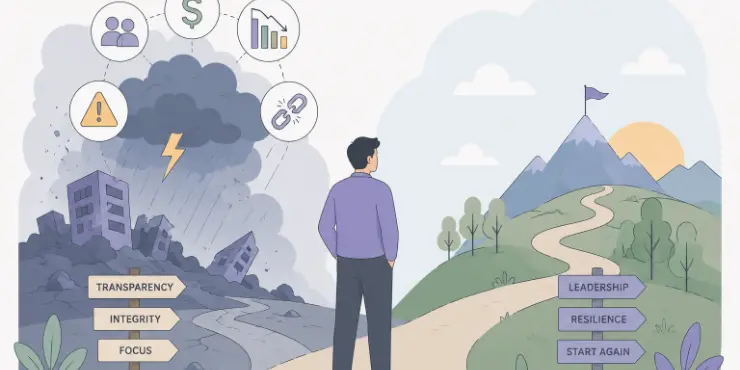

The Day Everything Breaks Is The Day Leadership Begins
Most entrepreneurs don’t fail when disaster strikes. They fail in the days that follow.
Nobody teaches you what to do when your investor disappears.
Nobody teaches you what to do when a key customer leaves.
Nobody teaches you what to do when the company you’ve spent ten years building suddenly starts collapsing around you.
The startup world loves victory stories. Funding announcements. Exits. Unicorn valuations.
What rarely gets discussed are the nights when founders stare at the ceiling wondering how they’ll make payroll next week.
Those moments are the real test.
This article is based on a conversation with Colin C. Campbell and Michael Gilmour on handling entrepreneurial disasters.
“When everything else disappears, integrity is the one asset you cannot afford to lose.”
Transparency Beats Panic
One of the most powerful stories came from a crisis that should have destroyed a business.
A utility company accidentally severed hundreds of critical phone lines serving a major internet provider. Overnight, thousands of customers lost service.
The easy response would have been silence. The actual response was the opposite.
The company immediately issued a press release, explained exactly what happened, and faced the problem publicly.
What looked like a catastrophe became national news.
The business recovered. The brand became stronger.
When disaster hits, people usually forgive bad news. They rarely forgive being misled.
Transparency creates trust when trust matters most.
Integrity Is Your Last Remaining Asset
Michael Gilmour shared a story every founder should hear.
After raising millions in venture capital, his company hit every milestone. Then an acquisition between two global corporations wiped out future funding commitments overnight.
The business was suddenly fighting for survival.
Employees had to be informed. Investors had to be informed. Creditors had to be informed. None of those conversations were easy.
Yet years later, many of those same investors backed him again.
Why?
Not because the company succeeded.
Because the founder operated with integrity when things failed.
Founders often think leadership is about vision.
During a crisis, leadership becomes character.
The Loneliest Job In Business
Entrepreneurship can be incredibly rewarding. It can also be incredibly lonely.
When disaster strikes, founders often discover something uncomfortable.
Most people around them cannot truly understand what they’re carrying.
Employees worry about their jobs. Investors worry about their money. Customers worry about service.
The founder worries about all of it. At the same time. That weight is difficult to explain unless you’ve carried it yourself.
The reality is simple. Leadership often means absorbing uncertainty so others don’t have to.
Facts First. Emotions Second.
Every entrepreneur experiences emotional reactions.
Anger. Fear. Frustration. Panic.
Those emotions are normal.
What matters is what comes next.
When faced with major external shocks, successful founders gather facts before making decisions.
Not assumptions. Not headlines. Not social media opinions. Facts.
One practical lesson from the conversation stood out.
Before making a major decision, build the spreadsheet. Map the options. Calculate the outcomes. Evaluate reality instead of reacting to emotion.
The crisis may not change.
Your response can.
Every Disaster Is An Expensive Training Course
Colin shared the story of losing over $100 million during the dot-com collapse.
It was devastating. Years of work evaporated. Employees lost jobs. Investors lost money.
A dream disappeared.
Yet that experience became the foundation for future success, including multiple successful exits and eventually the bestselling book Start. Scale. Exit. Repeat.
The lesson wasn’t financial. It was operational.
Every disaster teaches something.
Sometimes the tuition is painfully expensive.
The founders who survive are the ones who pay attention to the lesson.
Entrepreneurs Know How To Start Again
This may be the most important insight of all.
Entrepreneurship is not a single company.
It’s not a funding round. It’s not an exit. It’s a skill.
A founder who has learned how to create value can do it again. And again. And again.
Companies come and go.
Markets rise and fall.
Technology changes.
The skill remains.
That’s why experienced investors often back entrepreneurs who have failed before.
Not despite the failure. Because of it.
The Real Measure Of An Entrepreneur
Rocky Balboa said it best.
“It ain’t about how hard you hit. It’s about how hard you can get hit and keep moving forward.”
Every entrepreneur gets hit.
The question is never whether disaster will arrive.
The question is what you’ll do when it does.
Because in business, as in life, resilience is not avoiding the storm.
It’s learning how to build again after it passes.