Getting it right the first time & setting up for success
(Recorded Live on Clubhouse November 12, 2021)
We were joined by Lil Roberts, CEO and founder Fintech platform Xendoo, for insights into raising capital for your startup. We learned where to look and what to look for in an investor, preparing to meet with potential investors, plus Lil’s top tips for perfecting your pitch.
Moderators:Colin C. Campbell, Michele Van Tilborg, Rachael Lashbrook, Jeff Sass
Guest:Lil Roberts
Sign up to our email and never miss an update on our special events, guest speakers, and more: https://startup.club/
For the last two years, I’ve had some version of the same conversation with CEOs. What AI tools should we be using? What is everyone else doing with AI?
They’re fair questions, but I think we’re asking the wrong question.
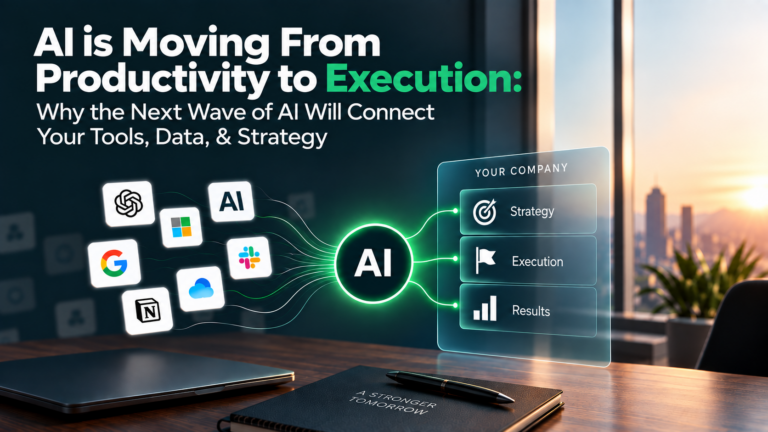
The next phase of AI isn’t about adding more tools. It’s about connecting AI to the way your company actually runs because right now, a lot of companies have AI everywhere, and integrated almost nowhere.
People are experimenting, teams are moving faster, everyone has a favorite tool, but ask AI what your company’s top three priorities are this quarter, which KPI has quietly been red for six weeks, or which strategic initiative has plenty of activity but no measurable progress, and most AI tools can’t tell you.
Not because the AI isn’t smart enough, but because it doesn’t have the context.
AI Doesn’t Need More Intelligence: It Needs More Context
This is the part I think CEOs need to pay attention to. AI is already incredibly capable, and the models will keep getting better, faster, and cheaper, but intelligence without context has limits.
Your AI might know almost everything on the internet and still know almost nothing about how your company is actually performing this quarter. It doesn’t know your strategy, your priorities, your KPIs, or which commitments are quietly slipping.
That’s the gap. The real opportunity begins when AI understands the context of your business well enough to spot patterns, surface risks, and help leaders see what they might be missing.
Stop Thinking About AI as Another App
I think we’re going to look back at this period and realize we spent too much time thinking about AI as a destination: open ChatGPT, Claude, or Copilot, ask a question, close it.
That’s useful, but I don’t think that’s where this ends.
AI shouldn’t become another place your team has to go. It should increasingly become an intelligence layer across the systems where your team already works. That’s why I’m paying so much attention to developments like Model Context Protocol, or MCP.
The technical details matter less to most CEOs than the larger idea behind it: AI can increasingly connect to the systems that contain the context of your business, and that’s where things get interesting.
Imagine asking AI, “What are we most at risk of missing this quarter?”, and it actually knows your priorities, KPIs, strategic initiatives, recent updates, and commitments. Or asking, “Where is execution slowing down?” and having it look across the business to surface patterns that might normally take your leadership team hours to piece together.
Maybe the most interesting question is simply: “What are we not talking about that we should be?”
That’s a very different relationship with AI.
This Is the Shift From Productivity to Execution
Most of the AI conversation so far has centered around productivity. Can I write this faster? Can I summarize this faster? Can I research this faster? Can I automate this task?
Those are good wins; take them, but CEOs should be thinking one level higher: Can AI help my company execute better?
And the research is starting to back this up. McKinsey found that, of 25 factors it studied, redesigning workflows had the biggest effect on whether companies saw bottom-line impact from generative AI. Yet only 21% of organizations using gen AI had fundamentally redesigned even some of their workflows.
That tells me we’re still early. Most companies are putting powerful new technology on top of the way they’ve always worked. The bigger opportunity is to rethink how work happens when AI is connected across the business — to the systems, data, and context it needs to become more than a standalone productivity tool.
The bigger opportunity is what happens when AI can connect across the systems where your business already lives. Your CRM knows what’s happening with customers. Your financial system knows what’s happening with the numbers, and your project management tools know what teams are working on. Your communication platforms hold thousands of conversations and decisions. Your strategy and execution systems know what you said matters most. Today, much of that context lives in separate places.
MCP begins to change that. Instead of AI operating inside one application at a time, it creates the possibility for AI to work across an increasingly connected ecosystem of tools and information. Now you can start asking much bigger questions, not just “Can you summarize this?” but “What’s happening across the business that I need to understand?”
That’s the shift that interests me. AI moves beyond being a tool you visit to becoming an intelligence layer that can connect information, recognize patterns, and bring the right context forward at the right moment. The value isn’t simply doing the same work faster; it’s giving leaders a more connected view of their business than they’ve ever had before.
We’re Testing This in Our Own World
This is one reason we’ve been experimenting with connecting AI directly to the execution data inside Rhythm, not because I think CEOs need another AI product. Actually, I think the opposite.
What interests me is what happens when the AI tools leaders already use can understand the priorities, KPIs, Winning Moves, commitments, and execution signals already happening inside the business.
Can AI spot something before the CEO does? Can it notice a KPI that has been red too long or connect a struggling priority to a larger strategic risk? Can it help a leadership team prepare for a better conversation instead of spending half the meeting figuring out what’s going on?
Those are the questions that interest me because the breakthrough isn’t the connector.
The breakthrough is context.
The Question I’d Put in Front of Your Leadership Team
Don’t spend your next leadership meeting debating which AI tool everyone should use. Ask a bigger question:
If AI actually understood how our company runs, where could it help us make better decisions or execute faster?
Maybe it’s seeing problems earlier, or maybe it’s preparing for leadership meetings, identifying patterns across KPIs, finding disconnects between strategy and execution, or simply helping your leaders ask better questions.
The answer will be different for every company, but the important thing is not to confuse AI adoption with AI integration.
Giving everyone an AI account is adoption. Changing the way information flows, decisions get made, and execution happens? That’s integration.
And I believe that’s where the next real wave of AI value will come from.
The companies that get the most from AI won’t necessarily be the ones with the most tools. They’ll be the ones that figure out how to put AI in the flow of how they actually run the business.
That’s the conversation CEOs should be having now.
The best time to build a company is often when the market is changing faster than established businesses can respond.
In the latest episode of Start, Scale, Exit, Repeat, the Startup Club community explores how founders can recognize major technology waves and turn them into real business opportunities.
https://youtu.be/8g2jAd4hcNI
“Execution is literally your only differentiator. AI can generate a hundred business plans before breakfast.”
Live in the Future
One of the best ways to recognize an emerging trend is to use the technology before it becomes mainstream.
Experimenting with broadband helped entrepreneurs see the future of streaming, cloud computing, and online services. Today, founders can take the same approach with AI by actively testing new models, agents, and automation tools.
You cannot fully understand a wave by watching from the shore. You have to get into the water.
Listen for the Noise
Important trends often create intense conversations inside smaller communities before reaching the broader market.
Pay attention to what founders, developers, creators, and early adopters are repeatedly discussing. Communities like Startup Club, Reddit, and industry groups can reveal signals that traditional market research may miss.
Look Beyond the First Opportunity
The original technology is not always the biggest opportunity.
Broadband enabled streaming. Streaming enabled YouTube and the creator economy. Generative AI opened the door to AI agents, automated services, and a new generation of solo businesses.
Founders should look for these second-order opportunities. Ask what becomes possible after a technology is widely adopted.
AI is lowering the cost of building, testing, and operating a company. Ideas are becoming easier to generate, which makes execution even more important.
The next wave is already forming. The entrepreneurs who experiment, listen, and ship will have the best chance of catching it.“Execution is literally your only differentiator. AI can generate a hundred business plans before breakfast.”
Entrepreneurs make decisions constantly. When every expense, contract, customer problem, and team question reaches the founder, that mental load becomes decision fatigue.
In this episode of The Complete Entrepreneur, Colin Campbell and Michael Gilmore discuss how founders can reduce stress, protect their focus, and build companies that operate without requiring their approval at every step.
https://youtu.be/xhFT-abC-YQ
“You will be the cork in the bottle. Everything will stop with you.” -Michael Gilmore
Stop Being the Bottleneck
Founders often believe they must make every important decision. That approach may work during the earliest stage of a company, but it eventually limits growth.
Michael shares a simple lesson: push decisions back to the people who have the knowledge to make them.
A team member who has studied a problem for several days is often better positioned to choose a solution than a founder who receives a five-minute summary. Give employees clear areas of responsibility, reasonable limits, and permission to make mistakes.
Mistakes that do not threaten the company should become learning opportunities. When people are accountable and empowered, they usually make thoughtful decisions.
Protect Your Financial Runway
Financial stress is one of the fastest ways to destroy a founder’s focus.
When cash is running out, entrepreneurs begin moving money between credit cards, accepting bad deals, and prioritizing immediate survival over long-term strategy.
Colin recommends funding the business through clear stage gates. Each stage gate should represent a measurable achievement, such as completing an MVP, securing initial customers, or proving revenue. The company should have enough cash to reach that milestone.
Possible ways to extend the runway include:
Bootstrapping for longer
Keeping a job while developing the business
Getting an early product into customers’ hands
Creating recurring revenue instead of one-time sales
Using customer commitments to fund growth
Preserving equity until the business becomes more attractive to investors
Raising money can help, but new capital should not become permission to abandon financial discipline.
Remove Persistent Sources of Stress
A difficult business partner can consume more attention than customers, strategy, and growth combined.
A strong partnership allows decisions to move forward. A misaligned partnership can leave one person pressing the accelerator while the other keeps a foot on the brake.
Founders should address persistent conflict directly. Sometimes the healthiest decision is restructuring responsibilities, buying out a partner, or ending the relationship before it drains more energy from the company.
Turn Workload Into Playload
The goal is not to eliminate every demanding day. It is to create the conditions where the founder can focus on strategy, customers, and opportunities.
Delegate responsibilities, protect the runway, establish planning systems, and remove obstacles that consume attention without creating value.
When the business has momentum and the founder is no longer buried in every decision, the workload begins to feel different. It becomes the game of building a company.
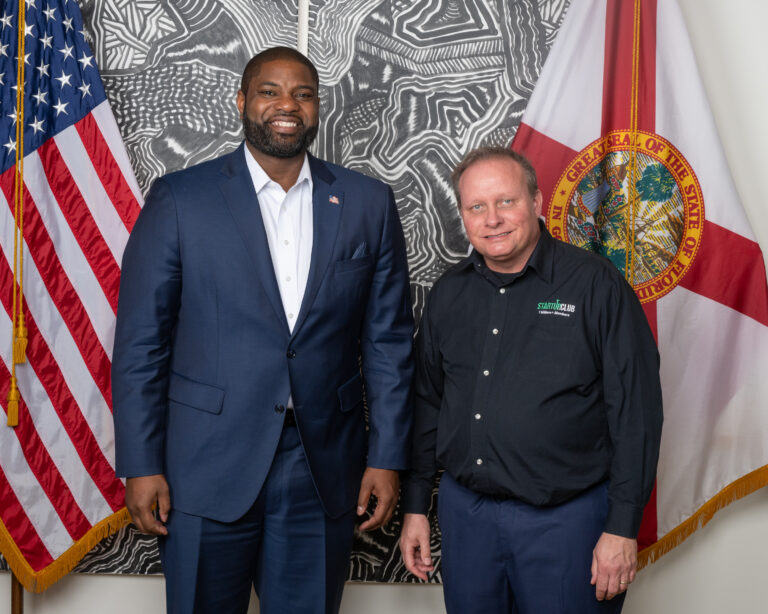
Not long ago, I had a chance to meet Byron Donalds at a local small business, and I told him about a CrossFit gym here in Fort Lauderdale.
It’s a great little business, with a loyal membership, a real community, and a reputation that brings in new members without a big marketing budget. In other words, the owners have done exactly what we tell entrepreneurs to do at Startup Club: find a problem, build something people love, and run it well.
And yet, when I talk to them, the conversation isn’t about growth. It’s about insurance premiums that keep climbing, rent that keeps climbing, and a dozen other costs that have nothing to do with how good they are at running a gym.
I’ve spent more than thirty years starting, scaling, and exiting companies, and I can tell you that entrepreneurs don’t mind risk because we sign up for it every day. Customers may not show up, a competitor may come out of nowhere, your best employee may leave, and the market may change under your feet. That’s the job.
What’s harder to accept is watching a healthy business get squeezed by structural costs it can’t control, costs that have very little to do with the quality of the company itself.
That’s the part where the next Governor of Florida can actually make a difference, and it’s why Startup Club is doing something we’ve never done before.
We are endorsing Byron Donalds, the Republican nominee, for Governor of Florida.
Let me be clear about what this is and what it isn’t. I’m a registered independent here in Florida. Startup Club is a global community of more than one million members: Republicans, Democrats, independents, and a whole lot of entrepreneurs who couldn’t care less about politics and would rather talk about customer acquisition costs.
Our mission has always been entrepreneurship, and that’s the lens I’m using to look at this race.
This isn’t about party loyalty or ideology. It’s about which candidate’s policies would create the best environment for people who start companies, hire people, invest capital, and take risks in this state.
Florida has changed a lot over the past several years, and mostly for the better. Entrepreneurs have moved here, investors have followed them, and now more capital is starting to flow here too. Access to startup capital in Florida has been a big issue since I moved here in 2002.
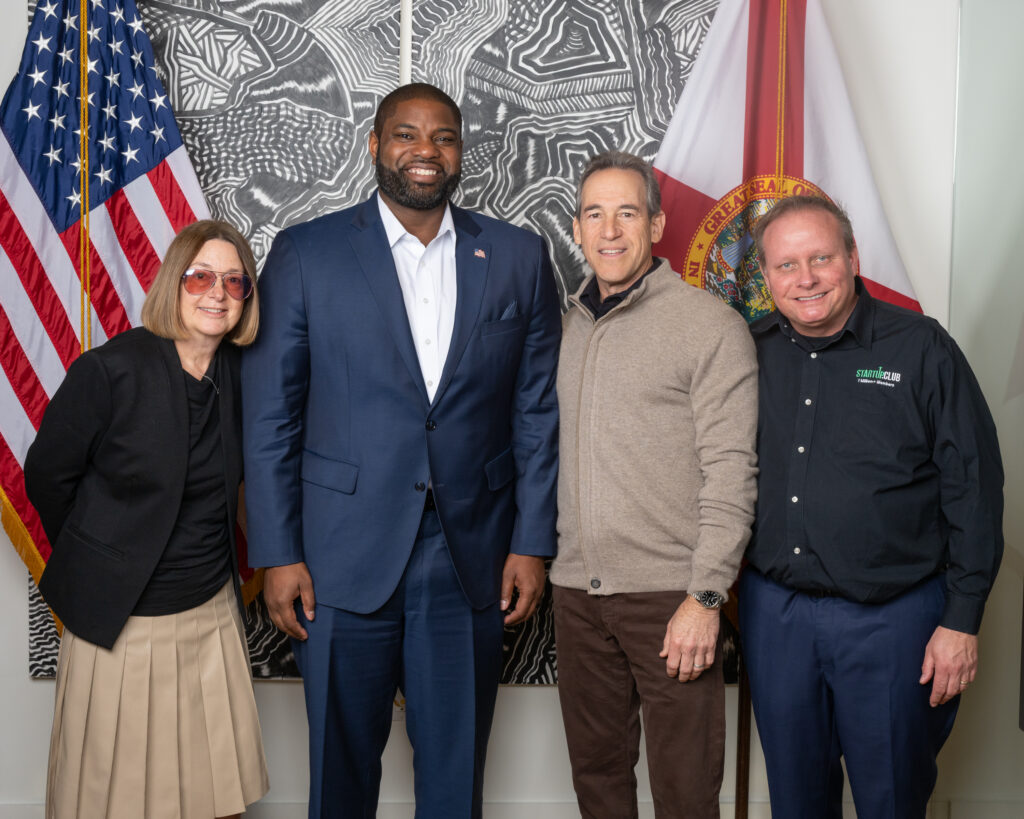
January 16, 2026, Fort Lauderdale, Florida. Photos from the Byron Donalds roundtable and luncheon.
South Florida in particular has an energy that would have been hard to imagine ten years ago.
But at the same time Florida has become a better place to start a company, it has become a much more expensive place to run one. Insurance costs have gone through the roof. Money is still expensive. Housing costs are squeezing employees and the employers trying to keep them. And permitting, licensing, and regulation add delays that quietly add cost.
A big corporation can absorb all of that. It has a legal department and a government-relations team. A small business doesn’t, and for a small business those costs can be the difference between making it and not. So what impressed me about Donalds? It wasn’t that he said he supports small business. Every politician says that, and they’ve been saying it for generations. What mattered to me was that he actually understands the plumbing. Before he ran for office, he worked in banking, finance, and insurance. In the Florida Legislature, he chaired the House Insurance and Banking Subcommittee, and in Congress he sits on the House Financial Services Committee. Insurance and access to capital happen to be two of the biggest problems facing Florida businesses right now, so it’s hard to imagine a more relevant résumé. On insurance, he has proposed something he calls an Insurer Scorecard, basically a modernized version of the state’s rate-comparison tool that pairs price with performance: how fast an insurer pays claims and how often it approves them. The idea is simple: give consumers and business owners a clear way to compare carriers, and let competition do some of the work that regulation alone hasn’t. I am experiencing this firsthand. I filed a claim for our beach house in North Captiva, and after two years, we still have not received the insurance funds. For someone who has experienced the system firsthand, the idea of making insurance companies more accountable is welcome news. Donalds has also said he would revisit Florida’s property insurance rules, which he argues could bring rates down by as much as 20 percent, while keeping the state’s hurricane catastrophe fund in place as the backstop for major storms. Will it come in at exactly 20 percent?
Campaign math always meets reality at some point. But the approach is consistent with how he thinks about markets in general: more transparency, more competition, fewer barriers. Then there’s friction, and I’d argue it matters just as much. I’ve written before that cash is the oxygen that keeps a business alive. Friction is what slowly cuts off the air supply. A permit that takes six months, a license with no clear timeline, one more layer of review, each one seems manageable on its own. Add them up and they change the economics of a business. For a small business owner, a six-month delay isn’t an inconvenience. It’s six months of rent, interest, and payroll, and sometimes it’s the deal you never got to do. That’s why Donalds’ “Florida Means Business” agenda resonated with me. It includes a public “shot clock” showing how long state and local agencies take to approve permits. As he put it, “If you can look up your county commissioner’s salary in 30 seconds, you should be able to look up how long your county takes to approve a permit the same way.” The plan also calls for a single online dashboard that tracks permits across local, regional, and state government, a task force to review the permits, licenses, and fees businesses have to deal with, faster review timelines for transportation, energy, and infrastructure projects, dedicated business courts so commercial disputes don’t wait behind every other civil case, and a modernized business registration process at the Department of State. None of this makes headlines. But it matters. My own beach house repairs were stalled for 18 months while permits were tied up with Florida’s environmental regulators. I’ve experienced firsthand what those delays cost. Bringing greater transparency and accountability to government is another step in the right direction. Now, I want to be fair to David Jolly, the Democratic nominee, because I looked at him seriously. Jolly is a credible candidate. He has focused on the right problems: affordability, insurance, and housing. I also respect that he has been willing to break with his former party and take positions that don’t fit neatly in either box. His big idea deserves a real look: a state-run catastrophic fund, which he says would need to reach $30 to $40 billion, that would pull hurricane and natural disaster risk out of the private insurance market entirely and leave private carriers covering things like fire and theft. He would fund it in part with a tax on insurer profits and by redirecting tourist development tax revenue, and he argues it could cut premiums by 60 to 70 percent. Don’t get me wrong. I am not here to tell you Jolly’s plan is crazy. It’s a serious proposal for a serious problem. The difference between the two candidates really comes down to approach.
Jolly’s proposals generally give the state a larger role in addressing insurance, housing, utilities, and affordability. And although that sounds tempting, greater government control of markets can also lead to unintended consequences. Donalds generally wants more competition, faster government, and fewer barriers to starting and growing a company. Both approaches deserve to be debated. But from where I sit as an entrepreneur, Donalds’ approach is the stronger bet for the people I spend my days with. Here’s why: small businesses are allergic to complexity. Big companies can afford lawyers, compliance teams, and lobbyists. Entrepreneurs can’t. When government gets more complicated, the burden doesn’t fall evenly. It falls hardest on the smallest players. In my experience, when you cut friction and add competition, the little guy benefits the most. There’s a bigger opportunity here, too. My brother, Bill, and I started our first internet company in the early 1990s, when most banks didn’t know what the internet was, let alone how to lend against a company built on it. Years later, we built another technology company and took it public. If those experiences taught me one thing, it’s this: great ideas need capital. Florida has something today it didn’t have a generation ago. The entrepreneurs are here, the investors are here, and the capital is starting to follow. That could become one of this state’s biggest competitive advantages. But capital is mobile, and so are entrepreneurs. If Florida becomes significantly more expensive, more difficult, or less predictable than the states we compete with, both can leave just as fast as they came. So the next chapter for Florida can’t just be about attracting people. It has to be about keeping them, making this a place where entrepreneurs can stay, build, and scale. That means getting insurance costs under control, improving access to capital, dealing with housing, investing in infrastructure, and taking the friction out of dealing with government. Why is Startup Club wading into a political race at all? Some of you will reasonably ask, and it’s a fair question. We’re not becoming a political organization, and our mission isn’t changing. But public policy affects entrepreneurs whether we choose to talk about it or not, and if we believe one candidate offers a better environment for the people who start companies, create jobs, invest capital, and take risks, then I think our community ought to be willing to say so. This endorsement doesn’t mean every Startup Club member will agree with me, and it doesn’t mean we’ll agree with Byron Donalds on every issue. It means something much narrower: when you look at this race through the lens of entrepreneurship and small business, we believe he’s the stronger candidate. After going through both candidates’ positions and meeting Donalds to talk about what Florida entrepreneurs are up against, I believe he has the background, the perspective, and the approach to keep Florida one of the best places in America to build a business.
For the first time in Startup Club’s history, we are endorsing a candidate for public office. We are endorsing Byron Donalds for Governor of Florida because we believe
Florida’s next chapter should be written by entrepreneurs, small businesses, investment, and growth. And if you’re an entrepreneur in Florida, I’d ask you to look at both candidates the same way, through the lens of your own business, and decide for yourself.
A founder can launch a company through personal effort. Scaling it requires something different: the ability to trust other people with meaningful responsibility.
In this episode, entrepreneur and U.S. Army National Guard officer Parker McCumber shares leadership systems that helped him scale an e-commerce business to more than $75 million in lifetime sales.
https://youtu.be/ZW2qi7wUmSE
“People will always lead people. AI will never lead people.” -Parker McCumber
Delegate Intent, Not Just Tasks
Many founders delegate individual tasks while keeping every important decision for themselves. This reduces their workload temporarily, but it does not create a team that can operate independently.
Parker recommends delegating intent. Team members should understand:
What must be accomplished
Why the objective matters
What limits they must respect
Which decisions they can make independently
Who owns the final outcome
When people understand the mission, they can adjust when the original plan encounters an obstacle. Parker calls this disciplined initiative.
Create a System for Learning
Delegation becomes less risky when the organization learns from every attempt.
Parker uses a short mission brief at the beginning of the week to define the objective and what winning looks like. At the end of the week, the team conducts an after-action review built around four questions:
What was supposed to happen?
What actually happened?
What should we sustain?
What should we improve?
Everyone checks rank and ego at the door. The purpose is not to assign blame. It is to improve the system.
Replace Reviews With Performance Counseling
Traditional performance reviews often focus on judging past behavior. Performance counseling focuses on building future capability.
A leader identifies what went wrong, provides guidance, and works with the employee to create a better process. Mistakes become learning opportunities that strengthen the individual and the organization.
This approach also gives founders the confidence to let go because the team has a repeatable process for correcting problems.
Use AI Without Outsourcing Leadership
Parker describes AI as a tool for processing information, analyzing content performance, and helping leaders make faster decisions. It can reduce the time required for research and execution.
It cannot build trust, accept responsibility, or lead people.
His suggested model is simple: provide the first 10% through clear input, allow AI to complete much of the middle work, and reserve the final 10% for human judgment, detail, and authenticity.
People will always lead people. The founder who wants to scale must learn how to communicate intent, transfer ownership, coach performance, and trust the team to execute.
Some business books explain entrepreneurship. The best ones help entrepreneurs act.
Start. Scale. Exit. Repeat. by Colin C. Campbell has been recognized with a 2026 NYC Big Book Award in the Business: Entrepreneurship & Small Business category. The honor marks the book’s 41st global award and recognition.
That milestone reinforces a simple idea at the heart of the book: entrepreneurship is not a single leap of faith. It is a repeatable process that founders can learn, test, and improve.
A practical playbook for entrepreneurs
Building a company can feel chaotic. There are always more ideas, more decisions, and more risks than one person can manage at once.
Start. Scale. Exit. Repeat. turns that complexity into a practical framework. Drawing on Campbell’s experience starting, scaling, and exiting multiple companies, the book walks entrepreneurs through the full business lifecycle, from finding the right idea to building a company that can grow beyond its founder.
The goal is not to romanticize entrepreneurship. It is to help founders make better decisions, avoid predictable mistakes, and build companies with intention.
That practical focus is why the book continues to resonate with entrepreneurs and business leaders around the world.
Recognition from across the book industry
The NYC Big Book Award is judged by professionals representing different parts of the publishing industry, including publishers, writers, editors, designers, booksellers, librarians, and professional copywriters. According to the award organizers, honorees are selected based on overall excellence.
The 2026 competition received submissions from around the world, with entries from established authors, first-time independent authors, and both small and major publishers.
Receiving recognition in the Business: Entrepreneurship & Small Business category is especially meaningful because that is exactly who the book was written to serve: founders who want a clearer, more disciplined way to build.
Forty-one awards, one mission
Awards are worth celebrating. But the real measure of a business book is whether readers use it.
Every framework in Start. Scale. Exit. Repeat. is designed to move an entrepreneur from insight to action. It helps founders pressure-test ideas, focus on scalable opportunities, build the right team, create systems, and think ahead about the kind of exit they want.
The book’s 41st global award is another validation of that mission.
For the Startup Club community, it is also a shared milestone. The conversations, lessons, and real-world founder stories that shape this community are built around the same belief: entrepreneurship can be learned, and no founder has to figure it all out alone.
4,000,000 books will be published in 2027. Just think about that for a second… That’s about half of the people in New York City, the world capital of book publishing. So if you’ve ever thought about writing a book—or you have a half-finished manuscript judging you from your hard drive—you should be asking one big question:
“How will my book stand out?”
As a nonfiction book coach and ghostwriter, that’s the question I’m always focused on with clients. So I studied the top 25 best-selling business books of all time to figure out if they shared any traits that helped them be so successful.
Yes, having a large platform definitely helps sell books, but authors like Robert Kiyosaki (Rich Dad, Poor Dad) and even Simon Sinek (Start With Why) didn’t have massive platforms when their books first came out. So when I crunched the numbers, I found 11 traits that nonfiction authors can turn into their personal “cheat sheet.” Start with these five:
Cheat #1. Storytelling Wins. Every time.
Readers remember stories, not stats or lectures.
Cheat #2. Titles Matter. A Ton.
A clear and memorable title is far better than a “clever” title. The title is your book’s hook. If the hook doesn’t work, the book doesn’t work. And the best titles usually reveal themselves through the process, not at the beginning.
Cheat #3. Challenge Conventional Wisdom.
Two ways you can challenge conventional wisdom: (A) Share a contrarian perspective, or
(B) Reframe an unpopular idea. Even if people disagree with you, you’re still generating buzz.
Cheat #4. Niche Down. Then Niche Up.
Speak to a single target reader but then find the broad appeal angle. Most books try to only niche down or niche up. The tricky part is doing both in tandem.
Cheat #5. Become Quotable.
You need a distinct voice to differentiate yourself. With more nonfiction authors leaning heavily on AI than ever before, distinct voices and perspectives are disappearing…and readers are noticing. Your catchphrases, frameworks, and go-to advice are your “personal IP.” Use it!
If you want to read all 11 with examples, go grab my free resource the Bestsellers Cheat Sheet. Which one of the 5 above is the hardest part for you? Which one do you feel like you have nailed down?
A great idea is not automatically a great business.
In this episode of The Complete Entrepreneur, Colin Campbell and Michael Gilmore explore how founders can evaluate an idea, manage the fear of launching, and use AI to move from concept to market.
“You’re only limited by your imagination.” Colin Campbell
Validate Before You Build
Before investing significant time or money, determine whether the idea solves a meaningful problem.
Ask:
Is the timing right?
Is there a clear target customer?
Will people pay for the solution?
Can the business scale?
What prevents a competitor from copying it?
Does the founder have the ability to adapt and execute?
Sharing the idea with experienced founders, potential customers, investors, and qualified advisers can expose weaknesses early. Positive feedback from friends is encouraging, but it is not market validation.
Quantify the Fear
Fear is not always a reason to stop. It can be a signal that important questions remain unanswered.
Michael Gilmore recommends quantifying that fear. Build a cash flow forecast, calculate the worst-case loss, identify funding gaps, and determine which assumptions still need evidence.
Once you turn uncertainty into numbers, you can make a clearer decision about whether the opportunity justifies the risk.
Use AI as a Research Partner
AI can help founders evaluate ideas faster by:
Researching competitors and market conditions
Testing different business scenarios
Drafting business and marketing plans
Building financial models
Creating prototypes and early products
Identifying weaknesses in an argument
Challenging assumptions before money is committed
The key is to ask AI to critique the idea, not simply confirm it. Its output still requires verification and human judgment.
Build What AI Cannot Copy
AI has lowered the cost of launching a company, but it has also lowered the barrier for competitors.
A product built quickly with AI may be just as easy for someone else to reproduce. That makes customer relationships, trusted distribution, specialized knowledge, strong execution, and brand loyalty even more valuable.
As Colin Campbell explains, you can never outsource the entrepreneur. AI can help build, research, market, and launch the company. The founder still has to choose the idea, understand the customer, solve problems, and create a reason for the business to endure.
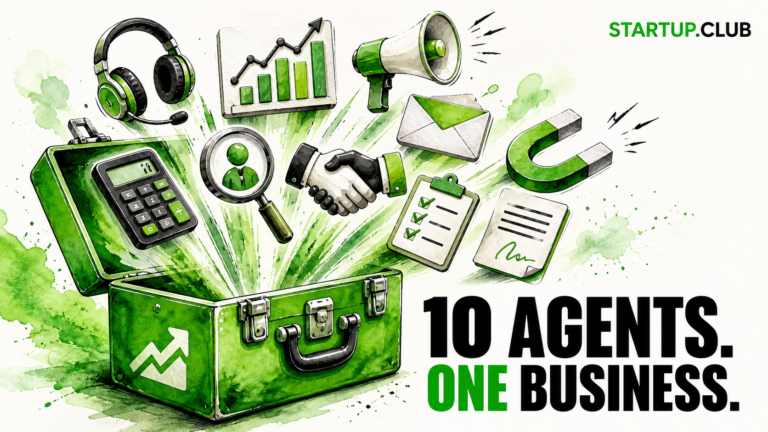
AI agents are giving entrepreneurs a new way to start and scale businesses. Unlike passive AI tools that wait for individual prompts, agents can monitor information, connect systems, and carry recurring processes forward.
In this episode of Start, Scale, Exit, Repeat, the Startup Club community shares practical examples of AI agents already being used in real businesses.
“There are no sacred cows.” — Michelle Van Tilborg
Which Processes Should You Automate?
Before creating an agent, look for work that is:
Repetitive
Prone to human error
Based on clear rules or an established process
Supported by reliable data
Performed frequently enough to justify automation
A task that takes five minutes every day can consume hours each month. That makes small, recurring processes an excellent place to begin.
10 Practical AI Agents for Entrepreneurs
The episode highlights ten valuable applications:
Customer service: Answer common questions and escalate unusual cases to a person.
Marketing analytics: Combine campaign data and identify the metrics that affect profit.
Advertising management: Monitor listings, ads, and performance across platforms.
Email management: Organize messages and flag contracts, payments, or tasks requiring attention.
Lead generation: Research prospects and prepare personalized outreach drafts.
Bookkeeping: Extract information from reports and prepare journal entries for review.
Job or talent matching: Compare opportunities with defined experience, skills, and requirements.
Investor outreach: Identify potential contacts and draft personalized messages using previous correspondence.
Weekly task reviews: Examine recent communications and produce a list of unfinished commitments.
Contract monitoring: Track agreements, renewal dates, deadlines, and required actions.
Keep a Human in the Loop
Automation should not mean surrendering control.
Agents can misunderstand instructions, overwrite information, or produce incorrect results. High-impact actions—especially those involving money, contracts, customer relationships, or external accounts—need clear limits and human review.
As Michelle Van Tilborg explains, agents may even need other agents to question their outputs and provide checks and balances.
The goal is not to automate everything. It is to automate the right processes deliberately, measure the results, and expand only after the system proves reliable.
This site uses functional cookies and external scripts to improve your experience.
Privacy settings
Privacy Settings
This site uses functional cookies and external scripts to improve your experience. Which cookies and scripts are used and how they impact your visit is specified on the left. You may change your settings at any time. Your choices will not impact your visit.
NOTE: These settings will only apply to the browser and device you are currently using.