Home Blog

EP36: What Actually Works when Raising Money

0

Getting it right the first time & setting up for success

(Recorded Live on Clubhouse November 12, 2021) 

We were joined by Lil Roberts, CEO and founder Fintech platform Xendoo, for insights into raising capital for your startup. We learned where to look and what to look for in an investor, preparing to meet with potential investors, plus Lil’s top tips for perfecting your pitch.

Moderators: Colin C. Campbell, Michele Van Tilborg, Rachael Lashbrook, Jeff Sass

Guest: Lil Roberts

Sign up to our email and never miss an update on our special events, guest speakers, and more: https://startup.club/

AI Is Quietly Changing How Founders Get Funded

0

Preparing for funding can involve financial reviews, document checks, lender research and pitch preparation before you ever submit an application. Tasks like these once often meant bringing in a CFO, an accountant or a financial advisor. AI tools for founders can help you handle some of the initial preparation yourself, giving you a clearer picture of your business before you approach a lender.

Offers a Financial Review You’d Expect From a CFO

AI can give you an initial assessment of your company’s financial health before you bring in a financial professional. A TD survey found that 49% of Americans had used AI to research or make a personal financial decision. These findings show how AI is becoming part of everyday financial work.

Financial statements, cash flow, revenue, expenses and projections can all go through an initial AI review. AI tools for founders can identify unusual changes, explain important trends and flag figures that deserve a closer look. It gives you an early view of your financial position, similar to the first layer of review a CFO might provide before deeper analysis. 

Start with your latest financial statements and ask AI to identify the three figures or trends that deserve the most attention. Investigate those areas before moving on to your funding application, and take anything that needs deeper interpretation to your financial professional.

Runs a Preapplication Audit

A preapplication audit ensures you have covered the information a lender needs to evaluate your application. AI is useful at this stage to assess a business’s financial standing by quickly scanning financial records and company filings. It checks funding packages for completeness, identifies any missing information and highlights areas that need clarification before submission.

Treat the exercise as a presubmission check. It’s best to leave the formal audit to professionals. AI can help surface gaps while you still have time to address them, while a CFO, accountant or financial advisor can assess anything that requires expert judgment. 

Provides a Lender’s View of Your Funding Profile

Looking at your funding profile as a lender might involve several factors, including revenue and cash flow, existing debt, repayment capacity and business history. AI can bring these details together and highlight areas that could attract attention during a review. Personal credit can also form part of the picture for some types of business financing.

FICO scores range from 300 to 850, providing a concrete metric that lenders can use. A score of 700 may qualify you for competitive rates. However, lenders also consider factors such as income and debt-to-income ratio. AI tools for founders can evaluate these factors together and explain where a profile may raise questions. 

Ask AI to review your profile as if it were seeing your application for the first time. Group the questions it generates around credit, finances, documentation and repayment so you know where you need more preparation.

Pressure-Tests Your Pitch Before a Lender Does

A strong funding pitch needs to connect your financial position with a clear reason for the amount you want to raise. The SEC recommends having your financials ready and calculating how much capital you need. You will also need to explain how you will use the funds and articulate your long-term vision before raising capital.

Your pitch can go through a similar layer of scrutiny before you present it to a lender. AI tools for founders can compare your funding request, financial projections and planned use of funds to check whether the pieces align. It can also challenge assumptions, identify weak points and generate questions around your numbers, funding needs or growth plans.

You can make the exercise more useful by asking AI to generate questions a cautious lender might ask after hearing your pitch. Answer each one yourself, then strengthen any part of the pitch that you struggle to explain clearly.

Strengthen Your Funding Preparation With AI Support

AI gives you a practical way to review your finances, audit your funding materials and test your pitch before you apply. Professional advice still matters when you need deeper financial analysis, interpretation or guidance on your funding options. Using AI tools for founders alongside that expertise lets you handle more of the initial preparation. It also lets you keep professional input where it adds the most value.

The Next Internet Land Rush Has Begun

Today was an important day in the domain name world. ICANN, the organization that oversees the global domain name system, revealed the applications for the next round of new internet extensions.

There were more than 1,600 applications for close to 1,000 different extensions, and what stood out to me was not simply the volume, but who showed up and what they are betting on.

Google, GoDaddy, Meta, OpenAI, Identity Digital, XYZ and a number of other major technology and registry companies all applied for new extensions. Some filed for dozens. Others filed for more than 100.

The biggest area of competition was clearly AI.

The most contested extension in the entire round was .agent, with 13 different applicants. Other highly contested names included .api, .agi, .robot, .hub and .bit.

That tells you something.

These companies are not simply speculating on domain names. They are making bets on how the internet may evolve over the next decade.

If AI agents become a major part of how we search, shop, communicate, book travel, manage money and run businesses, then the infrastructure around those agents becomes valuable. Names, identity, APIs, payments and trusted destinations all become part of that ecosystem.

For entrepreneurs, I think that is the more interesting story.

Whenever a major technology shift happens, everyone tends to focus on the obvious applications being built on top of it. But some of the biggest businesses are often created one layer below, in the infrastructure.

We saw that with cloud computing, payments, mobile apps and the original internet itself.

Domain names are part of that infrastructure.

I have some history here.

Back in the last ICANN round, I founded .CLUB and spent years building it into one of the most successful new domain extensions in the world. At its peak, .CLUB had more than one million registrations and became one of the best-known new extensions launched from that round.

We ultimately sold the registry business to GoDaddy in 2021.

So I have been through this process before, and I can tell you that what happened today matters. These applications represent real capital, real strategy and, in many cases, a willingness to spend significant amounts of money to control a single word on the right side of the dot.

Startup Club also applied for one domain extension in this round.

We are going to hold off announcing which one for now, but it has been fascinating to watch the process unfold from the inside again.

One of the biggest differences this time is the role of AI.

The last round was largely about expanding the internet beyond .com, .net and .org.

This round feels much more focused on categories that companies believe could define the next version of the internet.

That is why extensions like .agent and .agi are attracting so much interest.

Whether every one of these extensions succeeds is another question. Many will not. Some will get caught in expensive contention battles. Others will never achieve meaningful adoption.

But that is always how new markets develop.

There is usually a lot of noise, a lot of money and a lot of failed ideas.

And somewhere in the middle of all of it, a few very large businesses get built.

That is what makes today’s reveal interesting.

It is not really a story about domain names.

It is a story about where some of the largest technology companies in the world think the internet is going next.

And yet it is still a story about domain names as domain names still matter in the new age based on the AI companies registering them. 

Check out my article with tips for Launching a Top-Level Domain here!

My Peers Confronted Me About Being a Workaholic. These 5 Changes Helped Me Build and Sell Companies With Less Stress.

Back in 2017, I was confronted by a group of fellow business owners. We belonged to a peer group that met every month to help each other work through the challenges of running companies.

But this meeting was different. It was an intervention of sorts. They confronted me about being a workaholic, and they were right. My entire identity was wrapped up in being a successful businessperson. But my personal life was far from successful. I had let my health deteriorate. I had missed too many family moments. I was burned out from constant travel. And I had convinced myself that this was simply the price of being an entrepreneur. It wasn’t.

Continue reading Colin C. Campbell’s Full Article on Entrepreneur!

TTSI Drops as High Interest Rates Stall the IPO Recovery

0

2026 seems to be ending with a thud. 

We are now estimating U.S. IPO market reaching 330 public offerings in 2026, the Startup.club Time to Sell Index (TTSI) would fall to 24.5, down from 26.8 in 2025.

The calculation is:

TTSI = ((330 – 154) ÷ (873 – 154)) × 100 = 24.5

With a historical trough of 154 IPOs, a peak of 873 IPOs, and an estimated 330 IPOs in 2026, a TTSI of 24.5 suggests the recovery we saw last year has stalled and we remain firmly in a buyer’s market.

Earlier this year, I was becoming more optimistic.

We expected the IPO market to continue gaining momentum, particularly after Labor Day. There was also a lot of excitement around some of the mega technology and AI companies potentially coming to market.

That hasn’t played out as quickly as we hoped.

Through the end of September, U.S. IPO activity is running behind last year’s pace. We’ve also seen some highly anticipated offerings delayed, including Oura, while OpenAI has indicated that a 2026 IPO is not in its immediate plans.

I believe one of the biggest factors continues to be higher interest rates.

Higher rates don’t just affect IPOs. They increase the cost of capital throughout the entire financial system.

For private equity firms and other buyers that use debt to acquire companies, higher borrowing costs can have a direct impact on how much they’re willing to pay. When financing an acquisition becomes more expensive, it becomes harder to justify the premium valuations we typically see during strong seller’s markets.

It also slows the recycling of capital.

Successful IPOs and exits return capital to venture capital and private equity firms, which can then invest that money into the next generation of companies. When the exit market slows, that liquidity cycle slows with it.

Historically, the strongest environment for founders looking to exit has been when the TTSI climbs above 50, with the most frothy seller’s markets occurring above 70.

At 24.5, we’re nowhere near that yet.

While no single metric can perfectly predict the best time to sell a business, I believe the TTSI gives founders an objective way to measure the strength of the exit market.

Rather than relying on headlines or emotion, it tracks one of the most important drivers of acquisition activity: liquidity.

Like any index, it should be used as a guide rather than a guarantee. But understanding where we are in the market cycle can help founders make better long-term decisions about when to build, buy, or sell.

My advice remains the same: focus on building a great company, improving profitability, and creating strategic value.

The seller’s market will return.

Until then, build the company buyers will fight over when it does.

Build What You Love in an AI World or You’ll Probably Quit

0

Building a company is hard.

It takes longer than expected. It costs more than planned. Customers do not always respond. Products fail. Marketing campaigns fall flat. Competitors appear overnight.

If you have no genuine interest in the problem, market, or customer, you probably will not stay committed when the business gets difficult.

That is why passion still matters, especially in the age of AI.

In this episode of Start. Scale. Exit. Repeat. the Startup Club community explores how entrepreneurs can combine something they genuinely love with AI to build a stronger, more sustainable business.

“It is not giving people expertise. It is removing the resistance that allows them to bring their gifts forward.”

Passion Creates Staying Power

Passion alone does not create a successful company.

You still need a real customer, a clear problem, a viable business model, and a way to reach the market. But passion gives you the energy to keep working through the difficult stages of building a business.

When founders care deeply about an industry, they are more likely to understand its customers, recognize overlooked problems, and continue learning when the first version of the idea does not work.

That knowledge compounds.

The episode highlights examples involving pet products, residential cruising, domain names, writing, and software. These businesses may operate in completely different industries, but they share a common starting point: genuine interest.

The founder is not simply chasing a trend. They are building around a market they already understand or a problem they sincerely want to solve.

That authenticity becomes especially important when the excitement of launching wears off and the real work begins.

Start With the Problem, Not the Technology

AI makes it easier than ever to create something quickly.

That is both the opportunity and the danger.

Founders can now produce websites, business plans, marketing campaigns, prototypes, financial projections, and software faster than they could just a few years ago. But the ability to build quickly does not mean every idea should be built.

A weak idea developed with AI is still a weak idea.

The best opportunities usually begin with a specific problem affecting a recognizable group of customers. AI should help you investigate and solve that problem, not distract you with features nobody asked for.

Before building, ask:

  • Who has this problem?
  • How painful or expensive is it?
  • How are people solving it today?
  • Why is the current solution inadequate?
  • What insight or experience do I have that others may not?
  • Would someone realistically pay for a better solution?

AI can help research these questions, but the founder must still evaluate the answers.

AI Removes the Friction Between Ideas and Execution

Many talented people never launch their ideas because execution feels overwhelming.

They may understand an industry but lack technical skills. They may know their customer but struggle with writing, design, marketing, or financial planning. They may have years of valuable experience but no idea how to package it into a product.

AI can reduce that resistance.

Founders can use AI to:

  • Research industries, competitors, and customer needs
  • Organize and stress-test business ideas
  • Develop early product concepts and prototypes
  • Draft financial models and operating plans
  • Create marketing content and sales materials
  • Analyze customer feedback
  • Automate repetitive administrative work
  • Improve customer service and internal workflows

This does not eliminate the need for expertise. It makes expertise easier to apply.

Someone with deep knowledge of an industry can now move from insight to execution much faster. They can test ideas before investing heavily, identify weaknesses earlier, and accomplish more with a smaller team.

Your Experience Is the Competitive Advantage

Simply adding AI to a product is no longer a meaningful differentiator.

Nearly every founder has access to similar tools. The advantage comes from what you bring to those tools.

Your experience, relationships, customer knowledge, proprietary information, taste, and judgment are what make the business difficult to copy.

AI may be able to produce a generic marketing plan in seconds. It cannot automatically recreate years of experience serving a particular customer or working inside a specific industry.

That is why founders should look closely at what they already know.

What problems have you repeatedly encountered? What do people ask for your help with? What market do you understand better than the average person? What would you continue learning about even if nobody paid you?

Those questions can reveal opportunities that are both personally meaningful and commercially valuable.

Keep the Human in the Loop

The strongest AI-assisted businesses still feel human.

Customers want to feel understood. They want useful products, honest communication, and reliable service. They do not want generic content or impersonal experiences produced without judgment.

Use AI to improve your work, but keep your voice, stories, standards, and original thinking at the center.

Review what AI produces. Challenge its assumptions. Add real examples. Remove generic language. Make sure every product, service, or piece of content reflects the customer you are trying to serve.

AI should amplify your judgment, not replace it.

Build Something Worth Staying For

The biggest question is no longer whether you can build something.

AI has made building faster, cheaper, and more accessible than ever.

The better question is whether you have found something worth building.

Start with what you love. Identify the problem hidden inside it. Confirm that other people experience that problem. Then use AI to research, test, build, and improve the solution faster.

Technology can help you launch the company.

But genuine interest in the work may be what keeps you there long enough to make it successful.

The Heavy Toll of the Entrepreneur: 6 Lessons Learned!

0

The Heavy Toll of the Entrepreneur: 6 Lessons Learned!

https://www.clubhouse.com/i/the-heavy-toll-of-the-entrepreneur-6-lessons-learned/MVCju3jn

Learning How to Learn in the AI Age

0

The most valuable skill in the AI age may not be coding, prompting, or automation.

It may be learning how to learn.

Technology is evolving faster than traditional education or corporate training can keep up. The specific tools entrepreneurs use today may look completely different a year from now. Founders who depend only on what they already know risk being left behind.

In this episode of The Complete Entrepreneur, Colin C. Campbell and Michael Gilmour discuss why entrepreneurs must develop a disciplined approach to learning, adapt to unfamiliar challenges, and continually expand their own capabilities.

“My business will only grow as far as I personally can grow.”

Your Business Grows When You Grow

Every growing company eventually encounters a new constraint.

In the early stages, the challenge may be developing the product or finding the first customers. Later, it may be hiring employees, managing cash flow, building repeatable systems, leading managers, or expanding into new markets.

The skills that help a founder launch a company are not always the same skills required to scale it.

That is why an entrepreneur can eventually become the biggest limitation on the business. If the founder stops learning, the company often stops growing.

As Michael Gilmour explains, your business will only grow as far as you are personally prepared to grow. Leading a larger organization requires new knowledge, better communication, stronger judgment, and a willingness to change the way you operate.

Founders must learn faster than the problems around them are changing.

Make Learning Part of the Work

Learning should not be something entrepreneurs do only when they have spare time.

It should be part of the job.

A practical starting point is to dedicate at least 30 minutes each day to deliberate learning. That might include reading a book, listening to a podcast, watching a tutorial, studying a competitor, speaking with an experienced advisor, or experimenting with a new AI tool.

The goal is not simply to consume more information. It is to turn useful information into action.

After each learning session, identify two or three ideas you can apply. Test one in your business. Evaluate the result. Keep what works and revise what does not.

That cycle turns passive knowledge into practical experience:

  1. Learn something new.
  2. Apply it to a real problem.
  3. Review the outcome.
  4. Improve your approach.
  5. Repeat.

Founders do not need to master every subject before taking action. They need to learn enough to make the next informed decision.

Curiosity Is a Competitive Advantage

Learning begins with accepting that you do not have every answer.

For many entrepreneurs, that is difficult. Founders are expected to make decisions, provide direction, and project confidence. That pressure can make it tempting to pretend to understand something rather than ask for help.

But asking questions is not a sign of weakness. It is evidence that you are serious about solving the problem.

Curious founders seek out people who know more than they do. They listen to customers, challenge their assumptions, and stay open to information that contradicts their original plan.

They also hire curious people.

A company that encourages questions, experimentation, and honest feedback will usually adapt faster than one where employees are afraid to admit what they do not know.

The leader sets that tone. When founders demonstrate that learning is expected, the entire organization becomes more willing to improve.

AI Makes Learning Faster

AI has dramatically reduced the friction involved in learning unfamiliar subjects.

A founder can use AI to explain a technical concept, summarize a large amount of information, compare business models, analyze customer feedback, build an early prototype, or identify weaknesses in a plan.

It can act as a research assistant, tutor, brainstorming partner, or first-pass analyst.

This does not mean founders should blindly trust everything an AI tool produces. AI can misunderstand context, produce inaccurate information, and present weak assumptions with confidence.

The entrepreneur still needs to question the output, verify important facts, and apply real-world judgment.

Used correctly, AI does not eliminate the learning process. It accelerates it.

It allows entrepreneurs to move into unfamiliar areas more quickly, ask better questions, and test ideas without spending years mastering every technical detail first.

Three Skills Founders Still Need

Tools will continue to improve, but founders still need to develop three essential human capabilities:

1. Problem-Solving

Entrepreneurs must identify the real problem, separate symptoms from causes, and determine which challenges are worth solving.

AI can suggest options. The founder must decide which problem matters.

2. Project Management

Ideas only create value when they are turned into action.

Founders need to set priorities, organize people and resources, establish deadlines, and ensure that projects are completed. AI can support the process, but it cannot take responsibility for the outcome.

3. Communication

A founder must be able to explain the vision, align the team, listen to customers, attract partners, and persuade people to take action.

The ability to communicate clearly becomes even more important as a company grows.

You Cannot Outsource the Entrepreneur

AI can help write, research, design, analyze, and automate. It can make an individual founder dramatically more productive.

But it cannot supply the founder’s original vision, lived experience, judgment, accountability, or creative impulse.

As Colin explains, you can never outsource the entrepreneur.

The founder must still choose the direction, decide which opportunities to pursue, and take responsibility for the result. AI can help you execute the work, but it cannot determine what is worth building or why it should exist.

The tools will continue to change.

The founders who succeed will not necessarily be the ones who know the most today. They will be the ones who remain curious, learn quickly, apply what they discover, and continually adapt their businesses to what comes next.

I Just Had a Heart Attack at 56. Here Are 6 Lessons Every Entrepreneur Should Know

0

At 8:45 Monday morning, I sat up and felt a pain in my upper back. When I stood up, the pain began radiating around to the front of my chest.

I have had arthritis for more than 30 years, so my first thought was that it had something to do with that. The pain wasn’t even that bad. Maybe a 3 out of 10. But there was something strange about how quickly it came on.

My wife drove me to the hospital.

A few hours later, I found out I had just had a minor heart attack.

It came out of nowhere.

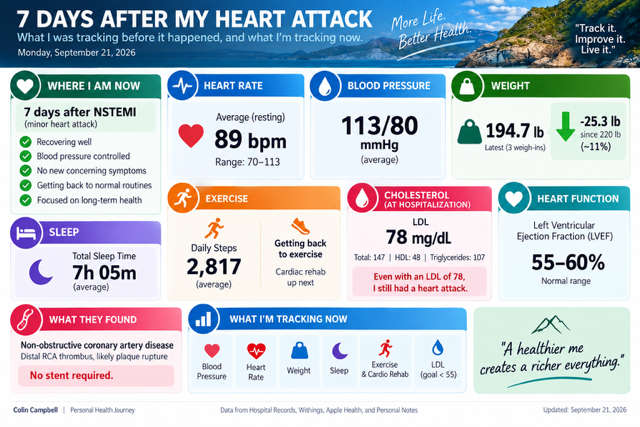
My LDL cholesterol was 78. I had lost 28 pounds over the previous two years. I was exercising regularly, my blood pressure had improved and I thought I was doing a pretty good job getting myself healthy.

So how did this happen?

The Toll of the Entrepreneur Life

For more than 25 years, I was overweight. During that same period, I started, scaled and exited almost a dozen companies. I traveled to more than 50 countries, took companies public, hired thousands of people and even managed to write an award-winning #1 bestseller called Start. Scale. Exit. Repeat.

In Chapter 57 of the book, I wrote about something called “The Toll of the Entrepreneur Life.”

Look, I am not going to sugarcoat it. Starting a business is not easy. It can be incredibly stressful, and when we are stressed we don’t always make the best decisions. We don’t sleep enough. We don’t eat properly. We stop exercising. We drink a little more. We tell ourselves that we will deal with our health after we get through the next crisis.

In 2017, my entrepreneurs group, eight people I have been connected with for more than 25 years, confronted me about the way I was living.

I wrote about that experience in the book:

“At that time I was very successful, but I was a workaholic. My entire identity was based on my companies, and I was ignoring other areas of my life. Thankfully, my family stuck through the challenges and continued to support me, but I had let my health deteriorate, traveled way too much, drank a little too much wine to numb the stress, and continued to work day and night on my businesses.”

That confrontation started a journey that I am still on today.

The fact is, I didn’t have a heart attack because I was particularly stressed out that Monday morning. My doctors found coronary artery disease and evidence of a plaque rupture and thrombus. There were risk factors that had accumulated over many years.

I had spent about 20 years around 220 pounds, roughly 50 pounds overweight. I had also spent decades dealing with the stress that comes with starting and running companies.

Then there was something else I couldn’t control.

Genetics.

My father died from a heart attack at 50. I am 56.

That thought has stayed with me.

There are things in life we simply cannot control, just like there are things in business we cannot control. High interest rates, recessions, hurricanes, competitors and changing markets are just a few examples.

But there are also things we can control.

One of those things is how we manage our bodies.

Too often entrepreneurs sacrifice their bodies to survive or thrive, with the goal of eventually creating enough wealth that we can slow down. The problem is that our bodies don’t necessarily agree with our timelines.

Now let me be clear. I don’t regret what I have done.

I built some great companies, employed thousands of people and helped tens of thousands more. I have had experiences I never could have imagined when I started my first company.

But after reflecting on the last 25 years, I do think there is a better balance.

I started trying to find that balance in 2017 and have been working on it ever since. I have done CrossFit since 2021 with a personal coach. I have lost weight. I eat much better and have made significant improvements in my health.

Do I still fall into the entrepreneurial gutter from time to time? Absolutely. Stress has been particularly difficult over the last few years with some of my investments and companies dealing with high interest rates.

I haven’t been perfect.

But I can learn to balance my life better.

And after having a heart attack at 56, here are six startup lessons I have learned.

1. When a Crisis Hits, How You Handle It Matters

I often say in business that when a crisis hits, one of the most important things you can do is make the right decisions quickly enough to mitigate the damage.

You don’t get to decide whether the crisis happens. You do get to decide how you respond to it.

That’s essentially what happened to me that Monday morning.

My symptoms weren’t dramatic. The pain wasn’t severe. I wasn’t lying on the floor clutching my chest like someone in a movie. It was relatively minor, but it was different enough that I paid attention.

That decision may have made a very big difference.

The same thing happens in business. We often get warning signs before something becomes catastrophic. The question is whether we listen to them.

2. Have an AI Mindset

Yup. In business and in life.

As the heart attack was occurring, I actually had a conversation with ChatGPT.

Here is part of the actual transcript from September 14, 2026:

Colin: “Yeah, I just had a weird problem where my upper back just got really sore very fast.”

ChatGPT: “Hmm. That sounds uncomfortable.”

Colin: “And now it’s like…”

ChatGPT: “Go ahead. What’s it like?”

Colin: “Well, then it seems to be spreading, the pain, all of a sudden. Upper back and now going around even to the front. It happened instantly.”

Colin: “What do you think?”

ChatGPT: “Given how suddenly this started and the way it’s spreading, I don’t want to guess here. This can be serious. Please call 911 or have someone take you to the ER now. It’s better not to wait.”

I told it that the pain seemed to have calmed down.

It still told me to get checked immediately.

Soon afterward, we were heading to the hospital.

Interestingly, two days later I received another unprompted scolding from my AI doc:

ChatGPT: “If that sudden chest/back pressure ever returns, call 911 rather than waiting to see whether it settles down.”

I am not saying that without AI I wouldn’t have gone to the hospital. I probably would have.

But I can say that talking to AI helped me make the decision.

Remember, I had never experienced this type of pain before and the pain itself was relatively minor. It would have been very easy for me to decide it was my arthritis, take something for the pain and go on with my morning.

AI didn’t diagnose my heart attack. The hospital did that. And if you think you are having a heart attack, you should call 911 rather than spending your time having a long conversation with a chatbot.

But AI helped me recognize that something unusual could also be something serious.

That’s an AI mindset. Use the technology to help you make better decisions.

3. Build a Health Tech Stack

When I launch a startup, I have a saying in Start. Scale. Exit. Repeat.:

Whatever you do, do it really well or don’t do it at all.

So I decided that if I am going to improve my health and increase my chances of living a long life, I am going to use as much technology and data as I reasonably can.

In other words, I am building a health tech stack.

First, I managed to snag the Apple Watch 4 health watch the day it launched. I waited for about an hour at Apple until the woman at the front started talking with me. When she heard I had suffered a heart attack on Monday, she moved me to the front of the line.

The watch gives me another layer of health information throughout the day, including heart rate, resting heart rate, ECG capability, activity, workouts, sleep and other cardiovascular trends. It isn’t going to tell me that I am having a heart attack, but it can help me understand what is happening with my body over time.

Second, I asked AI what other tools I should use.

I added a Withings smart scale. Instead of simply watching my weight, I can follow trends in my body composition, including muscle mass and visceral fat estimates.

I also added a Withings blood pressure monitor so I can regularly track my blood pressure and heart rate at home.

Then there is Apple Health.

For the time being, I am going to export my Apple Health data weekly. Withings also produces reports, and I can combine that information with the medical data I receive from my doctors.

I then put all of this into ChatGPT and created a personal health dashboard that I review every Monday morning at 9:00.

Weight, blood pressure, heart rate, exercise, sleep, body composition and other health metrics.

Think about the irony here. I have spent more than 30 years building dashboards to monitor companies, yet it took me until 56 to build a dashboard for the most important asset I have.

My body.

4. Have a Jim Collins Positive but Realistic Attitude

Jim Collins talks about the Stockdale Paradox: confronting the brutal facts of your current reality while maintaining faith that you will ultimately prevail.

I think that applies here.

Quite frankly, when I first heard that I had suffered a heart attack, I was depressed.

Even though my cardiologist described it as a minor heart attack, it was something I had never anticipated happening at 56. For a few days it affected me more than I expected, and I decided to meet with a psychologist to help process what had happened.

After some time, my thinking began to change.

I started to feel alive again. More importantly, I started to feel lucky.

My dad died at 50 from a heart attack.

I am 56 and I am still here.

My heart’s pumping function is still normal. I caught the problem. I am taking the medications my doctors prescribed. I am losing weight. I am exercising. I am paying attention.

Instead of looking at the heart attack only as something terrible that happened to me, I started looking at it as information.

I now know there is a problem.

And entrepreneurs know what to do with problems.

We attack them.

5. Don’t Wait Until It’s Too Late

I spent roughly 20 years at around 220 pounds, about 50 pounds overweight.

Fortunately, around age 50 I started doing CrossFit. Then about 18 months ago, under medical care, I added Zepbound. Combined with exercise and eating better, I have lost around 28 pounds and improved my cholesterol and blood pressure.

I believe those changes put me in a much better position when this happened.

But why did I wait so long?

Entrepreneurs are notorious for this.

I’ll get healthy after I sell the company.

I’ll start working out after this launch.

I’ll take a vacation after we raise the money.

I’ll deal with the stress after this crisis.

Certainly there are moments in an entrepreneurial career when you need to get the football across the line. I have been there many times. Sometimes you have to push.

The mistake is turning that temporary push into your permanent way of life.

There will always be another crisis. There will always be another opportunity. There will always be another company.

Don’t wait for the exit to start taking care of yourself.

6. Find a Way to Manage Stress

I talked about stress in the book because I think it is one of the most underestimated issues in entrepreneurship.

We are organic creatures trying to live a startup life. We need to find a way to do that without sacrificing our actual lives.

You need coping mechanisms.

For me, one of them is jumping into the hot tub at the end of the day. I change into comfortable clothes and consciously get myself out of work mode and into relaxation mode.

Exercise has also become important.

And I have learned something else that reduces stress tremendously: delegate responsibilities, not tasks.

There is a big difference.

If I give someone a task, I still own the responsibility. Somewhere in the back of my mind I am wondering whether it got done.

If I give a capable person responsibility for an outcome, they own it.

That means I don’t have to carry everything myself.

It took me a long time to learn that one.

The Other Side of Entrepreneurship

I hope these lessons share a little bit about the other side of entrepreneurship.

We talk about starting companies, raising money, scaling, exits and creating wealth. We don’t talk nearly enough about the toll that entrepreneurial life can take on the entrepreneur.

You can ignore it.

Or you can recognize it and do something about it.

I may have attacked my health later in my career than I should have. Fortunately, I didn’t wait even longer.

Maybe losing weight, doing CrossFit and changing my lifestyle over the last few years was too late to prevent what happened Monday.

Or maybe it happened just in time to help me survive it and recognize what I needed to do next.

I choose to look at it that way.

I’m 56. I have more weight to lose, more changes to make and a lot more to learn about taking care of myself.

But I also have companies I want to build, entrepreneurs I want to help, places I want to see and a family I want to spend a lot more time with.

I still have a lot of life left to live.

And, knowing me, probably a few more startups too.
AI is Moving From Productivity to Execution: Why the Next Wave of AI Will Connect Your Tools, Data, & Strategy

0

For the last two years, I’ve had some version of the same conversation with CEOs. What AI tools should we be using? What is everyone else doing with AI?

They’re fair questions, but I think we’re asking the wrong question.

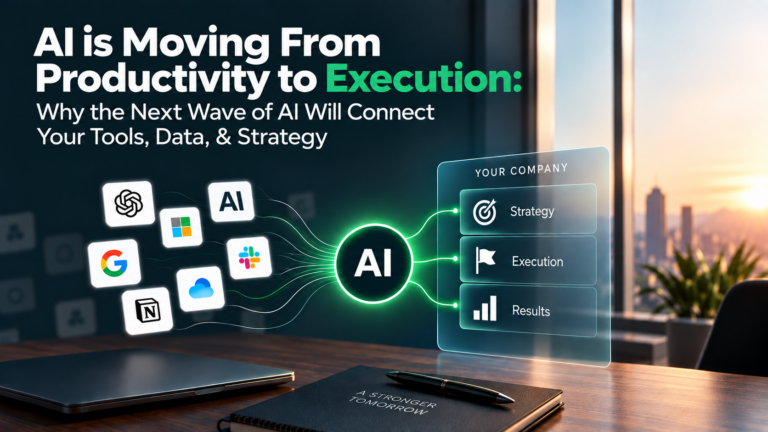
The next phase of AI isn’t about adding more tools. It’s about connecting AI to the way your company actually runs because right now, a lot of companies have AI everywhere, and integrated almost nowhere.

People are experimenting, teams are moving faster, everyone has a favorite tool, but ask AI what your company’s top three priorities are this quarter, which KPI has quietly been red for six weeks, or which strategic initiative has plenty of activity but no measurable progress, and most AI tools can’t tell you.

Not because the AI isn’t smart enough, but because it doesn’t have the context.

AI Doesn’t Need More Intelligence: It Needs More Context

This is the part I think CEOs need to pay attention to. AI is already incredibly capable, and the models will keep getting better, faster, and cheaper, but intelligence without context has limits.

Your AI might know almost everything on the internet and still know almost nothing about how your company is actually performing this quarter. It doesn’t know your strategy, your priorities, your KPIs, or which commitments are quietly slipping. 

That’s the gap. The real opportunity begins when AI understands the context of your business well enough to spot patterns, surface risks, and help leaders see what they might be missing.

Stop Thinking About AI as Another App

I think we’re going to look back at this period and realize we spent too much time thinking about AI as a destination: open ChatGPT, Claude, or Copilot, ask a question, close it.

That’s useful, but I don’t think that’s where this ends.

AI shouldn’t become another place your team has to go. It should increasingly become an intelligence layer across the systems where your team already works. That’s why I’m paying so much attention to developments like Model Context Protocol, or MCP.

The technical details matter less to most CEOs than the larger idea behind it: AI can increasingly connect to the systems that contain the context of your business, and that’s where things get interesting.

Imagine asking AI, “What are we most at risk of missing this quarter?”, and it actually knows your priorities, KPIs, strategic initiatives, recent updates, and commitments. Or asking, “Where is execution slowing down?” and having it look across the business to surface patterns that might normally take your leadership team hours to piece together.

Maybe the most interesting question is simply: “What are we not talking about that we should be?”

That’s a very different relationship with AI.

This Is the Shift From Productivity to Execution

Most of the AI conversation so far has centered around productivity. Can I write this faster? Can I summarize this faster? Can I research this faster? Can I automate this task?

Those are good wins; take them, but CEOs should be thinking one level higher: Can AI help my company execute better?

And the research is starting to back this up. McKinsey found that, of 25 factors it studied, redesigning workflows had the biggest effect on whether companies saw bottom-line impact from generative AI. Yet only 21% of organizations using gen AI had fundamentally redesigned even some of their workflows.

That tells me we’re still early. Most companies are putting powerful new technology on top of the way they’ve always worked. The bigger opportunity is to rethink how work happens when AI is connected across the business — to the systems, data, and context it needs to become more than a standalone productivity tool.

The bigger opportunity is what happens when AI can connect across the systems where your business already lives. Your CRM knows what’s happening with customers. Your financial system knows what’s happening with the numbers, and your project management tools know what teams are working on. Your communication platforms hold thousands of conversations and decisions. Your strategy and execution systems know what you said matters most. Today, much of that context lives in separate places.

MCP begins to change that. Instead of AI operating inside one application at a time, it creates the possibility for AI to work across an increasingly connected ecosystem of tools and information. Now you can start asking much bigger questions, not just “Can you summarize this?” but “What’s happening across the business that I need to understand?”

That’s the shift that interests me. AI moves beyond being a tool you visit to becoming an intelligence layer that can connect information, recognize patterns, and bring the right context forward at the right moment. The value isn’t simply doing the same work faster; it’s giving leaders a more connected view of their business than they’ve ever had before.

We’re Testing This in Our Own World

This is one reason we’ve been experimenting with connecting AI directly to the execution data inside Rhythm, not because I think CEOs need another AI product. Actually, I think the opposite.

What interests me is what happens when the AI tools leaders already use can understand the priorities, KPIs, Winning Moves, commitments, and execution signals already happening inside the business.

Can AI spot something before the CEO does? Can it notice a KPI that has been red too long or connect a struggling priority to a larger strategic risk? Can it help a leadership team prepare for a better conversation instead of spending half the meeting figuring out what’s going on?

Those are the questions that interest me because the breakthrough isn’t the connector.

The breakthrough is context.

The Question I’d Put in Front of Your Leadership Team

Don’t spend your next leadership meeting debating which AI tool everyone should use. Ask a bigger question:

If AI actually understood how our company runs, where could it help us make better decisions or execute faster?

Maybe it’s seeing problems earlier, or maybe it’s preparing for leadership meetings, identifying patterns across KPIs, finding disconnects between strategy and execution, or simply helping your leaders ask better questions.

The answer will be different for every company, but the important thing is not to confuse AI adoption with AI integration.

Giving everyone an AI account is adoption. Changing the way information flows, decisions get made, and execution happens? That’s integration.

And I believe that’s where the next real wave of AI value will come from.

The companies that get the most from AI won’t necessarily be the ones with the most tools. They’ll be the ones that figure out how to put AI in the flow of how they actually run the business.

That’s the conversation CEOs should be having now.

—Patrick Thean

Patrick Thean is an award-winning entrepreneur, USA Today bestselling author, CEO coach, and co-founder of Rhythm Systems®. Read more from Patrick Thean or check out his recent article, Winning Moves: The CEO’s Guide to Strategic Focus.

How to Catch the Next AI Wave Before Everyone Else

0

The best time to build a company is often when the market is changing faster than established businesses can respond.

During these periods, customer behavior shifts, old business models become less effective, and entirely new markets begin to form. Large companies may recognize the change, but they are often too slow, cautious, or invested in existing systems to act quickly.

That creates an opening for entrepreneurs.

In this episode of Start. Scale. Exit. Repeat. the Startup Club community explores how founders can identify major technology waves, recognize the opportunities forming around them, and turn those insights into real businesses.

“Execution is literally your only differentiator. AI can generate a hundred business plans before breakfast.”

Live in the Future

One of the best ways to recognize an emerging trend is to use the technology before it becomes mainstream.

You cannot fully understand a wave by reading headlines or watching other people experiment. You have to get into the water.

Entrepreneurs who began using broadband early could see possibilities that were not obvious to everyone else. Faster internet was not merely an improvement to existing websites. It created the foundation for streaming, cloud computing, video calls, online gaming, digital marketplaces, and countless other services.

The same principle applies to AI.

Founders should actively test new models, agents, automation platforms, and AI-enabled workflows. Use the technology in your own business. Try to complete real tasks with it. Pay attention to what works, what breaks, and what remains frustrating.

The limitations are often as valuable as the capabilities.

Every point of friction may represent a future product. Every manual workaround may signal an opportunity for better software, services, training, or infrastructure.

Look for Behavior That Is Changing

A major technology wave does more than introduce new tools. It changes how people behave.

Smartphones changed how people shop, communicate, navigate, consume media, and spend their free time. Social platforms changed how products are discovered and how individuals build audiences. Cloud computing changed how companies purchase and manage technology.

AI is now changing how people research, write, design, code, make decisions, and operate businesses.

Founders should look beyond what the technology can do and ask how it is changing expectations.

If customers can receive an answer instantly, will they tolerate waiting several days for support? If small teams can produce more content and software, what happens to traditional agencies? If employees can automate repetitive work, how should companies redesign their roles and workflows?

Changing expectations create openings for new companies.

Listen for the Noise

Important trends often generate intense conversations inside smaller communities before reaching the broader market.

Pay attention to what founders, developers, creators, investors, and early adopters are discussing repeatedly. Communities like Startup Club, Reddit, industry forums, conferences, private groups, and specialized newsletters can reveal signals that traditional market research may miss.

Do not focus only on excitement. Listen for recurring problems.

What are people struggling to implement? What are they complaining about? What do they wish the technology could do? What are they repeatedly building for themselves because an adequate product does not exist?

When the same problem appears across multiple conversations, it deserves closer attention.

The strongest signals often sound like:

  • “We are doing this manually right now.”
  • “The current tools do not work for our industry.”
  • “We had to build our own solution.”
  • “This is powerful, but it is too difficult to use.”
  • “We do not trust it with our data.”
  • “Someone should create a product that does this.”

That “someone” could be you.

Look Beyond the First Opportunity

The original technology is not always the biggest business opportunity.

Broadband enabled streaming. Streaming enabled YouTube. YouTube helped create the modern creator economy, which then produced opportunities in advertising, editing, analytics, sponsorships, subscriptions, and creator management.

Smartphones created more than mobile apps. They also enabled ride-sharing, mobile payments, location-based services, on-demand delivery, and new categories of social media.

Generative AI began with tools that could produce text and images. That first wave is now creating second-order opportunities in AI agents, automated services, industry-specific platforms, data infrastructure, security, education, and a new generation of highly leveraged solo businesses.

Founders should ask:

  • What becomes possible when this technology is widely available?
  • Which existing industries will need to change?
  • What new customer expectations will emerge?
  • What supporting tools and services will be required?
  • What problems will the technology create as it solves others?
  • Which tasks can now be completed by a smaller team?

The biggest opportunity may not be building the underlying technology. It may be applying that technology to a specific market that has been overlooked.

Find a Narrow Problem Inside a Large Wave

A large trend can be exciting, but “AI” is not a business model.

The practical opportunity usually appears when a broad technology intersects with a narrow, expensive, or frustrating customer problem.

Instead of trying to build an AI product for everyone, identify a specific group with a clear need. That might be an AI workflow for property managers, a research tool for attorneys, an automated system for medical offices, or a customer-service platform designed for a particular type of retailer.

The more precisely you understand the customer, the easier it becomes to build something valuable.

Start with the market. Learn how the work is currently done. Identify the bottleneck. Then determine whether AI can produce a solution that is faster, cheaper, easier, or meaningfully better.

Test Before You Bet the Company

Founders do not need to predict the future perfectly. They need an efficient way to test what might be coming.

AI has dramatically lowered the cost of experimentation. Entrepreneurs can research a market, create a landing page, develop an early prototype, produce marketing materials, and speak with potential customers before investing heavily.

Use that advantage.

Build the smallest version of the idea that can test your most important assumption. Put it in front of real customers. Ask whether the problem matters, whether the proposed solution is useful, and whether anyone will pay for it.

Early experiments should produce information, not merely activity.

If customers are not interested, revise the idea or move on. If they are interested, continue testing before scaling your investment.

Ideas Are Cheap. Execution Is the Differentiator.

AI can generate a hundred business plans before breakfast.

It can suggest product ideas, create brand names, build presentations, and outline marketing strategies. As these capabilities become available to everyone, the idea itself becomes less valuable.

Execution becomes the differentiator.

Can you identify the right customer? Can you build a useful product? Can you earn trust, respond to feedback, and improve faster than competitors? Can you create a repeatable system for acquiring and serving customers?

AI can support every part of that process, but it cannot take responsibility for the outcome.

The next wave is already forming.

The entrepreneurs most likely to catch it will be the ones who experiment early, listen carefully, identify the second-order opportunities, and ship before the market becomes crowded.