

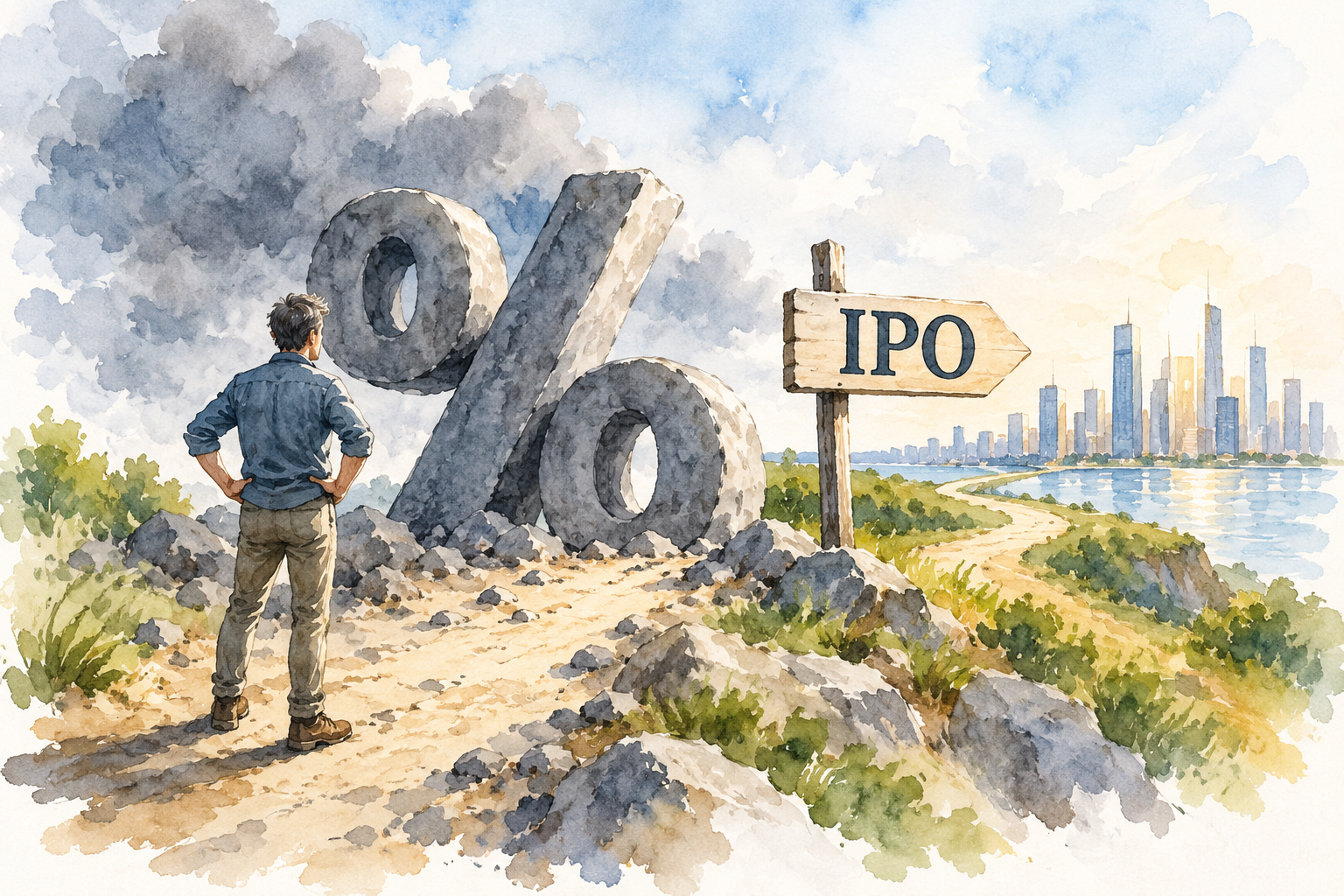

2026 seems to be ending with a thud.
We are now estimating U.S. IPO market reaching 330 public offerings in 2026, the Startup.club Time to Sell Index (TTSI) would fall to 24.5, down from 26.8 in 2025.
The calculation is:
TTSI = ((330 – 154) ÷ (873 – 154)) × 100 = 24.5
With a historical trough of 154 IPOs, a peak of 873 IPOs, and an estimated 330 IPOs in 2026, a TTSI of 24.5 suggests the recovery we saw last year has stalled and we remain firmly in a buyer’s market.
Earlier this year, I was becoming more optimistic.
We expected the IPO market to continue gaining momentum, particularly after Labor Day. There was also a lot of excitement around some of the mega technology and AI companies potentially coming to market.
That hasn’t played out as quickly as we hoped.
Through the end of September, U.S. IPO activity is running behind last year’s pace. We’ve also seen some highly anticipated offerings delayed, including Oura, while OpenAI has indicated that a 2026 IPO is not in its immediate plans.
I believe one of the biggest factors continues to be higher interest rates.
Higher rates don’t just affect IPOs. They increase the cost of capital throughout the entire financial system.
For private equity firms and other buyers that use debt to acquire companies, higher borrowing costs can have a direct impact on how much they’re willing to pay. When financing an acquisition becomes more expensive, it becomes harder to justify the premium valuations we typically see during strong seller’s markets.
It also slows the recycling of capital.
Successful IPOs and exits return capital to venture capital and private equity firms, which can then invest that money into the next generation of companies. When the exit market slows, that liquidity cycle slows with it.
Historically, the strongest environment for founders looking to exit has been when the TTSI climbs above 50, with the most frothy seller’s markets occurring above 70.
At 24.5, we’re nowhere near that yet.
While no single metric can perfectly predict the best time to sell a business, I believe the TTSI gives founders an objective way to measure the strength of the exit market.
Rather than relying on headlines or emotion, it tracks one of the most important drivers of acquisition activity: liquidity.
Like any index, it should be used as a guide rather than a guarantee. But understanding where we are in the market cycle can help founders make better long-term decisions about when to build, buy, or sell.
My advice remains the same: focus on building a great company, improving profitability, and creating strategic value.
The seller’s market will return.
Until then, build the company buyers will fight over when it does.