
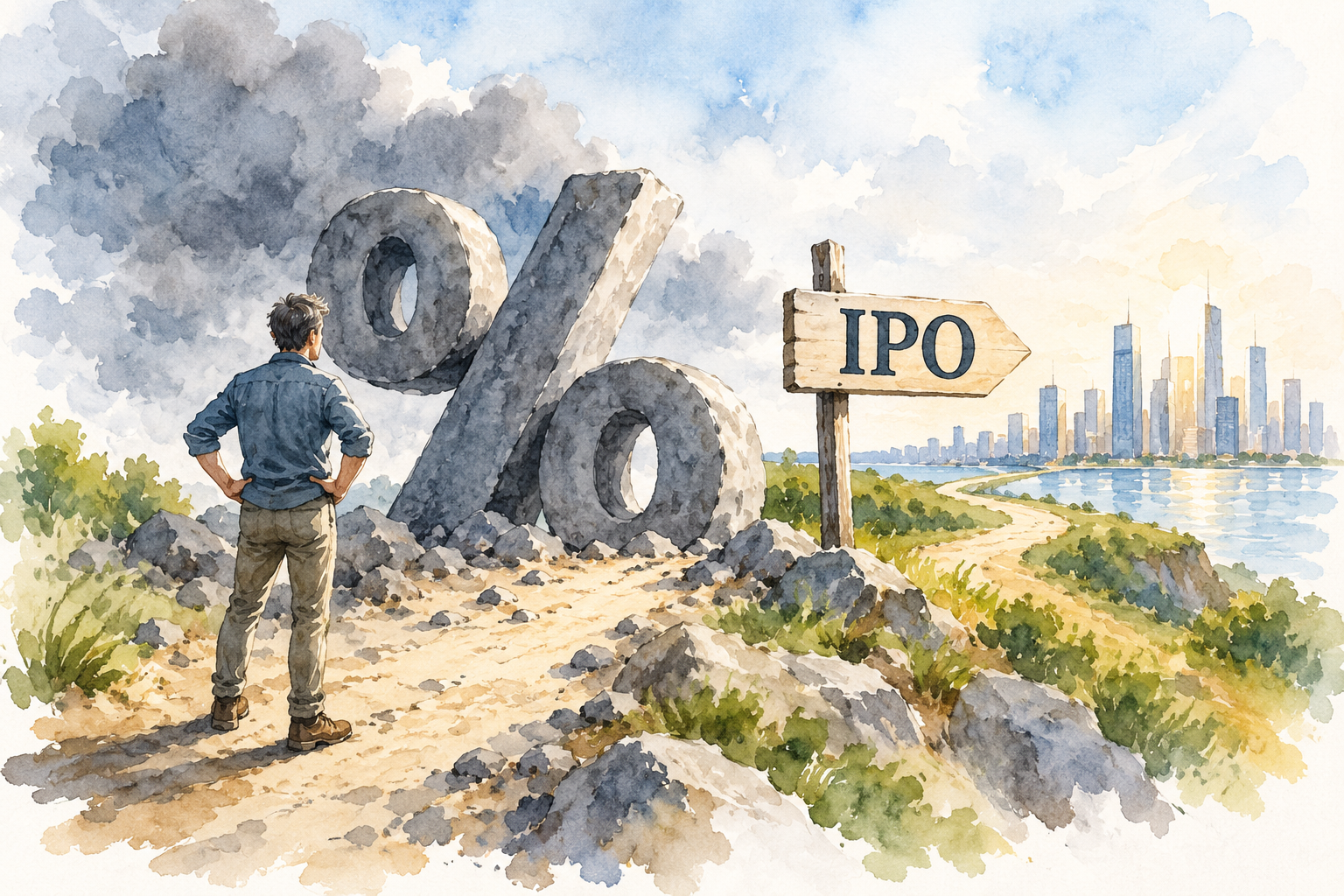

Higher interest rates and the enormous capital demands of AI companies may be putting the brakes on the IPO recovery.
At the beginning of 2026, I was optimistic about the IPO market. After several difficult years, it looked like we were finally heading toward a stronger market for entrepreneurs looking to exit their businesses.
I thought we might see as many as 385 IPOs this year. Unfortunately, that doesn’t look likely anymore.
As of November 3, approximately 264 U.S. IPOs have been completed, compared with 300 during the same period last year. That’s a decline of about 12%.
We’ve now lowered our 2026 forecast to 310 IPOs, which puts the Startup Club Time to Sell Index (TTSI) at 21.7, down from 26.8 in 2025.
For those unfamiliar with the index, we developed the TTSI at Startup Club to help entrepreneurs understand the broader market for selling businesses. We use IPO activity as an indicator of market liquidity, comparing the current market against historical highs and lows.
Our calculation for 2026 is:
TTSI = ((310 – 154) / (873 – 154)) x 100 = 21.7
When the index rises above 50, we generally consider the market to be more balanced. Above 70, we’re entering a particularly strong seller’s market.
At 21.7, we’re still very much in a buyer’s market.
What’s Holding Back the IPO Market?
I believe higher interest rates are a big part of the problem.
When money is expensive, it becomes harder for private equity firms to finance acquisitions. Buyers can’t justify paying the same multiples when their borrowing costs are significantly higher.
And when companies aren’t going public or being acquired, venture capital and private equity firms aren’t returning as much capital to their investors. That money isn’t being recycled into new deals as quickly.
We had expected IPO activity to pick up after Labor Day, but the recovery hasn’t been nearly as strong as anticipated.
There’s also another factor I’ve been thinking about.
Is AI Crowding Out the Rest of the Market?
We all know the extraordinary amounts of money being invested in AI. Companies like OpenAI and Anthropic are raising billions, and the capital required to build data centers and AI infrastructure is staggering.
But I wonder if there’s an unintended consequence.
Could the enormous capital requirements of a relatively small number of AI companies be crowding out more traditional businesses looking to go public?
Think about it. Institutional investors have only so much capital to allocate. If they’re committing billions to AI, does that leave less money available for traditional technology companies, consumer businesses, industrial companies, and other businesses that private equity firms would like to take public?
Private equity firms have spent years building portfolios of companies with the expectation that they could eventually exit through an IPO or acquisition.
But if investors are concentrating more of their capital on AI, those exits could become harder to achieve at attractive valuations.
I’m not saying AI is responsible for the slowdown. There are clearly other factors at work, particularly interest rates.
But I do wonder whether the AI investment boom is having a negative impact on the broader IPO market.
It’s an interesting possibility. The same technology that’s creating enormous wealth and opportunity for a handful of companies could be making it more difficult for other businesses to raise capital or achieve successful exits.
What Does This Mean for Entrepreneurs?
I’ve learned over the years that timing can have an enormous impact on the value of a business.
During the dot-com boom, I spent nearly a decade building a company that reached a valuation of more than $180 million. Then the market collapsed.
The company hadn’t suddenly become a bad business. What changed was the market and what investors were willing to pay.
That experience had a significant influence on my book, Start. Scale. Exit. Repeat.
I believe the timing of an exit can account for more than half the value of a business.
That’s one of the reasons we created the TTSI. It’s not a perfect indicator, but it gives entrepreneurs another tool to help understand where we are in the market cycle.
At 21.7, we’re a long way from a strong seller’s market.
That doesn’t mean you can’t sell a business today. There are always buyers for good companies. But valuations may be more challenging, and buyers are likely to be more selective.
Looking Ahead to 2027
I still believe the market will recover. There is a tremendous amount of capital sitting in private equity funds, and those firms eventually need to exit their investments.
Lower interest rates would certainly help. So would a broader recovery in IPO activity beyond the handful of AI companies attracting most of the attention.
But for now, it looks like 2026 will end with a whimper rather than the strong recovery I had hoped for.
My advice to entrepreneurs is to keep building. Focus on profitability, strengthen your balance sheet, and position your company for an eventual exit.
The market will turn. The question is whether your company will be ready when it does.