
The Ultimate Scale Workbook Official Launch
https://www.clubhouse.com/invite/nQgUZd87nW7Eg0Zw9NGYA669K9EgFy0GVrr:I0xzQ3z-QU8fXP_OEfKBpZqgRI1jnJR-hrr9ZvrBZCA
The Ultimate Scale Workbook Official Launch
https://www.clubhouse.com/invite/nQgUZd87nW7Eg0Zw9NGYA669K9EgFy0GVrr:I0xzQ3z-QU8fXP_OEfKBpZqgRI1jnJR-hrr9ZvrBZCA
The Ultimate Scale Workbook Official Launch
https://www.clubhouse.com/invite/nQgUZd87nW7Eg0Zw9NGYA669K9EgFy0GVrr:I0xzQ3z-QU8fXP_OEfKBpZqgRI1jnJR-hrr9ZvrBZCA
The Scale Mindset – Complete Entrepreneur
https://www.clubhouse.com/invite/JJ7H6vJEYGg0J4qXybjK6krYWQboTarLZAA:ePf4U6YXmLcBvVp-4reTkB5r7TYT0G8KlJq1sVz6mfg

Launching a Kickstarter in Real Time: Lessons, Mistakes, and Strategies from a Live Campaign
(Recorded Live on Clubhouse March 6, 2026)
Launching a successful Kickstarter campaign is not luck. It is preparation, positioning, and execution.
I recently sat down with Michele Van Tilborg, CEO of Paw.com, a company in our incubator whose team launched the AirX Foam™ Outdoor & Cooling Dog Bed after three years of development.
The campaign was not rushed. It was engineered.
What surprised me most was the level of attention to detail and the sheer amount of effort and investment behind the launch. Nothing in the startup world happens by accident. It takes focus and effort.
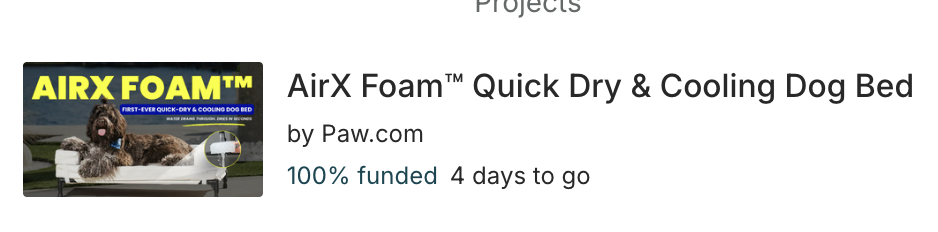
Here are the 10 lessons she shared:
1. Create Something Truly Unique. Invent It.
Crowdfunding is not the place to launch a copycat product.
Paw.com did not tweak an existing dog bed. They reinvented it. The team created the first outdoor dog bed designed to drain instantly and dry in minutes using proprietary AirX Foam™ technology.
“We spent three years designing an outdoor dog bed that dries instantly,” Michele says. “We aren’t fighting the rain or mother nature. We embrace it.”
If your product does not clearly solve a real problem in a different way, the crowd will not fund it.
A great Kickstarter video isn’t about flashy production – it’s about clarity, authenticity, and momentum. Viewers should understand the problem and the product within seconds. The most successful campaigns come from real collaboration between the founders and the production team, where everyone is aligned on the story and the audience. When that happens, the video doesn’t just explain the product – it invites people to become part of the story.
Ian LaQua, Head of Production at Braveman Media
2. Invest in the Video
Kickstarter is visual. Your video is your pitch.
Paw.com hired a professional production company. The day after filming, Michele sent this note to the team:
“Just wanted to say a huge thank you from our whole crew. The shoot was amazing, and we had an absolute blast working with you all. You’re great to collaborate with, and the energy on set made the day fly by. We’re really excited to get into the edit and start shaping the video.”
The video became the emotional anchor of the campaign.
If budget is tight, negotiate. You can sometimes lower upfront costs in exchange for a small percentage of sales. But do not compromise on video quality. It directly impacts conversion.
3. Tell a Real Story
Authenticity converts.
In the Kickstarter video, Michele shares Paw.com’s three year journey, including failed attempts at outdoor dog beds. That honesty builds credibility.
Failure signals experience. It shows you know what does not work.
Backers fund people and stories, not just products.
The Power of the story.
4. Build a Professional Page That Sells
A Kickstarter page is a sales page.
Paw.com structured its campaign with clear benefit statements, visual proof of performance, and short GIFs showing water draining instantly. Every section answered one question: why should someone back this?
Design matters. Clarity matters more.
5. Pre Promote Before You Launch
Momentum starts before launch day.
Paw.com emailed its audience in advance and opened the preview page so people could follow it before it went live. When launch day arrived, they were not starting from zero.
The goal is velocity on day one.
6. Understand the Momentum Curve
Kickstarter runs on psychology and visibility.
Days 1 to 3 are critical. This is when you convert your warm audience and try to reach at least 30 percent of your funding goal. Early traction increases visibility on the platform.
Days 4 to 25 are often quieter. This is when you must push updates, announce stretch goals, pursue press, and continue outreach. Do not disappear.
The final 48 to 72 hours bring urgency back. Countdown messaging and limited tiers can drive a second wave of pledges.
If you understand the rhythm, you can manage it.
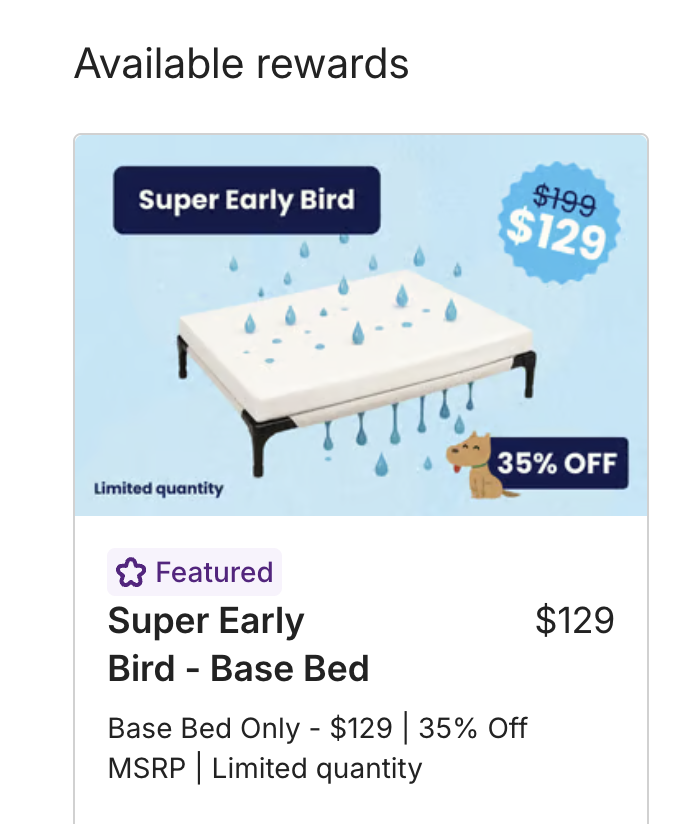
7. Use Early Bird Pricing Strategically
Pricing is leverage.
Paw.com offered a limited Super Early Bird tier, then increased pricing in stages. The first tier sold out quickly, which created urgency and social proof.
Scarcity creates momentum.
8. Be Ready to Ship and Be Honest About Delivery
Manufacture before you launch if possible.
Paw.com had its first 500 units produced before launch to test quality and ensure readiness. After those sold out, later backers were given longer delivery timelines.
Transparency builds trust. Add buffer to your shipping estimates. It is better to deliver early than to explain delays.
9. Protect Your Idea
Kickstarter is public. Competitors watch closely.
Trademark your brand elements. File patents where appropriate. In the United States, you typically have up to one year from public launch to file a patent application.
If you invent something meaningful, protect it. The Paw.com team have done just that to stop others from taking down their products. In fact, the company actually objected to a competitor that launched another Paw.com product that was very similar to a patented product in Costco and after contacting them about the violation, they never restocked.
The company has also been effective at taking down competitors on Amazon. Work with Amazon if you have a trademark violation.
10. Turn Kickstarter Momentum Into a Multi-Channel Launch
Kickstarter is proof. It is not the business.
When a campaign gains traction, funding is not the finish line. It is validation. Validation unlocks distribution.
Once your campaign succeeds, you now have three powerful assets: demand validation, real customers, and social proof. Use them immediately.
Start with your own brand site. This is where you control margins, own the customer relationship, and build long-term brand equity. Convert Kickstarter backers into repeat buyers.
Then expand strategically. Marketplaces like Amazon give you search demand and scale. TikTok and social commerce platforms give you discovery and viral reach. Each channel plays a different role. Do not rely on just one.
Some of today’s most recognizable brands followed this path:
Pebble used Kickstarter to validate demand before becoming one of the most funded campaigns in history.
Oculus launched on Kickstarter before being acquired by Facebook for billions.
Allbirds leveraged early crowdfunding validation before scaling into a global footwear brand.
Away used early momentum and direct-to-consumer distribution to build a dominant luggage brand.
Peloton began with crowdfunding support before growing into a multi-billion-dollar fitness company.
In each case, crowdfunding was the spark, not the ceiling.
Leverage your Kickstarter credibility in paid media. “Fully Funded” badges, real backer testimonials, milestone screenshots, and user-generated content lower friction and increase conversion rates.
If the product is strong and the margins are healthy, paid acquisition becomes fuel. You do not need perfect ads. You need math that works.
Many founders obsess over hitting a 3x ROAS as if it is a universal rule. It is not. What matters is contribution margin and lifetime value. If your unit economics support it, you can scale profitably even below a 3x ROAS. The key is knowing your numbers cold before you increase spend.
Build retargeting audiences from campaign traffic. Create lookalike audiences from early buyers. Feed purchase data back into ad platforms. Algorithms reward products that convert consistently.
Once the numbers work, scale aggressively.
In my award winning book Start. Scale. Exit. Repeat. I talk about “Scaling in Zeros”. If you sell 100, now go for 1,000 then 10,000 then 100,000, you get the picture.
A validated product with disciplined paid acquisition, and strong word of mouth can grow far beyond crowdfunding.
Kickstarter is the spark. The real company is built in what happens next.
Both Michele and I had the opportunity to host a show on Startup.club about this very topic. Unlike a typical theoretical discussion, this episode was recorded during the actual product launch. Listen to the full conversation above, or get it as a podcast on all platforms.
What Private Equity isn’t Telling You – Serial Entrepreneur
https://www.clubhouse.com/invite/8dku4RgkbQYJZoNGjXJEwGd4Z3O8slVNg77:9RC_313OtWKHYMdhGrcfT0fT46vWKzA4ZvuM9H16PjM
Steve Simonson of Catalyst88 – Serial Entrepreneur
Room Link:
https://www.clubhouse.com/invite/gg1S6QQpaRrkJGeLzJ1alB9a008GHnpLXYY:PBVjmIbKFlzg6_l5NjQwfe-iYH2vLZbrPblU2q3M26M
The Ultimate Scale Plan – Launching the Scale Workbook!
https://www.clubhouse.com/invite/ED7IVpRpw6R1nE2vw8dYOKYO7A3rcAD2533:ROABN6cM3fQ8pCEcXSAzvoI1P1kP5Wv01jAHRMq9DfM

Ever thought about living at sea, working remotely while traveling the world, or building a company without being tied to a single city? Avora Residence, owned by Residential Cruise Holdings, is moving residential cruising one step closer to the mainstream.
The company recently announced the acquisition of Regent Seven Seas Navigator, a luxury cruise ship that will be converted into a floating residential community. The planned launch is January 2028. This is not Residential Cruise Holdings’ first attempt at residential cruising. The owners already operate Villa Vie Odyssey, giving it operational experience in this emerging category of long-term living at sea. “Residential cruising has proven its viability,” said Mikael Petterson, Founder of Avora Residences. “Avora Lumina represents the next evolution — purpose-built for long-duration global living, expedition capability, and a more refined residential experience.“

The Growing Market for Residential Cruising
Cruising continues to grow as a global lifestyle option. In 2025, the cruise industry reached approximately 37.7 million passengers worldwide. Each year, an estimated 30,000 to 40,000 people take world cruises, often lasting several months.
Luxury world cruises typically cost between $75,000 and $100,000, while ultra luxury cruises can reach $200,000 to $300,000 per voyage. Regent Seven Seas Navigator falls squarely into the ultra-luxury category. A recent review of pricing showed that the a 500 square foot suite on Regent’s Navigator for a 14 day cruise from Barcelona to London on July 5th, 2026 was $46598, or $3328 per night excluding fares.

Residential cruising offers a different model. Instead of paying repeatedly for short-term access, residents purchase a long-term home that continuously travels the world. If you have a constant desire to be on the ocean this can be a game changer.
Why Regent Seven Seas Navigator Works as a Residential Ship
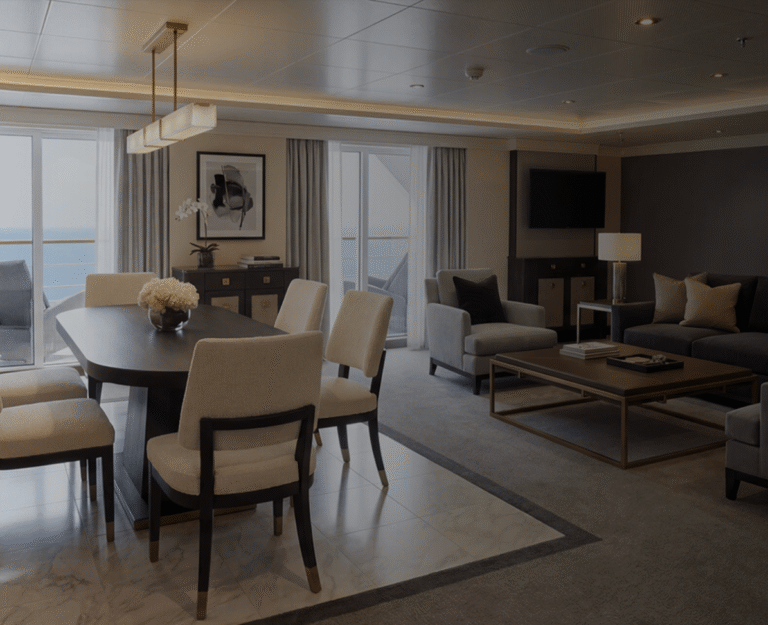
Navigator is particularly well suited for conversion into residential use. The ship already has a more apartment-like feel, with features such as laundry rooms and relatively large suites. Even the smallest stateroom measures approximately 301 square feet, which is considered spacious by cruise standards. I had the opportunity to sail on the Navigator a few years ago and was impressed by both the suite layouts and the onboard facilities. It is a smaller, more intimate ship compared to the massive vessels that dominate the seas today, which makes it better suited for long-term living and connecting with a community.
“Our philosophy is evolution, not disruption,” said Kathy Villalba, Co-Founder & CEO of Avora Residences. “Navigator has a soul — built through years of disciplined operations, experienced crews, and trusted relationships. We intend to honor that legacy while transforming the ship into a true long-term residential platform.”
The ship also underwent a $40 million refurbishment in 2016, giving it a modern and refined luxury design. Avora plans to make additional changes, including expanding select suites and adding dedicated workspaces. This makes the concept especially appealing to remote workers, entrepreneurs, and founders who want to stay productive while traveling.
High speed satellite internet is expected, likely powered by Starlink. Having personally used Starlink on a recent transatlantic cruise, I was able to take Zoom calls, record a podcast, and work normally while crossing the North Atlantic on the way to Iceland. Although, I did have one problem…. finding a quiet place to work.
You can see from the image below the changes Avora is making converting the casino to workspaces.
Yes, launching a startup at sea is now a realistic option.

Pricing, Ownership, and Rental Potential

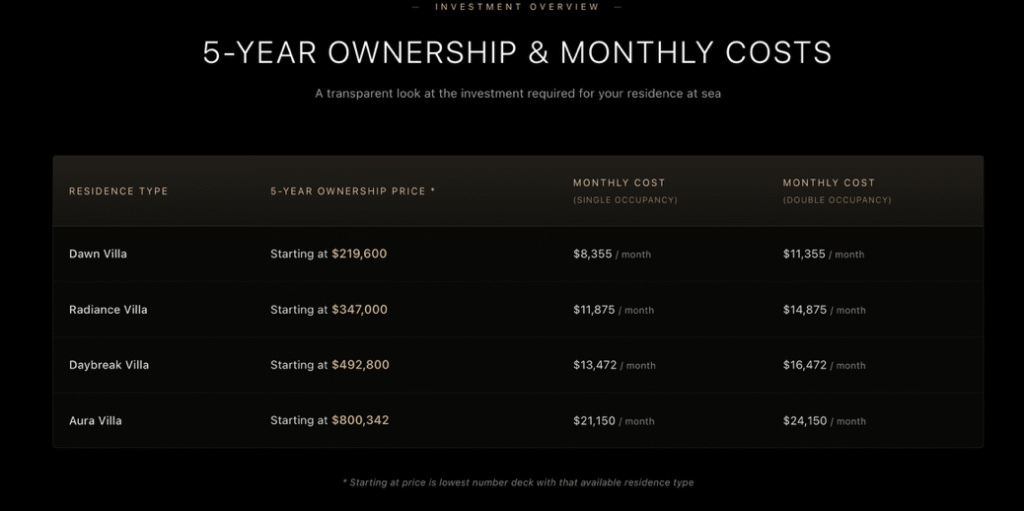
Avora has introduced aggressive early pricing, including a five-year option priced at roughly 40 percent of a unit’s value. Compared to other ultra luxury residential cruise offerings, this pricing is notably competitive. They are also offering a discounted early bird rate of 10% off for purchasing units. I find their pricing to be very fair given the costs of other luxury residential ships like The World.
While most buyers will likely use their residence as a primary or secondary home, we have confirmed with the company that owners will also have the option to rent out their units when not onboard. This makes the residences potentially investable, or at the very least capable of offsetting ownership costs.

Here is a simplified example using conservative assumptions of the Solstice Suite:
Purchase price for a 500 square foot unit with balcony – $1,425,200
Assuming a rental rate of $1,500 per night, which is roughly half the nightly cost of a traditional luxury cruise in the same room and ship, and only 300 nights rented per year, annual gross rental revenue could be as high as $450,000. Of course most people will choose to live on the ship and forgo some of this revenue.
Estimated monthly expenses are $18,725, or $224,000 annually.
That results in an estimated net operating profit of $226,000 per year, which equates to an approximate annual return of 16 percent before taxes and financing and rental commissions which will be paid to the ship. And what I really like is that you can still use it whenever you want and store your stuff on the ship so you don’t even have to pack a bag.
Even with lower occupancy or lower nightly rates, rental income could significantly reduce the effective cost of ownership. My wife and I have two second homes both of which we rent out when not there. This makes owning a second home much more affordable.
Monthly Fees and Lifestyle Comparison
Monthly residential fees are expected to range from approximately $8,355 for single and $12,355 for double occupancy, for the smallest of the suites. These fees include an all-inclusive lifestyle with multiple dining venues, housekeeping, concierge services, and continuous global travel.
When compared to luxury condos in cities like Miami, the costs are surprisingly comparable once HOA fees, insurance, property taxes, staffing, and amenities are considered. The difference is that instead of staring at the same skyline, your view changes weekly.
A New Way to Live and Travel
For thousands of years, humans have been tied to land. Residential cruising offers a fundamentally different way to live, combining travel, community, and luxury into a single experience.
Unlike traditional cruises, residential ships are quieter, less crowded, and designed for long-term living. Guests do not rotate every week, relationships have time to develop, and the pace is intentionally slower. Some residents on similar ships have even joked that the ship can feel quiet at times due to the low density, which for many is part of the appeal.
Residential cruising is not for everyone. But for people seeking freedom from fixed locations, deeper community, and a more adventurous lifestyle, it represents one of the most interesting experiments in modern living.
If you want the inside scoop on cruise condos join our Live at Sea Facebook Group or visit www.LiveAtSea.com.
Bon Voyage and safe travels.
Colin C. Campbell
Part 2- OpenMic: Make $1M using AI
https://www.clubhouse.com/invite/zg8SZQKZkZkEVODg5VaqOyDr778GcEw8r66:XfIjlJYd8noOjeW1gbYhAxbH0Gb2qTl1FjcC4J90q4w