


This article is based on a live conversation on The Complete Entrepreneur, a Startup Club show hosted by Colin C. Campbell and Michael Gilmour.
Most entrepreneurs who start something never scale it. Not because the idea was wrong. Because the mindset never changed.
Startup mode and scale mode are not the same job. They require completely different instincts, and making the shift from one to the other is where 82% of small businesses quietly stop growing.
This is what Colin C. Campbell and Michael Gilmour broke down in a recent live session on The Complete Entrepreneur, alongside Matt Herbert, Chief Revenue Officer at Park Logic, and community member Jason.
“Any tiny speed bump on the road when you scale becomes a Mount Everest”
-Michael Gilmour
Start Mode Is Personal. Scale Mode Is Not.
In start mode, everything runs through the founder. You know every customer, every problem, every decision. That intimacy is your advantage. It is also your ceiling.
The moment you try to scale with a startup mindset, you become the bottleneck. You are no longer the asset. You are the constraint.
Michael Gilmour, who runs Park Logic and has been building companies for over two decades, described buying out his business partner and going back into startup mode almost overnight. Then, through deliberate hiring, strategic positioning, and a decision to stop doing everything himself, he doubled revenue in a single year in an industry that contracted by 95%.
“You never know when scaling is going to hit you until it hits you,” Michael said. “I just knew it was going to happen at some stage.”
That does not happen by accident. It happens by design.
Delegate Responsibilities, Not Tasks
This is the line that separates founders who scale from founders who stall. Colin put it plainly: delegate tasks is start mode. Delegate responsibilities is scale mode.
Handing someone a task keeps them dependent on you. Handing someone a responsibility gives them ownership of an outcome. The difference sounds subtle. The operational impact is enormous.
Michael’s first move was finding someone he trusted completely and handing him the keys, including a corporate credit card with a $10,000 limit and no approval required. His travel policy for the entire company became one sentence: I trust my staff.
He now receives one macro spreadsheet report per month. That is his involvement in the finances. Everything else belongs to the people he hired to own it.
Hire People Who Irritate You
If everyone around you agrees with everything you say, Michael and Colin agree: you have built a very expensive mirror.
The leaders worth hiring will negotiate hard in their first conversation. They will challenge your thinking in the first meeting. They will drive you crazy on a regular basis.
Colin hired Elliot Noss in 1997 to run a company called Two Cows. They fought constantly. Elliot went on to run that company for thirty years and build it to over $500 million in value.
“If they’re not negotiating their salary, I’m not hiring them,” Colin said. “That means they’re just going to get along and be nice, and they’re not going to go out of their way to build value for you.”
Jason, a community member and frequent contributor to the show, reinforced the point. The most important trait in a team member is confidence. People who cannot state a contrary idea, who are intimidated by the person who can fire them, simply cannot contribute at the level a scaling business needs.
Give Permission to Fail
In startup mode you cannot afford mistakes. You are too close to zero.
In scale mode, if you do not allow failure you will not get the speed you need. Michael pushed his technology team with a single directive: just launch it. He knew rockets would blow up. He built in a stabilization role specifically to clean up after the launches.
The result was the best technology in their industry. Not despite the failures. Because of the pace the permission created.
Matt Herbert, Michael’s Chief Revenue Officer at Park Logic, captured this dynamic from the inside. “You don’t hold your truth beyond everyone else’s,” Matt said of Michael’s leadership style. “You certainly hold the direction and the vision tightly, but it’s not always your way or the highway. That’s what has led to the growth.”
Check the Ego at the Door
Start mode requires self-promotion. You are selling the vision, the company, yourself, to investors, customers, and anyone who will listen.
Scale mode requires the opposite. Colin was direct about this: in scale mode, your job is to promote your people, not yourself.
That means recognizing achievement. Listening before speaking. Speaking last in the room, not first. It costs nothing to recognize greatness. It costs nothing to implement core values. These are the highest-leverage moves available to a scaling founder, and they are almost universally underdone.
“Any tiny speed bump on the road when you scale becomes a Mount Everest,” Michael said. “Deal with the speed bumps now, before they become huge things, because everything gets exaggerated when you start scaling.”
The Scale Workbook
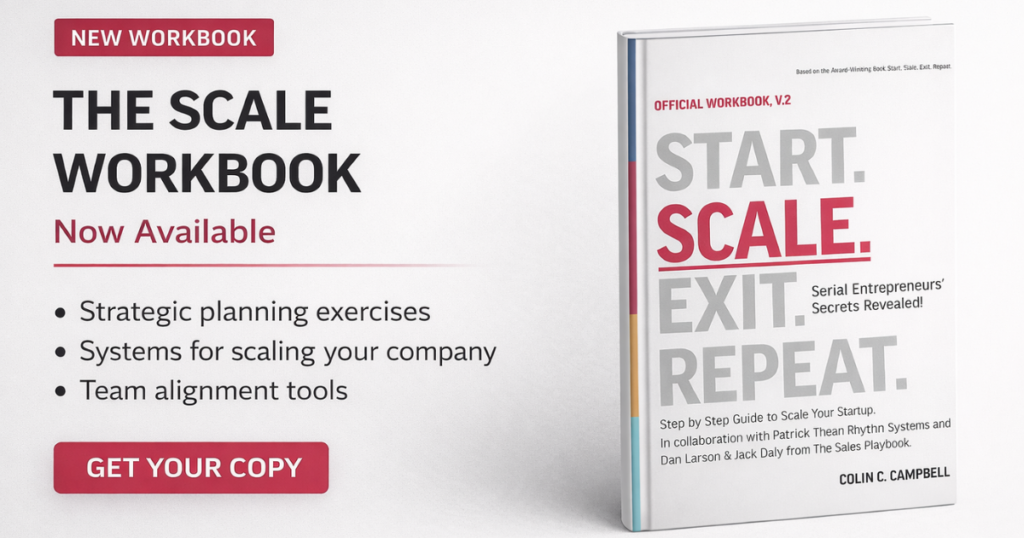
The framework behind this conversation is now available. After two years of development, the official Scale Workbook from Start, Scale, Exit, Repeat launched this week on Amazon for $10.
Built in partnership with Patrick Thean from Rhythm Systems and the sales playbook from Jack Daly and Dan Larson, it covers everything from defining your X factor and core values to goal-setting methodology, pitch deck structure, hiring frameworks, and a complete sales playbook. QR codes throughout link to embedded GPT tools that work alongside the pen-and-paper exercises.
It is the most comprehensive scaling resource the Startup Club team has built, and it is priced to be in everyone’s hands.