Getting it right the first time & setting up for success
(Recorded Live on Clubhouse November 12, 2021)
We were joined by Lil Roberts, CEO and founder Fintech platform Xendoo, for insights into raising capital for your startup. We learned where to look and what to look for in an investor, preparing to meet with potential investors, plus Lil’s top tips for perfecting your pitch.
Moderators:Colin C. Campbell, Michele Van Tilborg, Rachael Lashbrook, Jeff Sass
Guest:Lil Roberts
Sign up to our email and never miss an update on our special events, guest speakers, and more: https://startup.club/
What founders get wrong about selling… and how to exit with leverage
In this episode, Colin C. Campbell and Michele Van Tilborg are joined by Alexis Sikorsky to break down what founders misunderstand about selling their business—and how to maximize value when exiting. Drawing from his experience on both sides of the deal, Alexis shares how to position your company for private equity, prepare years in advance, and avoid costly mistakes that leave money on the table. If you’re thinking about an exit, this is a practical guide to navigating the process with clarity and control.
The real reason founders don’t start, and how to move through fear
In this episode of Start, Scale, Exit, Repeat, Colin C. Campbell and Michele Van Tilborg sit down with bio-psychologist Dr. Rowshanak Hashemiyoon to unpack the real reason founders get stuck before they even begin: fear rooted in biology, not mindset. They explore the nervous system’s role in self-doubt, fear of success, and visibility, along with practical tools to regulate, take action, and build momentum. If you’ve ever felt stuck, overwhelmed, or hesitant to take the next step, this conversation reframes fear—and shows you how to move forward anyway.
Why most founders fail to scale, and how to get out of your own way.
In this episode of The Complete Entrepreneur, Colin C. Campbell and Michael Gilmour break down why most businesses get stuck, and how shifting from startup mode to scale mode unlocks real growth. Joined by Matt Herbert and community member Jason, they dive into leadership evolution, delegation, hiring the right people, and building systems that remove the founder as the bottleneck. If you’re looking to grow beyond the early stages, this conversation is a practical roadmap to scaling with intention.
Build & Aquire – Software Deals Unlocked w/ David Awad
Buy it, build it, scale it. Talking founder and investor strategies used to grow software companies through acquisition and organic growth with David Awad
This article is based on a live conversation on Start, Scale, Exit, Repeat, a Startup Club show hosted by Colin C. Campbell and Michele Van Tilborg, featuring Alexis Sikorsky, business advisor and author of Cashing Out.
Most founders spend years building a company and weeks thinking about how to sell it. That gap is where the money gets left on the table.
Alexis Sikorsky has been on both sides of the deal. He built and sold his banking software company to private equity in 2019, and now advises founders on how to exit with maximum leverage. What he shared in this conversation challenges almost everything the standard entrepreneurship playbook says about selling to private equity.
“You sold your car to a guy and you don’t like the way he’s driving it. Not your problem anymore.”
-Alexis Sikorsky
You Are Not Selling to a Villain
The most common complaint Colin hears about private equity is that they bought the company and then changed everything. Alexis had a sharp response to that.
“You sold your car to a guy and you don’t like the way he’s driving it. Not your problem anymore.”
Once you sign, the company is no longer yours. The founders who struggle most post-acquisition are the ones who did not accept that before the deal closed, not after. If maintaining control is non-negotiable for you, private equity is probably not your buyer. If you can make peace with becoming a minority shareholder and an employee of the firm, you may find PE gives you more runway than a strategic buyer ever would.
“Usually when you sell to a strategic, you end up being fired,” Alexis said. “PE at least needs you to run the company. That’s not their business.”
Strategic Buyers Do Not Always Pay More
The assumption that strategic buyers deliver higher valuations than PE is increasingly outdated, at least below the $150 million deal range.
At that size, you might have three to five potential strategic acquirers in the market for your company. You have an essentially unlimited number of PE funds. If you know how to speak PE language and run a competitive process, the valuation gap disappears, and in some cases inverts.
“If you are a little bit professional and knowledgeable in terms of how to sell to private equity, the difference tends to diminish,” Alexis said. “And at some point you get better deals from PE.”
The Nominal EBITDA Nobody Explains to You
Private equity does not buy a multiple of your EBITDA. They buy a multiple of your nominal EBITDA, which is what the business would earn next year, all else being equal.
Here is a simple example. You fired someone in November. Their ten months of salary still sits in your EBITDA for the year. But PE removes that from the calculation because that cost will not exist next year. Nominal EBITDA is almost always higher than reported EBITDA.
If you do not calculate this yourself before entering negotiations, PE will calculate it for you and keep the difference. That is one of the clearest examples of what PE is not telling you.
Dress the Bride Before You Go to Market
Alexis calls the pre-sale preparation process dressing the bride or dressing the groom. It is a list of specific financial, operational, and positioning actions that make your company desirable before any PE firm ever opens a spreadsheet on you.
The work starts two years before you want to sign. Not six months. Not when you feel ready. Two years.
That timeline exists because you need to build the short list of target funds, test your deck on PE firms in other geographies who have no stake in the deal, refine your story based on their feedback, and then approach your actual targets with a competitive process already in motion.
“Send your deck to PE firms that are not potential buyers but are close,” Alexis advised. “There is no incentive for them to lie to you. And you do not waste a shot.”
When you do go to market, put your own valuation in the deck. Do not wait for PE to anchor the number. That is your leverage, and most founders give it away before the first meeting.
Three Things to Do Before You Are Ready to Sell
Alexis gave Magnificent, a solopreneur in the audience, a framework that applies to any founder thinking about an exit in the next ten to fifteen years.
First, identify the tasks only you can do. Take a week and log every action you take. Then separate the ones where you are genuinely irreplaceable from the ones where you just have not hired the right person yet. The list of truly irreplaceable tasks is always smaller than founders expect, and it should shrink as the company grows.
Second, build systems before you need them. Process documentation, clean financials on a monthly basis, clear procedures. This is boring work that creates real enterprise value.
Third, know your growth path. Are you selling more to existing customers, expanding to new markets, or building through acquisition? PE wants to see where the next phase of growth comes from. If you cannot answer that question clearly, the valuation reflects it.
Do Not Hire a Broker for a Sub-$150 Million Deal
This was the most contrarian position Alexis took, and he acknowledged it would cost him friends.
Investment banks and brokers are paid by you but incentivized by the buyer. They do more deals with the PE firms you are pitching than they will ever do with you. When their interests conflict, they resolve it in favor of the relationship that keeps paying them.
“You pay them and they end up being on the side of the buyer very often,” Alexis said.
For smaller deals, the value a broker adds is largely findable through LinkedIn and ChatGPT. The deck work they do is typically outsourced to consultants you end up paying for anyway.
Colin added the counterpoint from his own experience: ultimately, deals close when two decision makers trust each other. During a difficult IPO process, Colin bypassed his bankers and called the lead investor directly. One honest conversation about price, and the deal closed.
The Question You Have to Answer Before Everything Else
Before the EBITDA, before the deck, before the buyer list, Alexis starts every founder engagement with one question.
What is your number? How much do you need in the bank to never have to work again if you choose not to?
Most founders cannot answer it cleanly. They have built a company without knowing what finish line they are running toward. That ambiguity is what lets PE set the terms instead of you.
“If you cannot get where you want to go in five years,” Alexis said, “then don’t go there. Go somewhere else.”
Your identity is not your company. It is entrepreneurship itself. Understanding that distinction is what makes it possible to exit, start again, and build more.
This article is based on a live conversation on Start, Scale, Exit, Repeat, a Startup Club show hosted by Colin C. Campbell and Michele Van Tilborg, featuring Dr. Rowshanak Hashemiyoon.
The number one reason people never start a business has nothing to do with money, timing, or the idea. It is fear. And most of the advice on how to handle it completely misses the point.
Dr. Rowshanak, a bio-psychologist who studies the nervous system and entrepreneurial resistance, joined Colin C. Campbell and Michele Van Tilborg to break down what is actually happening when a founder freezes, pulls back, or talks themselves out of the next move.
“I do actually think about the impact it has on everyone else, and that concerns me more.”
-Michelle Van Tilborg
It Is Not Weakness. It Is Biology.
Most people who experience self-doubt assume something is wrong with them. They are not disciplined enough, not confident enough, not ready.
Dr. Rowshanak was direct: that framing is wrong.
“We don’t hold ourselves back because we’re stupid, weak, lazy, or unmotivated,” she said. “In fact, we’re the opposite of all those things.”
The real mechanism is biological. Your nervous system registers risk before your conscious mind has a chance to intervene. Exposure, pressure, judgment, the possibility of letting others down: your body processes all of it as threat. The psychological story, I am not ready, this is not the right time, what if I fail, comes after. It is your mind building a narrative around an activation that already happened.
You cannot think your way out of a nervous system response. That is the core insight most entrepreneurship advice skips entirely.
Fear of Success Is More Common Than Fear of Failure
Everyone understands fear of failure. Almost nobody talks about fear of success, and Dr. Ak argues it is just as prevalent.
Success means visibility. Visibility means more people watching, judging, expecting, and depending on you. The higher you climb, the more exposed you become. As Dr. SI put it, drawing on a Jamaican proverb: the higher the monkey climbs, the more his nakedness shows.
Michele described this dynamic from her own experience leading the pot.com Kickstarter launch. The fear was not about personal embarrassment. It was about letting down the people who had committed to the project, the employees, the contributors, the community.
“It’s not just about me,” Michele said. “I do actually think about the impact it has on everyone else, and that concerns me more.”
Dr. Rowshanak named this as a pattern among heart-centered founders. The self-doubt is not coming from insecurity or selfishness. It is coming from genuine care about the consequences of failure on others. That compassion, while admirable, can shrink your risk tolerance until you stop moving entirely.
The Physiology of Calming Down
The breathing advice you have heard before is incomplete. Dr. Rowshanak explained the actual mechanism.
It is not about breathing deeply. It is about the length of your exhale.
When your exhale is longer than your inhale, it slows your heart rate. A slower heart rate signals to your brain that the threat has passed. That is the physiological brake on your sympathetic nervous system, what most people call fight or flight.
The ratio is simple: exhale twice as long as you inhale. Four seconds in, eight seconds out. Five seconds in, ten seconds out. Breathe in through your nose, out through your mouth slowly. That is it. No apps, no equipment, no meditation practice required.
“You trick your nervous system into going into a rest and digest state,” she said. “Now you can think more clearly.”
Write It Down. Not on a Screen.
The second technique recommended addresses rumination, the 3am thought spiral that Michelle described and that most founders know well.
Humans have roughly 60,000 to 70,000 thoughts per day. The vast majority are repetitive. A high percentage are negative. They loop through the same part of the prefrontal cortex responsible for depression and rumination.
Writing by hand activates a different part of that same region, the area responsible for considered thought. The act of putting words on paper literally engages a competing neural process that slows the spiral.
You do not need to journal. You just need to write the thought down. That alone begins to shift the brain out of reactivity and into something more useful.
One Step, Not the Whole Plan
Pierre and Jason both reinforced a practical truth that Dr. Rowshanak grounded in neuroscience: you do not need to see the whole path. You need to take the next step.
Breaking the challenge into the smallest possible action, registering a domain, having one conversation, finishing one section, does two things. It removes the overwhelm of eating the whole problem at once. And it activates what Dr. Rowshanak called the competence-confidence cycle, where small wins build neurological evidence that your actions have effects. That evidence reduces anxiety and builds momentum.
Colin described a similar framework from Start. Scale. Exit. Repeat. called stage gates. Set a specific first milestone, give yourself a clear date, and shut out the noise until you hit it. Most of the fear people feel is about the entire journey. Stage gates make the question smaller and more answerable.
Build Your Visibility Muscle Before You Need It
The deeper work is not managing fear in the moment. It is building the capacity to be seen before the pressure hits.
She called it a visibility ladder. Write down five to ten situations involving exposure, from the least threatening to the most. Start with the easiest one. Stay there until the fear drops. Then move to the next.
This is standard exposure therapy applied to entrepreneurship. It works because the nervous system can be trained. Visibility stops feeling like a threat when you have enough evidence that you survived it.
“The challenge is not just building the offer, the team, or the revenue,” she said. “It is building the capacity to stay regulated while being seen.”
The Closing Thought That Matters
Colin closed with a line from Tolkien, delivered through Gandalf: all we have to decide is what to do with the time that is left to us.
Dr. Rowshanak’s version was simpler. You are born to create. You are born to bring forth what you have. You are born to be seen. There is no such thing as failure, only experience.
The fear is real. The biology behind it is real. But so is the fact that you can work with it, regulate it, and move anyway.
This article is based on a live conversation on The Complete Entrepreneur, a Startup Club show hosted by Colin C. Campbell and Michael Gilmour.
Most entrepreneurs who start something never scale it. Not because the idea was wrong. Because the mindset never changed.
Startup mode and scale mode are not the same job. They require completely different instincts, and making the shift from one to the other is where 82% of small businesses quietly stop growing.
This is what Colin C. Campbell and Michael Gilmour broke down in a recent live session on The Complete Entrepreneur, alongside Matt Herbert, Chief Revenue Officer at Park Logic, and community member Jason.
“Any tiny speed bump on the road when you scale becomes a Mount Everest”
-Michael Gilmour
Start Mode Is Personal. Scale Mode Is Not.
In start mode, everything runs through the founder. You know every customer, every problem, every decision. That intimacy is your advantage. It is also your ceiling.
The moment you try to scale with a startup mindset, you become the bottleneck. You are no longer the asset. You are the constraint.
Michael Gilmour, who runs Park Logic and has been building companies for over two decades, described buying out his business partner and going back into startup mode almost overnight. Then, through deliberate hiring, strategic positioning, and a decision to stop doing everything himself, he doubled revenue in a single year in an industry that contracted by 95%.
“You never know when scaling is going to hit you until it hits you,” Michael said. “I just knew it was going to happen at some stage.”
That does not happen by accident. It happens by design.
Delegate Responsibilities, Not Tasks
This is the line that separates founders who scale from founders who stall. Colin put it plainly: delegate tasks is start mode. Delegate responsibilities is scale mode.
Handing someone a task keeps them dependent on you. Handing someone a responsibility gives them ownership of an outcome. The difference sounds subtle. The operational impact is enormous.
Michael’s first move was finding someone he trusted completely and handing him the keys, including a corporate credit card with a $10,000 limit and no approval required. His travel policy for the entire company became one sentence: I trust my staff.
He now receives one macro spreadsheet report per month. That is his involvement in the finances. Everything else belongs to the people he hired to own it.
Hire People Who Irritate You
If everyone around you agrees with everything you say, Michael and Colin agree: you have built a very expensive mirror.
The leaders worth hiring will negotiate hard in their first conversation. They will challenge your thinking in the first meeting. They will drive you crazy on a regular basis.
Colin hired Elliot Noss in 1997 to run a company called Two Cows. They fought constantly. Elliot went on to run that company for thirty years and build it to over $500 million in value.
“If they’re not negotiating their salary, I’m not hiring them,” Colin said. “That means they’re just going to get along and be nice, and they’re not going to go out of their way to build value for you.”
Jason, a community member and frequent contributor to the show, reinforced the point. The most important trait in a team member is confidence. People who cannot state a contrary idea, who are intimidated by the person who can fire them, simply cannot contribute at the level a scaling business needs.
Give Permission to Fail
In startup mode you cannot afford mistakes. You are too close to zero.
In scale mode, if you do not allow failure you will not get the speed you need. Michael pushed his technology team with a single directive: just launch it. He knew rockets would blow up. He built in a stabilization role specifically to clean up after the launches.
The result was the best technology in their industry. Not despite the failures. Because of the pace the permission created.
Matt Herbert, Michael’s Chief Revenue Officer at Park Logic, captured this dynamic from the inside. “You don’t hold your truth beyond everyone else’s,” Matt said of Michael’s leadership style. “You certainly hold the direction and the vision tightly, but it’s not always your way or the highway. That’s what has led to the growth.”
Check the Ego at the Door
Start mode requires self-promotion. You are selling the vision, the company, yourself, to investors, customers, and anyone who will listen.
Scale mode requires the opposite. Colin was direct about this: in scale mode, your job is to promote your people, not yourself.
That means recognizing achievement. Listening before speaking. Speaking last in the room, not first. It costs nothing to recognize greatness. It costs nothing to implement core values. These are the highest-leverage moves available to a scaling founder, and they are almost universally underdone.
“Any tiny speed bump on the road when you scale becomes a Mount Everest,” Michael said. “Deal with the speed bumps now, before they become huge things, because everything gets exaggerated when you start scaling.”
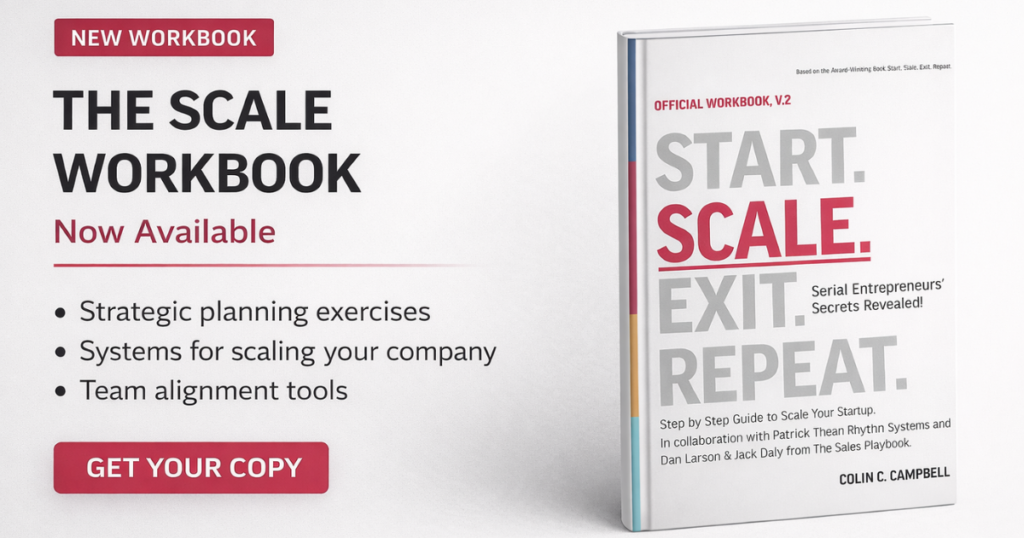
The Scale Workbook
The framework behind this conversation is now available. After two years of development, the official Scale Workbook from Start, Scale, Exit, Repeat launched this week on Amazon for $10.
Built in partnership with Patrick Thean from Rhythm Systems and the sales playbook from Jack Daly and Dan Larson, it covers everything from defining your X factor and core values to goal-setting methodology, pitch deck structure, hiring frameworks, and a complete sales playbook. QR codes throughout link to embedded GPT tools that work alongside the pen-and-paper exercises.
It is the most comprehensive scaling resource the Startup Club team has built, and it is priced to be in everyone’s hands.
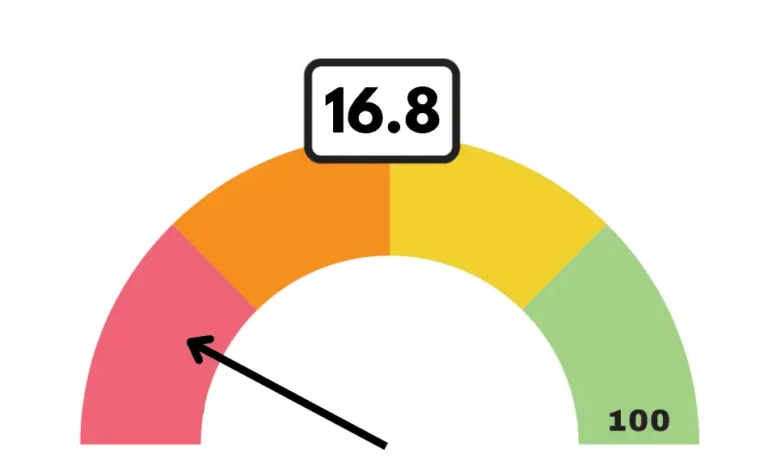
The Time to Sell Index (TTSI) jumped to 26.8 in 2025, fueled by a sharp rebound in IPO activity with 347 listings. That marked a 125% climb from 2022 lows and a 54% year-over-year increase. Momentum is back. Liquidity is returning. Founders can feel it.
But this is not a seller’s market.
Looking ahead, the 2026 pipeline tells a more tempered story. With roughly 190 companies currently queued for IPO and a normalized estimate of about 275 listings, the TTSI is expected to settle closer to 16.8. Translation: the market is stabilizing, not accelerating.
Timing still matters more than most founders think. The difference between exiting at the right moment versus the wrong one can swing outcomes dramatically, often accounting for more than half of a company’s value. While conditions are far better than the 2022–2023 trough, persistent higher interest rates and global uncertainty are keeping a lid on full recovery.
What could change that? Watch the next wave of AI IPOs. If major players like OpenAI, Anthropic, or SpaceX hit the public markets, they could reset expectations overnight and inject real energy back into the system. Until then, the pace remains measured.
The takeaway is simple: the market is recovering, not roaring. This is a window to build, tighten operations, and position for strength. The real upside comes when the shift to a true seller’s market happens, and we are not there yet.
Ever since I hosted a podcast from the North Atlantic aboard a Royal Caribbean cruise ship, I’ve been thinking seriously about the possibility of living at sea. Thanks to Elon Musk’s high-speed satellite internet, that idea is now actually viable.
I can give up a lot to make the move, but not the internet.
So, when the opportunity came to buy a unit on a cruise ship, my wife and I decided to go for it. Unfortunately, our first attempt never made it to market. Although we did receive a refund, we still lost money on the venture.
That experience shifted our mindset. When we revisited the idea, we started thinking about it not just as a lifestyle decision, but also as an investment. Don’t get me wrong, the primary appeal of living at sea is the lifestyle and community. It’s completely different from a traditional cruise. There are no crowds, and you get to really know the people on board.
We explored Villa Vie Residences, a boutique expedition ship, and while we loved the community and pricing, with units starting as low as $129,000, it didn’t quite fit our needs. We wanted a larger unit in a more luxurious setting.
Next, we looked at The World, a highly exclusive luxury residential ship. I know several people who live there, and it’s a fantastic experience. However, my impression is that it caters primarily to well-off retirees. We were looking for a more diverse community, one that includes families, entrepreneurs, digital nomads, professionals, and retirees. I recently posted on our Live at Sea Facebook Group about a 337 square foot unit for $3,750,000 – definitely above our budget.
Another drawback of The World is the lack of an active rental program. When you’re not on board, you’re still responsible for substantial maintenance fees. That didn’t work for us.
We also operate an Airbnb business in South Florida, including a beach house on the west coast. Quite frankly, we wouldn’t be able to afford that property without renting it when we’re not there. We do the same with a cottage in Canada and plan to rent out our Fort Lauderdale home while we’re at sea.
The sharing economy has made it possible for us to travel and own properties we otherwise couldn’t afford.
So when it came to buying a cruise condo, rental flexibility was essential. Cruise condo fees don’t stop when you’re not on board. If you’re not using the unit, you’re essentially burning money (or actually burning diesel).
That’s what led us to Avora Lumina.
Avora Lumina launched in February 2026 and is set to sail in January 2028. The company has secured a deal with NCL’s Regent Cruises to acquire the Navigator. As former Regent customers, we were drawn to the ultra-luxury experience, personalized service, exceptional cuisine, and lack of crowds. Prices start as low as $219,000 for a decked out 305 square foot suite (under a 5-year plan) with a $403 dollar per night maintenance fee for double occupancy.
We did extensive research, including interviewing the founders in an AMA on Startup Club. They were transparent about the structure of the deal.
Here are the key reasons we decided to buy:
1) The Community The buyer profile aligns with what we’re looking for: families, entrepreneurs, professionals, and retirees. Several people we already know and like are purchasing units on the ship.
2) Investment Potential While this wasn’t our primary motivation, the unit is investable. The company openly supports rentals, recognizing that many owners will treat these as second homes.
There are approximately $600 per day in maintenance fees, so covering those costs is critical. Comparable units to the one we acquired currently rent through Regent Seven Seas for between $2,000 and $3,000 per night. Even at half that rate, we would comfortably recover our fees.
Our assumption is that renting the unit for about six months per year could offset the cost of using it for the other six months. Nothing is guaranteed, but based on our experience operating luxury rentals, we feel confident in the demand.
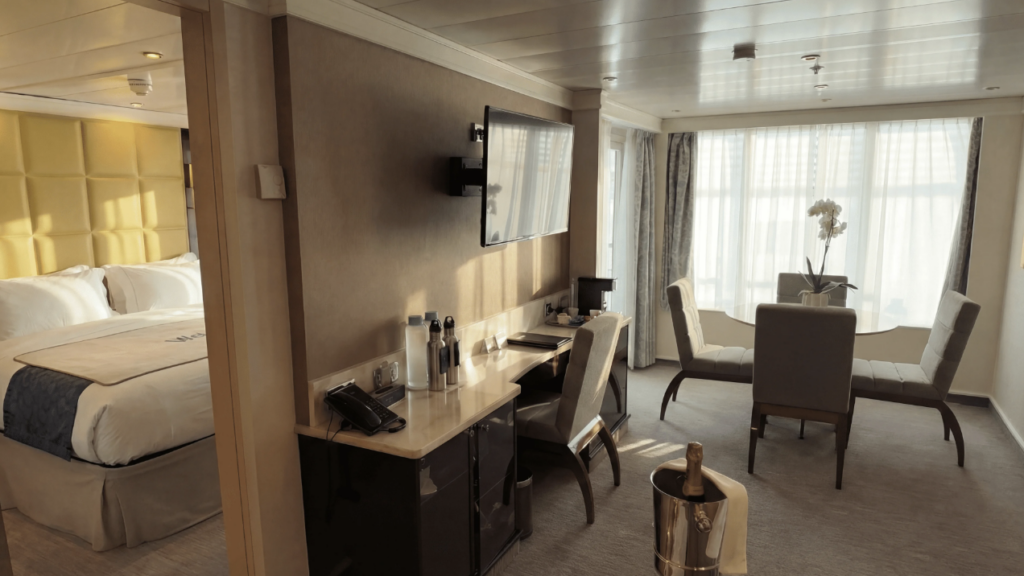
3) The Unit Layout We chose the 501-square-foot Solstice Suite. It includes a balcony, dining area, separate bedroom, walk-in closet, full bath, and living space. Realistically, the entire ship becomes your living room.
4) Ship Longevity and Maintenance The ship has been professionally maintained, which matters. Knowing it was operated and maintained by NCL gives us additional confidence in its condition and longevity.
While the company guarantees 15 years, well-maintained ships can last significantly longer. Proper maintenance is everything when it comes to extending the life of a vessel.
5) Recent Upgrades The ship underwent a $40 million renovation in 2016, modernizing key areas.
6) Ongoing Improvements and Work Environment The company is actively upgrading the ship. They’ve recently announced additions like onboard toys including a submarine and jet skis, which adds to the overall experience.
They are also converting the casino into dedicated workspaces. While my wife would love for me to retire, I have no interest in stopping work completely. What appeals to me is the ability to blend work, travel, and daily life in a more balanced way.
7) Lifestyle Freedom I’ve traveled globally for decades, and I’ve grown to dislike airplane travel and hotel rooms. The idea of constantly packing, unpacking, and living out of temporary spaces has lost its appeal.
Living at sea flips that model. You stay in one place while the world comes to you.
8) Early Pricing Advantage We secured early-stage pricing. As inventory decreases, prices will likely rise. Waiting was an option, but we didn’t want to risk being priced out.
Living at sea might sound radical. But there are now several viable options available. At the end of the day, life is short. One well known philosopher (Gandalf) says “All we have to decide is what to do with the time that is left to us.”
This site uses functional cookies and external scripts to improve your experience.
Privacy settings
Privacy Settings
This site uses functional cookies and external scripts to improve your experience. Which cookies and scripts are used and how they impact your visit is specified on the left. You may change your settings at any time. Your choices will not impact your visit.
NOTE: These settings will only apply to the browser and device you are currently using.