


Part of Startup Club’s ongoing series exploring Colin C. Campbell’s Start. Scale. Exit. Repeat.—reimagined for the AI era. This post is adapted from Chapter 3: Catching the Next Wave Is Critical.
There’s an old saying in entrepreneurship about being in the right place at the right time. But after building multiple startups and watching countless founders succeed—or fail—it’s clear that success is less about luck and more about finding the right wave at the right moment.
Today’s wave is unmistakable.
Artificial Intelligence.
But just because AI is transforming every industry doesn’t mean every AI startup will succeed. The lesson from Chapter 3 is more relevant than ever: great founders don’t simply build great products—they build products that arrive when the market is ready.
Don’t Build Before the Wave
History is full of brilliant ideas that failed because they were too early.
The technology worked.
The founders were talented.
The execution was solid.
The market simply wasn’t ready.
Colin shares the story of Barpoint.com, an idea that let shoppers scan barcodes to compare prices and reviews instantly. Today that sounds obvious. In the early 2000s, before smartphones and QR codes became commonplace, it was simply too early. The surfboard was built—but there wasn’t a wave to ride.
AI founders should ask themselves the same question: Is the market ready for what I’m building?
AI Has Crossed the Chasm
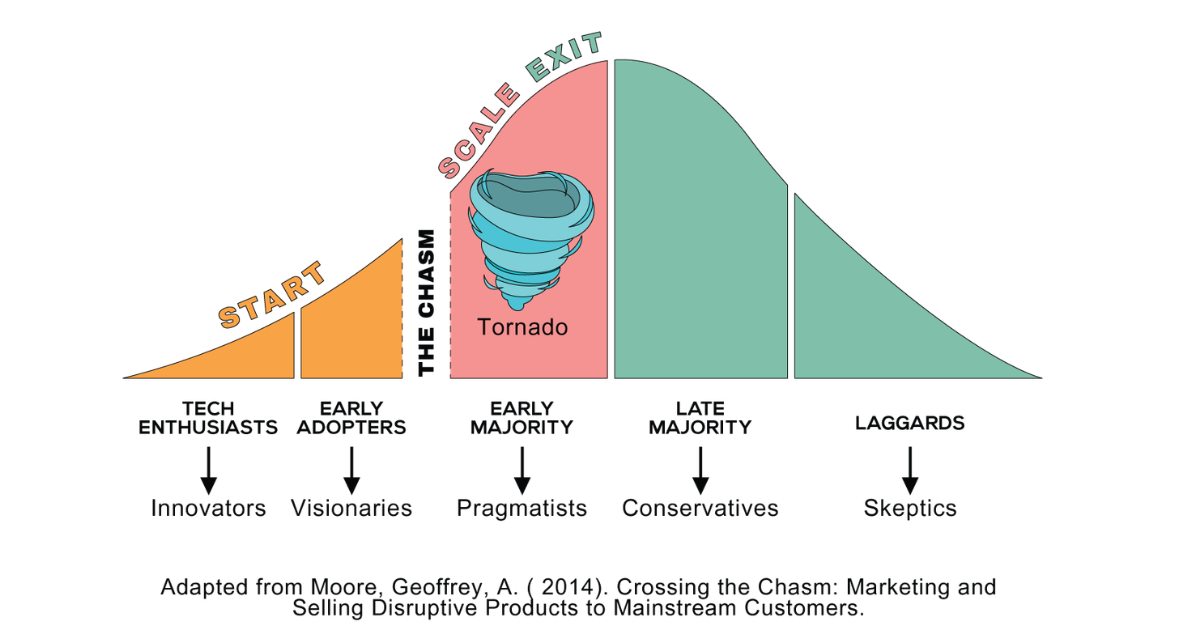
One of the biggest concepts in entrepreneurship comes from Geoffrey Moore’s Crossing the Chasm.
New technologies are first embraced by innovators and early adopters. The real opportunity comes when they cross into the early majority and become mainstream.
For years, AI lived mostly with researchers and technical enthusiasts.
Today, that’s changed.
Millions of people use ChatGPT, Claude, Gemini, Midjourney, Cursor, Perplexity, and countless AI-powered products every day. Businesses aren’t asking whether they’ll adopt AI anymore—they’re asking how quickly.
That means the opportunity has shifted.
It’s no longer enough to build an AI model.
The winners will build businesses that make AI easier, faster, and more valuable for everyday users.
Winning Isn’t About Being First
Many founders obsess over being first to market.
Chapter 3 argues something different.
Being first matters far less than being ready when demand explodes.
We’ve seen this repeatedly in AI.
OpenAI wasn’t the first company researching language models.
GitHub Copilot wasn’t the first coding assistant.
Perplexity wasn’t the first search engine.
Cursor wasn’t the first IDE.
They won because they delivered exceptional products at precisely the moment customers were ready.
Timing compounds execution.
Don’t Force New Behaviors
One of the biggest mistakes startups make is trying to convince customers to behave differently.
People rarely change habits just because your startup exists.
Instead, the best products fit naturally into workflows customers already have. Colin points out that companies like Uber and Airbnb transformed industries without forcing customers to learn entirely new behaviors—people already took taxis and booked accommodations.
The same principle applies to AI.
Ask yourself:
- Does this replace work people already do?
- Does it save time?
- Does it remove friction?
- Does it integrate with existing tools?
If the answer is yes, you’re surfing the wave.
If you’re asking users to completely rethink how they work, adoption becomes much harder.
Make AI Invisible
One of Colin’s recurring themes is simple:
Make it easy. Market easy.
This may be the biggest opportunity in AI today.
Customers don’t actually want AI.
They want faster hiring.
Better marketing.
Cleaner code.
More sales.
Better customer support.
Less paperwork.
The companies that win won’t necessarily have the smartest models.
They’ll remove the most friction.
Great AI products make complex technology feel effortless.
Focus Before You Expand
Another key takeaway is to strive for depth before breadth.
Rather than solving everything for everyone, dominate a single niche first. Geoffrey Moore’s “bowling pin” strategy emphasizes winning one focused market before expanding into adjacent ones.
AI makes this easier than ever.
Instead of building “AI for everyone,” build:
- AI for dentists
- AI for real estate investors
- AI for construction firms
- AI for accountants
- AI for podcast creators
Depth creates trust.
Trust creates referrals.
Referrals create momentum.
Momentum creates scale.
Every Wave Creates New Opportunities
When Colin first wrote this chapter, AI was already appearing as one of the next major technology waves entrepreneurs should pay attention to.
Just a few years later, that prediction has become reality.
But the biggest opportunities are no longer in building foundational AI models.
They’re in applying AI to industries that haven’t yet been transformed.
Healthcare.
Education.
Legal.
Manufacturing.
Construction.
Government.
Financial services.
Every major shift creates thousands of startup opportunities—not because the technology changes, but because entrepreneurs discover new problems worth solving.
Final Thought
Entrepreneurship has never been about predicting the future perfectly.
It’s about recognizing when the future has finally arrived.
AI is no longer a distant trend.
It’s today’s wave.
The founders who succeed over the next decade won’t simply build with AI—they’ll understand timing, reduce friction, solve real problems, and deliver exactly when the market is ready.
That’s how companies don’t just launch.
That’s how they scale.
Read the Book Series
This article is part of Startup Club’s series on Start. Scale. Exit. Repeat. by Colin C. Campbell, adapted for an AI-first world. In each chapter, we’re revisiting timeless startup principles through the lens of today’s rapidly evolving technology landscape—helping founders build businesses that are ready for the next wave. Check out our Chapter 2 article about taking ideas to business reality.