Getting it right the first time & setting up for success
(Recorded Live on Clubhouse November 12, 2021)
We were joined by Lil Roberts, CEO and founder Fintech platform Xendoo, for insights into raising capital for your startup. We learned where to look and what to look for in an investor, preparing to meet with potential investors, plus Lil’s top tips for perfecting your pitch.
Moderators:Colin C. Campbell, Michele Van Tilborg, Rachael Lashbrook, Jeff Sass
Guest:Lil Roberts
Sign up to our email and never miss an update on our special events, guest speakers, and more: https://startup.club/
We set out to have an honest and open conversation.
No polished pitch. No filtered answers.
This AMA was hosted by myself and Aaron Alexander, a fellow moderator from the Live at Sea community. We asked questions directly, and members from the Live at Sea Facebook group submitted questions as well, which we brought into the discussion.
The goal was simple. Ask the real questions people are thinking about when it comes to Avora cruise residences, and see how the team responds in real time.
What came out of it was far more useful than any brochure.
This is not a vacation product. It’s a capital-intensive, operationally complex, slightly unconventional model that might actually work if executed well.
The Deal Behind the Ship
This is where things usually get confusing, and to their credit, they explained it clearly.
Avora is operating under a nine-year charter-to-purchase agreement with Norwegian Cruise Line for the Seven Seas Navigator.
Here’s what that actually means:
– They put down roughly $20 million – They make structured payments over nine years – At the end, there is a nominal buyout to take full ownership
During the AMA, they made an important clarification.
Even though the financing structure is nine years, when you buy a residence, you are buying it for the life of the vessel, not just nine years.
They estimate the ship’s usable life at 20 years or more, and they are guaranteeing 15 years with a prorated protection if something prevents the ship from operating before that.
In other words, the financing timeline and the ownership timeline are two different things.
What Buyers Actually Pay
Pricing discussed in the AMA:
– Entry-level residences start around $560,000 – Balcony units run roughly $850,000 to just over $1 million – Larger suites range from about $1.4 million up to $4.5 million
Monthly costs:
– Approximately $8,000 per month for single occupancy – Around $11,000 or more for double occupancy in smaller units
What the Ship Is Actually Like
I’ve personally traveled on Regent’s luxury ships before, including this class, and it’s worth saying this plainly.
They don’t feel crowded. The service level is noticeably higher.
The ship underwent a $40 million refurbishment in 2016 and still feels modern today.
What This Really Is
After sitting through the AMA, this is not a standard investment.
It is a lifestyle decision with a financial structure behind it.
You are choosing mobility over permanence, experience over predictability, and community over isolation.
Intro Storylines Cruise once promised a revolutionary way to live at sea: luxury condos aboard a floating city, global travel, and a self-sustaining lifestyle for digital nomads and adventurous retirees. Millions of dollars have been collected from hopeful buyers.
But eight years after the company’s founding, construction still hasn’t begun. Refund requests have previously gone unanswered, lawsuits are piling up, and the project is facing mounting challenges.
-Image originally featured on Storylines website
Background Founded in 2016 by Australian entrepreneurs Alister Punton and Shannon Lee, Storylines initially aimed to retrofit an old cruise ship into permanent residences.
By 2019, the plan shifted to a newbuild ship: the MV Narrative, with 530 fully furnished residences ranging from $1 million to $8 million.
The ship was originally slated to launch in the early 20s, then delayed to 2024, then 2026. As of early 2026, no steel has been cut, and the company has not yet announced financing while collecting millions of dollars from customers.
-Image originally featured on Storylines website
The Promise Storylines marketed MV Narrative as a full-service residential community with global itineraries, 20 restaurants, coworking spaces, an onboard school, and a medical clinic.
Buyers could purchase lifetime leases or fractional ownership. Storylines claimed the ship would be the most sustainable in the industry and offered refund guarantees to early depositors.
In April 2021, the company partnered with the top designer firm Tilberg Design of Sweden to design a state-of-the-art ship.
“The ship features fully furnished residences ranging from 237 sq. ft. to 2411 sq. ft., priced from $300,000 to more than $8 million for a premium two-level penthouse suite. Owners and invited guests will have the opportunity to live a sustainable life of luxury and freedom while at sea.”
The company renewed a shipbuilding contract with Brodosplit in March of 2024.
Storylines’ CEO Alister Punton explained that the renewal was necessary due to global supply chain and financial disruptions.
Brodosplit’s president Tomislav Debeljak stated that extensive design and technical work had already been completed.
Storylines began requesting 10–20% down payments from customers, referred to as the “first milestone payment,” despite the absence of active construction or confirmed financing. Documents reviewed by Startup Club show that these payments were tied to a trust structure in which up to 10% could be retained as a non-refundable fee, covering trustee and banking costs (Secupay AG/Commerzbank AG), as well as expenses related to construction, design, equipment, fit-out, operations, and management.
Refund Controversies Multiple Storylines individuals have come forward describing stalled or unfulfilled refund requests, often involving large sums of money.
One investor reported submitting banking details for a refund, only to be met with silence from Storylines representatives. Others reported no communication from the trustee after submitting proper documentation.
One customer shared, “No response to my request from the trustee or Storylines.” Another said they were fortunate to exit early before being asked to contribute additional funds.
There has been growing frustration among buyers, with some calling for investigations and others organizing legal action.
One early buyer reported investing approximately $370,000 into the project. As of this writing, she has not received any refund and reports ongoing stress and lack of communication.
Another investor had been waiting over 12 months for nearly $900,000 and has pursued legal action in Germany against trustee Till Hafner.
Some buyers reportedly sold their homes to finance the investment. Other early customers have waited months before resorting to credit card disputes.
Online forums and social media groups from 2025 to 2026 reflect consistent complaints about lack of communication, delayed refunds, and uncertainty.
On Monday the 16th, 2026, the original deadline for this article, the company confirmed that nine refunds had been issued. I confirmed with multiple residents that they did receive those payments. Some had been waiting for over one year.
However, several of those individuals reported receiving significantly less than expected. They shared with me that they received less than half of what they had paid into the trust. Others posted similar messaging on social media.
Based on their understanding of the trust agreement, many believed they were entitled to approximately 87%-89% of their funds. These discrepancies have raised new concerns about how refund amounts are being calculated. Startup.club reviewed documentation showing that the refund structure contemplated returns of approximately 87%- 89% of resident funds under the trust framework.
Trustee Conversations I spoke directly with trustee Till Hafner on two occasions, including a call on February 4.
He stated that refund requests had been received and that processing them involved a complex administrative process. Some refunds had been completed, while others were still in progress.
He did not provide specific timelines but stated that refunds would be handled in the coming weeks.
On March 16th, the company confirmed that nine refunds were processed, and I verified that several residents did receive funds.
However, none of those individuals reported receiving refunds at the roughly 87%-89% level many depositors expected. Several confirmed receiving less than half their trust funds.
Shortly after my call with Till, CEO Alister Punton stated publicly that issues with the trustee had been resolved and that refunds would now be paid and were in process.
Despite those statements, several weeks passed before refunds could be verified, and those confirmed appear to be reduced by more than half.
Where is the Money? A reliable source familiar with the matter, and confirmed through Startup.club’s review of documentation provided, indicates that approximately €13.3 million has been collected from customers and €7.1 million had remained at the time of reviewing that document.
According to those materials, at least €4.7 million has already been disbursed for project-related costs, including payments made between June to December of 2024 of €3.5 million in total to engineering firm Gelen Marine and €1.25 million to ship design firm Tillberg Design.
Startup.club has reviewed documentation indicating that trust funds were used for design, technical planning, and early-stage shipbuilding work, and that refunds may be limited to each purchaser’s proportional share of the remaining funds rather than the original deposited amount.
This may help explain why residents were receiving reduced refunds. If funds have already been used, the remaining balance may not support returning the approximately 87-89% many expected.
Legal Landscape As of 2025–2026, several lawsuits have emerged in U.S. courts and German courts related to Storylines. These filings reflect a pattern of customer dissatisfaction and disputed contractual obligations.
Kristen Schulz v. Storylines Global Inc., filed in the U.S. District Court for the District of Utah in January 2024, remains active. The court denied summary judgment for both parties in September 2025. The case includes allegations of breach of contract, misrepresentation, and related claims.
Storylines Global Inc. v. Robert Fong, filed in the Southern District of New York, was initially dismissed for procedural reasons and later refiled before being closed without relief granted to Storylines.
Storylines Global Inc. et al. v. The Smith Family Trust and Horace Halsey Smith, also filed in New York, was voluntarily dismissed shortly after filing.
Aaron Alexander and NAZ Investments LLC v. Storylines Global Inc., filed in the Southern District of Florida in August 2025, remains active and includes allegations of breach of contract, fiduciary duty violations, and deceptive practices.
A reported case in Germany involves a dispute between a Storylines customer and trustee Till Hafner.
Many of these cases have been resolved.
– Image from Youtube
Company Response In response to questions regarding refunds and the handling of resident funds, Storylines Chairman Dick Rosman, provided the following statement on March 25, 2026:
“Storylines has consistently operated on the basis of multiple independent legal and professional opinions in relation to the structure, governance, and application of resident funds.
We are aware that aspects of this may be subject to differing interpretations, which is precisely why we have initiated an internal review process to reconfirm alignment with all applicable frameworks and stakeholder expectations.
These expectations are to be based on all aspects of the individual contracts with each resident and charges levied under these contracts.
It is also important to note that resident protections have been a priority throughout, including the implementation of insurance-backed safeguards.
Our focus remains on advancing a solution that protects stakeholders and supports the successful delivery of the project.”
This statement does not directly address the discrepancy between expected refund levels of approximately 87-89% and the reduced amounts reported by multiple residents, nor does it provide detail on how funds have been allocated.
Conclusion
Is this a case of ambition outpacing reality, or something more serious? What is clear is that Storylines are under increasing scrutiny. Refunds that have been delayed for extended periods are now being issued at reduced amounts. Lawsuits continue to mount.
On Monday, March 23, reports from multiple sources indicated that a memo was distributed to existing customers stating the company is actively pursuing a sale of substantially all of its assets. The stated goal is to improve the chances of a successful outcome. The memo also noted that, as part of any potential transaction, a resident transition plan would be implemented for customers. Startup Club has not independently reviewed this memo.
We may still be on the cusp of a new way of living at sea. Like any emerging industry, it will likely include both visionary operators and questionable actors.
I currently run the Live at Sea Facebook group, where hundreds of travelers and future nomads talk about living at sea or wanting to live at sea. We also just launched LiveatSea.com.
There are currently three residential cruise options: The World (an ultra-luxury residential ship, reportedly sold out), Villa Vie Odyssey (a more budget-friendly option), and Avora Lumina, recently announced by Villa Vie’s operators after acquiring the ultra-luxury ship Regent Seven Seas Navigator from NCL.
My wife and I still believe that one day we’ll live at sea, and we won’t let this stop us from pursuing that dream.
NOTES: This article is based on publicly available documents, court filings, statements from company representatives, and verified accounts from customers. Some individuals requested anonymity to protect their privacy.
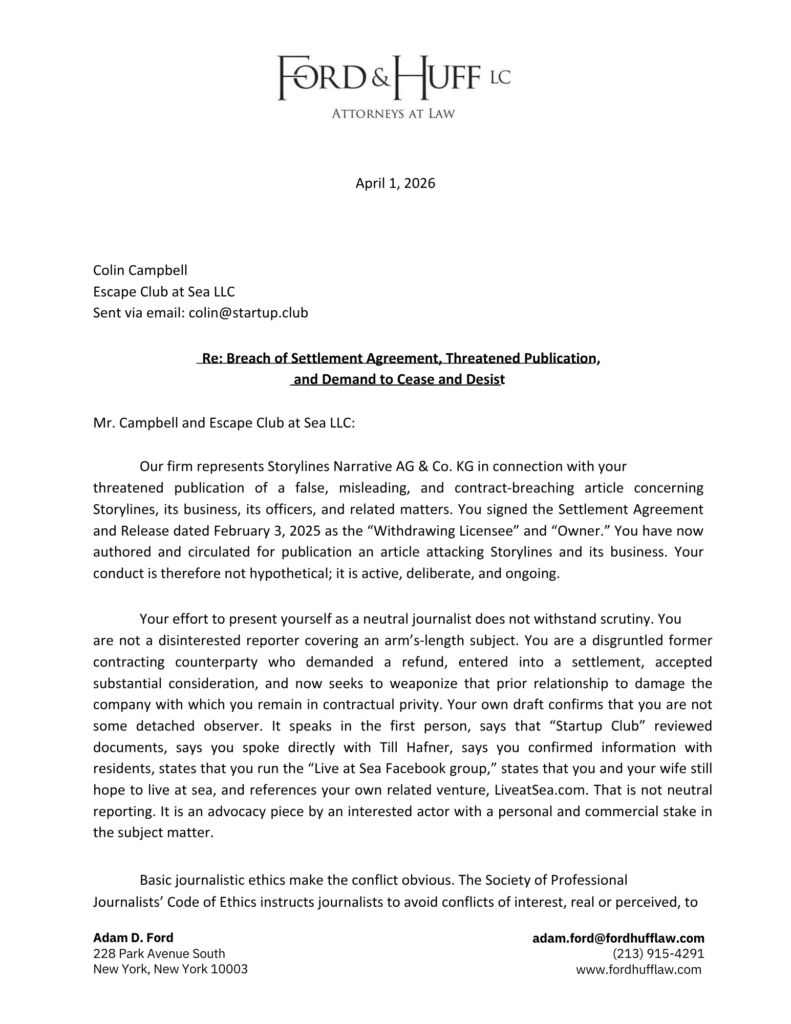
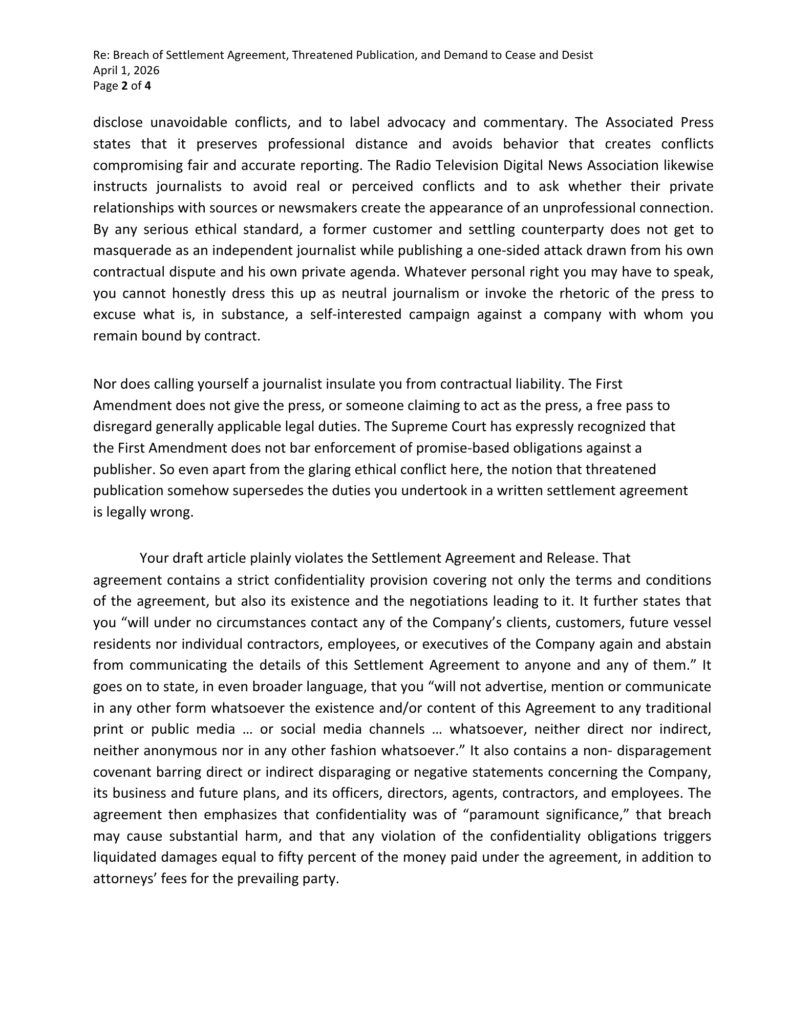
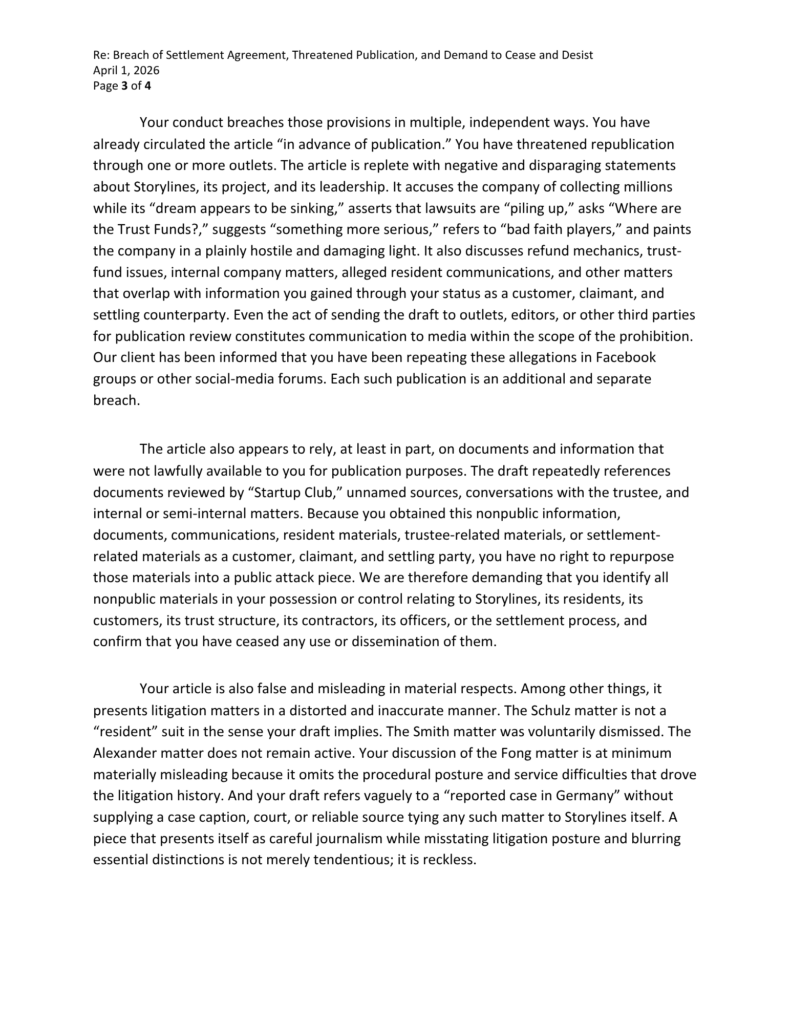
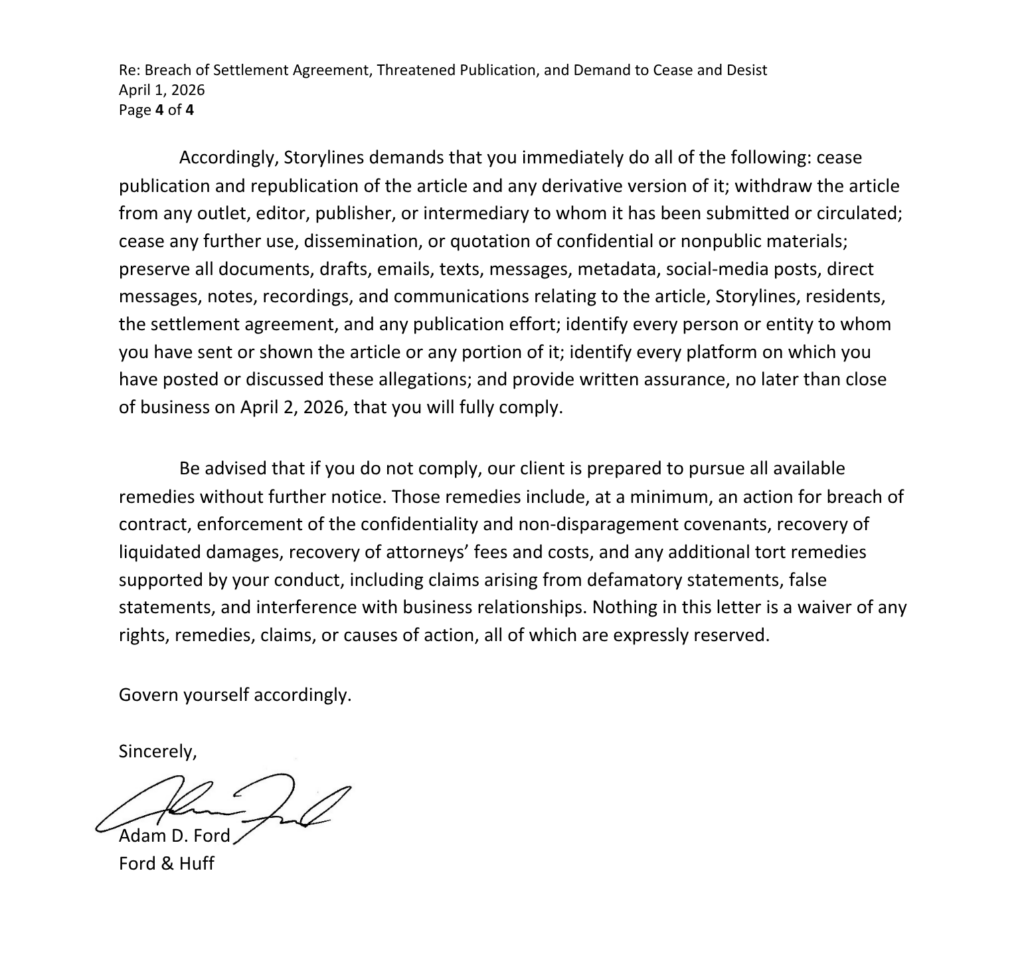
Storylines has reviewed this article and has no additional statements other than this statement from the chairman: “I guess as our project is still “work in progress” so one gets to the point that what you write and publish is never correct. This causes us to be prudent with further comments on what you have to date. As evidence of the work in progress part please be advised that a few more refunds were signed off today for execution.” In addition, the company sent a Demand to Cease and Desist letter included below.
Several people contributed to this story, and publication was delayed multiple times to ensure accuracy. As more information surfaced, it became clear that this story needed to be told.
The purpose of publishing is simple: to present the facts and allow others to learn from what happened. In response to a legal demand I received regarding this article, I want to address several of the claims directly.
The letter characterizes this reporting as “an advocacy piece by an interested actor with a personal and commercial stake in the subject matter.” That is incorrect. I received my refund in full and have no financial interest in the outcome of this story. Based on my reporting, I appear to be among the only individuals who has received a full refund, while multiple others report receiving significantly reduced amounts. This reporting is not driven by personal loss, but by verified discrepancies affecting others.
The letter also claims I am “not a disinterested reporter” and attempts to discredit the work based on prior involvement. For clarity: I have written extensively on startups, including both successes and failures, across platforms such as Startup Club, Entrepreneur, Forbes, and Built In. This article follows that same standard of investigation and verification.
It further alleges that the article is “replete with negative and disparaging statements.” The article does not rely on opinion or speculation. It presents documented timelines, court filings, direct statements, and verified accounts from customers. Where customers ask questions such as “Where are the trust funds?”, those questions are reported as coming from the individuals directly affected.
The letter asserts that the article “plainly violates the Settlement Agreement,” including confidentiality provisions. This is also incorrect. The article does not disclose the existence, terms, or substance of any personal settlement agreement. All information presented is derived from independent sources, publicly available materials, or direct statements from involved parties.
It is also suggested that the reporting relies on “documents and information that were not lawfully available.” The article is based on information provided by sources and materials reviewed in the course of standard investigative reporting. No confidential settlement materials were used or disclosed.
Finally, the letter frames this reporting as “a self-interested campaign.” That claim is contradicted by the facts. I spent six months investigating this story, provided the company opportunities to respond, included their statements, and delayed publication multiple times to ensure accuracy. Including providing the full article for their comments 6 days before release. Approximately a half dozen people reached out to me to share their stories while others posted their stories on social media.
This is not about personal grievances. It is about transparency.
Most people see cruise ships as vacations. Colin sees them as homes.
With the launch of LiveAtSea.com, he’s betting on a shift that feels obvious once you hear it: if people can work from anywhere, why not live anywhere… including the ocean?
This isn’t theory. It’s already happening.
The early content on the site points to a growing movement of people choosing long-term cruise living over traditional housing. Not because it’s flashy, but because it solves real problems. Predictable costs, built-in community, travel without logistics, and a lifestyle that replaces routine with motion.
One post breaks down the difference between world cruises and residential ships.
Because once you remove the assumption that “home” has to be fixed, everything changes. Housing, travel, social life, even identity. You’re no longer visiting places. You’re rotating through them.
That’s the pattern Colin tends to spot early. Not just trends, but shifts in behavior that become businesses.
LiveAtSea isn’t just a blog. It’s a signal.
The same way remote work quietly rewired where people live, this is what happens when mobility becomes permanent.
And like most new categories, it sounds niche… until it doesn’t.
Every week someone opens an AI chat and types the same doomed prompt: “Make me a million dollars.” And every week, the AI politely tells them to go buy index funds.
That’s not a technology problem. That’s a thinking problem.
“What that told me: you are only limited by your imagination now. If you can see it, you can build it.”
The Question That Changes Everything
I tested this myself. I typed “make me a million dollars” into ChatGPT. The response was basically: if I could do that, I’d be living on a server farm on a private island.
Then I changed the question. I said I had an app idea, and I wanted help building it, marketing it, and getting to a million in revenue. Different question, completely different answer.
The AI said: now we’re talking. Here’s the path. Idea. MVP. Users. Retention. Monetization. Scale.
Same tool. Wildly different outcome. That’s the whole lesson.
I Built an App and I’ve Never Coded Anything
I don’t know how to transfer a domain name. That’s not an exaggeration.
But I built a working version of a card game app using Claude Code. Not a mockup. A working version. I took screenshots every time I hit a wall and fed them back to the AI until we pushed through. About ten or fifteen loops to figure out Xcode.
What that told me: you are only limited by your imagination now. If you can see it, you can build it. But building it is only the beginning. You still have to market it, find users, handle the logistics, and deal with every other element of the business.
The AI doesn’t replace that work. It just removes the excuse that you couldn’t do it.
AI Is a Multiplier, Not a Magic Wand
Michele used AI to analyze a production video for a Kickstarter campaign before launch. It gave back specific, actionable feedback we would have paid an agency $25,000 to produce.
We used it to build a full pre-launch to post-launch marketing schedule. Refined it ten times. Still faster than two weeks of manual research, and it cited its sources.
The AI didn’t come up with the product. It didn’t know the audience. It didn’t have the instinct. But once we brought those things to it, it compressed months of work into hours.
The Real Opportunity Nobody Is Talking About
Data is the new moat.
If you have proprietary data in any vertical, you have something the generic models don’t. Feed that into a custom AI workflow and you’ve got something no one can easily replicate.
And on the content side, we are seeing front-page Google results on nearly every article we publish at Startup Club. The formula is real and raw data fed into the AI. Actual quotes. Real conversations. Human input that the model sharpens and structures.
If you feed AI back to AI, it spits it right back out. Bring something real to the process and the output is different.
LLM Optimization Is the New SEO
Search engines are no longer the only gatekeepers. AI answers are the new front page.
Start thinking about where AI scrapes for credible, human-sounding answers. Reddit. Quora. FAQs structured with proper schema. If your content shows up in those AI-generated answers, you’ve bypassed the algorithm entirely and gone straight to the reader.
This is wide open right now. Move fast.
The Bottom Line
You cannot outsource the entrepreneur. The instinct, the idea, the conviction, the relentless follow-through: none of that is replaceable.
What you can do is use AI to become the master of every trade you used to have to hire for. Legal, logistics, code, marketing, content. You don’t have to be the expert. You just have to know enough to know when the AI is wrong.
The million dollars isn’t in the prompt. It’s in the person asking the right questions.
This article is based on a live conversation with the Startup Club community, hosted by Colin C. Campbell and Michelle Van Tilburg.
Entrepreneurship comes with inevitable highs and lows, and this conversation dives into how founders handle disappointment when deals fall apart or expectations aren’t met. Learn how to process setbacks, avoid emotional spillover, and recalibrate quickly so you can keep moving forward.
Entrepreneurship is not just building. It is losing, recalibrating, and getting back up faster than before. In this Startup Club session, founders unpacked one of the most universal but least discussed parts of the journey: disappointment. Deals fall apart. Opportunities disappear at the last second. Wins turn into losses overnight. And no matter how experienced you are, it still hits.
“The conversation made something clear: you cannot eliminate the emotional impact, but you can control how you handle it.”
What stood out most is how normal this is. A seven-figure deal collapses. A dream property gets taken at the last minute. A project you believed in doesn’t land. These moments are not outliers. They are built into the system. The mistake isn’t experiencing disappointment. The mistake is thinking you won’t. Entrepreneurs operate in uncertainty, and uncertainty guarantees emotional swings. The highs are real, but so are the drops.
The conversation made something clear: you cannot eliminate the emotional impact, but you can control how you handle it. The best operators don’t suppress it or let it spill onto their teams. They process it intentionally. Step away. Get perspective. Talk to someone who understands the game. Not just anyone, but someone who has been through it. Because sharing with the wrong person often leads to bad advice, or worse, pressure to quit.
Another pattern emerged around expectations. Many disappointments are self-created. Entrepreneurs tend to overestimate short-term outcomes and underestimate long-term results. You expect the home run. You get a base hit. And instead of recognizing progress, you feel like you failed. That gap between expectation and reality is where frustration lives. The shift is simple but powerful: recalibrate faster. Take the win. Move to the next play.
There is also a leadership layer to this. As a founder, your emotional state doesn’t stay contained. It spreads. Teams feel it. Families feel it. That means you have a responsibility to process disappointment without projecting it. Strong founders don’t pretend everything is fine. But they don’t destabilize the people around them either. They absorb pressure, create stability, and keep moving forward.
At the core, entrepreneurship is a constant cycle of momentum and setback. You go from losing a major deal to landing a major client within days. It can feel chaotic, even irrational. But that is the job. You are not just building a business. You are solving problems, over and over again, in real time.
The founders who last are not the ones who avoid disappointment. They are the ones who expect it, manage it, and keep going anyway.
The emotional and operational reality of entrepreneurship, and how founders navigate uncertainty, pressure, and the constant highs and lows of building.
Entrepreneurship is a rollercoaster, and this conversation breaks down how founders manage the highs, the setbacks, and everything in between. From external pressures like interest rates and market shifts to the internal challenges of stress, relationships, and leadership, this episode offers real insights on how to stay grounded while building. If you are navigating uncertainty, this is a reminder that you are not alone, and that resilience is part of the process.
Entrepreneurship is not a straight line. It’s a rollercoaster of risk, pressure, momentum, setbacks, recovery, and optimism. In this Serial Entrepreneur episode, founders unpacked what it really feels like to build in a world shaped by economic pressure, political uncertainty, high interest rates, shifting markets, and constant change. The discussion was honest, raw, and familiar to anyone who has ever launched something, lost sleep over payroll, questioned a decision, or tried to hold it together while everyone else was looking to them for answers.
Do not create false emergencies. Real emergencies already exist in business. The job is not to dramatize every problem, but to focus the team on what matters, communicate clearly, and move forward productively instead of spiraling.
One of the clearest themes from the conversation: founders cannot control everything, but they can control how they respond. Interest rates, insurance costs, tariffs, policy changes, and market slowdowns are all real forces, and they can hit hard. But panic makes everything worse. Michele Van Tilburg shared a practical truth that many leaders need to hear: do not create false emergencies. Real emergencies already exist in business. The job is not to dramatize every problem, but to focus the team on what matters, communicate clearly, and move forward productively instead of spiraling.
The conversation also went deeper than operations. It got into the emotional cost of entrepreneurship and how the rollercoaster affects not just the founder, but the people around them. Colin spoke openly about intensity, emotional availability, and the way business stress can spill into family life, team dynamics, and relationships. Dr. Rowshanak Hashemiyoon offered one of the most valuable insights of the discussion by drawing a distinction between guilt and shame. Guilt recognizes behavior that is out of alignment and can be changed. Shame attacks identity. That difference matters. Founders do not need more self-condemnation. They need awareness, support, and better ways to manage the pressure without losing themselves or the people they care about.
Fortunately, experience helps founders ride the entrepreneurial roller coaster with more perspective. Over time, entrepreneurs get better at telling the difference between noise and real danger, between urgency and panic, between a bad day and a broken business. That is part of why Startup Club exists. Building can be lonely, and loneliness can be dangerous. Community reminds founders that they are not the only ones navigating the highs, the lows, and the hard middle. The ride is real, but so is the resilience that comes from sharing it with other entrepreneurs who understand exactly what it takes.
This site uses functional cookies and external scripts to improve your experience.
Privacy settings
Privacy Settings
This site uses functional cookies and external scripts to improve your experience. Which cookies and scripts are used and how they impact your visit is specified on the left. You may change your settings at any time. Your choices will not impact your visit.
NOTE: These settings will only apply to the browser and device you are currently using.