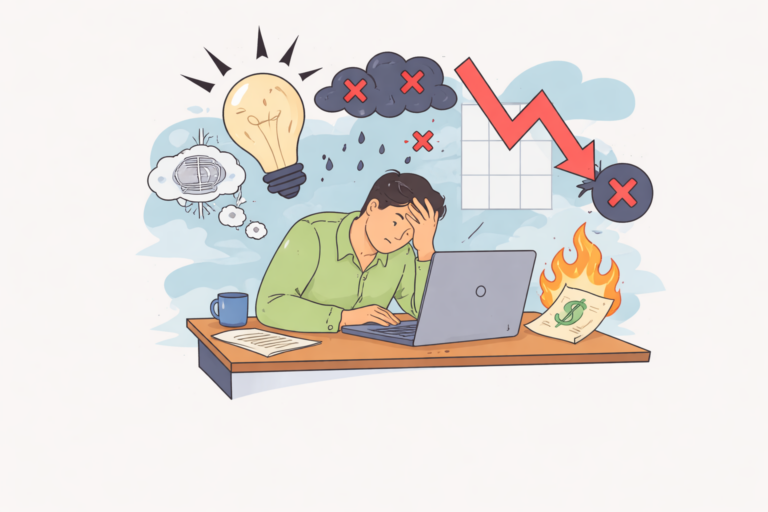
Entrepreneurship comes with inevitable highs and lows, and this conversation dives into how founders handle disappointment when deals fall apart or expectations aren’t met. Learn how to process setbacks, avoid emotional spillover, and recalibrate quickly so you can keep moving forward.
Entrepreneurship is not just building. It is losing, recalibrating, and getting back up faster than before. In this Startup Club session, founders unpacked one of the most universal but least discussed parts of the journey: disappointment. Deals fall apart. Opportunities disappear at the last second. Wins turn into losses overnight. And no matter how experienced you are, it still hits.
“The conversation made something clear: you cannot eliminate the emotional impact, but you can control how you handle it.”
What stood out most is how normal this is. A seven-figure deal collapses. A dream property gets taken at the last minute. A project you believed in doesn’t land. These moments are not outliers. They are built into the system. The mistake isn’t experiencing disappointment. The mistake is thinking you won’t. Entrepreneurs operate in uncertainty, and uncertainty guarantees emotional swings. The highs are real, but so are the drops.
The conversation made something clear: you cannot eliminate the emotional impact, but you can control how you handle it. The best operators don’t suppress it or let it spill onto their teams. They process it intentionally. Step away. Get perspective. Talk to someone who understands the game. Not just anyone, but someone who has been through it. Because sharing with the wrong person often leads to bad advice, or worse, pressure to quit.
Another pattern emerged around expectations. Many disappointments are self-created. Entrepreneurs tend to overestimate short-term outcomes and underestimate long-term results. You expect the home run. You get a base hit. And instead of recognizing progress, you feel like you failed. That gap between expectation and reality is where frustration lives. The shift is simple but powerful: recalibrate faster. Take the win. Move to the next play.
There is also a leadership layer to this. As a founder, your emotional state doesn’t stay contained. It spreads. Teams feel it. Families feel it. That means you have a responsibility to process disappointment without projecting it. Strong founders don’t pretend everything is fine. But they don’t destabilize the people around them either. They absorb pressure, create stability, and keep moving forward.
At the core, entrepreneurship is a constant cycle of momentum and setback. You go from losing a major deal to landing a major client within days. It can feel chaotic, even irrational. But that is the job. You are not just building a business. You are solving problems, over and over again, in real time.
The founders who last are not the ones who avoid disappointment. They are the ones who expect it, manage it, and keep going anyway.
The emotional and operational reality of entrepreneurship, and how founders navigate uncertainty, pressure, and the constant highs and lows of building.
Entrepreneurship is a rollercoaster, and this conversation breaks down how founders manage the highs, the setbacks, and everything in between. From external pressures like interest rates and market shifts to the internal challenges of stress, relationships, and leadership, this episode offers real insights on how to stay grounded while building. If you are navigating uncertainty, this is a reminder that you are not alone, and that resilience is part of the process.
Entrepreneurship is not a straight line. It’s a rollercoaster of risk, pressure, momentum, setbacks, recovery, and optimism. In this Serial Entrepreneur episode, founders unpacked what it really feels like to build in a world shaped by economic pressure, political uncertainty, high interest rates, shifting markets, and constant change. The discussion was honest, raw, and familiar to anyone who has ever launched something, lost sleep over payroll, questioned a decision, or tried to hold it together while everyone else was looking to them for answers.
Do not create false emergencies. Real emergencies already exist in business. The job is not to dramatize every problem, but to focus the team on what matters, communicate clearly, and move forward productively instead of spiraling.
One of the clearest themes from the conversation: founders cannot control everything, but they can control how they respond. Interest rates, insurance costs, tariffs, policy changes, and market slowdowns are all real forces, and they can hit hard. But panic makes everything worse. Michele Van Tilburg shared a practical truth that many leaders need to hear: do not create false emergencies. Real emergencies already exist in business. The job is not to dramatize every problem, but to focus the team on what matters, communicate clearly, and move forward productively instead of spiraling.
The conversation also went deeper than operations. It got into the emotional cost of entrepreneurship and how the rollercoaster affects not just the founder, but the people around them. Colin spoke openly about intensity, emotional availability, and the way business stress can spill into family life, team dynamics, and relationships. Dr. Rowshanak Hashemiyoon offered one of the most valuable insights of the discussion by drawing a distinction between guilt and shame. Guilt recognizes behavior that is out of alignment and can be changed. Shame attacks identity. That difference matters. Founders do not need more self-condemnation. They need awareness, support, and better ways to manage the pressure without losing themselves or the people they care about.
Fortunately, experience helps founders ride the entrepreneurial roller coaster with more perspective. Over time, entrepreneurs get better at telling the difference between noise and real danger, between urgency and panic, between a bad day and a broken business. That is part of why Startup Club exists. Building can be lonely, and loneliness can be dangerous. Community reminds founders that they are not the only ones navigating the highs, the lows, and the hard middle. The ride is real, but so is the resilience that comes from sharing it with other entrepreneurs who understand exactly what it takes.
This article is based on an in-depth interview with Ryan Serhant conducted by Scott Clary on the Success Story Podcast.
By Colin C. Campbell Founder, Startup.club
Ryan Serhant doesn’t survive chaos. He manufactures it, then builds businesses inside the wreckage.
What struck me most about this conversation wasn’t the scale of Serhant’s success, but how deliberately he engineers pressure as a growth tool.
Someone once told him, “Most people are tornado chasers. You’re a tornado creator.” It wasn’t meant as praise. He took it anyway.
Because in New York City, calm is optional. Chaos is the raw material.
New York Doesn’t Break You. It Reveals You.
People call New York “the loneliest city in the world.” Serhant disagrees.
The city runs on energy. It was built by people with a relentless get up and go mentality. People who wanted more, bigger, faster, better.
If you don’t lean into that energy, the city doesn’t gently ignore you. It consumes you.
For Serhant, that chaos fuels momentum. Every person on the street is a potential relationship that could change his life. Letting that go to waste feels irresponsible.
Three Career Deaths, Zero Endings
Serhant’s rise wasn’t clean or linear.
He failed the LSATs and law school disappeared overnight. He was killed off a soap opera, written out of the story. Then he started real estate on the exact day Lehman Brothers collapsed.
Wall Street’s worst day became his first day on the job.
None of it stopped him because he doesn’t treat setbacks as brick walls. They are speed bumps. Moments to slow down, learn, and keep moving.
Nothing is final. Not failure. Not rejection. Not humiliation.
The Greatest Deal Philosophy
Serhant lives by a deceptively simple belief: the greatest deal you’ve ever done, you haven’t done yet.
The same applies to relationships, careers, and opportunities. That mindset keeps the future open and prevents today’s disappointment from becoming tomorrow’s identity.
Capacity Is the Real Superpower
Serhant says his edge isn’t motivation or talent. It’s capacity.
He runs a holding company with four C corps while juggling television, books, content, sales leadership, family, health, and sleep. Then he adds more.
Some people excel by doing one thing exceptionally well. Others scale by carrying many things at once. Neither approach is right or wrong, but capacity creates leverage.
When You Win, Squeeze the Opportunity
Most people treat success like a trophy. Serhant treats it like a lever.
When Million Dollar Listing launched his visibility in 2012, he didn’t stop at doing the show. He immediately asked what else could be built from the opportunity.
That mindset led to Sell It Like Serhant. The show didn’t last, but it launched sellit.com, now a major education platform.
Attention became leverage. Leverage became infrastructure. Infrastructure became an empire.
Work Creates Luck
Serhant’s view on luck is blunt. Hard work beats luck when luck doesn’t work hard.
He doesn’t hide the cost. Sleepless nights. Self doubt. Anxiety. Moments of wondering if something is wrong with you.
And then he returns to the same solution: action.
Work changes your emotional state. Momentum quiets anxiety. Worry grows in inaction.
A Note on the Interview
I look forward to listening to Scott Clary’s podcasts because he consistently commits to deep dive conversations.
I know this firsthand. My own interview on the Success Story Podcast ran nearly two hours. By the end, I was completely exhausted. That was the point. Scott pushed past surface level answers and pulled out real stories and real lessons.
That depth shows in this conversation with Ryan Serhant. The lesson I learned from this podcast was that most startup founders burn energy on fear and imagined failure. Serhant channels that same energy into action, turning anxiety into momentum and results.
I’ve spent a good part of my life traveling for business, and for reasons I still can’t fully explain, hotel rooms depress me. Maybe it’s the sameness. Maybe it’s the artificial quiet. Or maybe it’s the feeling that no matter how nice the place is, it was never meant to be lived in.
Airbnbs were supposed to fix that.
And sometimes they did. I liked having a kitchen, a living room, and space to breathe. It felt more like real life and less like I was temporarily stored somewhere between meetings.
But then there were the other experiences.
Notes on the freezer: “Do not touch the meat.” Rooms you weren’t allowed to use. Spaces that technically belonged to you, but didn’t feel like it.
So you trade the sterility of hotels for the awkwardness of someone else’s rules.
That’s when it clicked.
Years ago, when I started my own short-term rental business, we set out to build something better. A model that combined the consistency and professionalism of a hotel with the experience people actually want from an Airbnb.
We called it Escape Club.
Today, we host homes in Fort Lauderdale and North Captiva. North Captiva is one of those rare places with no cars, just golf carts, boats, and a kind of quiet you can’t manufacture.
But the real breakthrough wasn’t the locations. It was the system.
Recently, I sat down with our property manager, who was recognized as one of the top three hosts in the country. Our properties consistently sit near five stars and perform in the top 90th percentile.
I asked her a simple question.
What’s the secret?
Her answer wasn’t complicated.
Think like a first-time guest
Walk through your property like someone who has never been there. Is it easy to find? Is it clean? Does everything work without confusion?
Small friction kills reviews, and reviews drive this business.
Go a step further and stay there yourself or have friends stay. Build a hit list. There are always issues. The key is catching them before they turn into a bad review.
Pick the right location first
You cannot out-design a bad location.
Choose areas with consistent, year-round demand. Some seasonality is fine. Dead months are not.
Our cottage in Canada rents about two months a year. North Captiva rents year-round.
Avoid heavy HOA restrictions and overly regulated markets. Look for renter-friendly areas, usually near the beach or downtown.
Underwrite conservatively
Assume less income than you want. Assume more expenses than you expect.
If the deal still works, you’re in a strong position. If it only works in a best-case scenario, walk away.
Design for a specific guest
Do not design for everyone.
Pick your guest. Families, couples, or groups.
Use a professional designer. Details matter more than you think. Don’t ignore outdoor space. It often drives bookings.
Your photos do the selling
Photos are your first impression.
They shouldn’t just show the home. They should sell the experience.
Think lighting, staging, and mood. Make someone feel what it’s like to stay there before they ever click “book.”
Operate like a luxury hotel
This is where most hosts fall short.
We use Westin Heavenly beds, high-end pillows, and white sheets so they can be properly cleaned. Never use colored sheets.
Fast response times, clear communication, thoughtful touches.
Old-school hospitality still wins. Your guest’s perception becomes your reviews, and reviews drive everything.
Be the local guide
Your guests don’t know the area. Help them.
Recommend restaurants, activities, and hidden spots.
When you improve the trip beyond the house, you build trust. That turns into better reviews and repeat stays.
Maintain relentlessly
Your 100th guest should have the same experience as your first.
This site uses functional cookies and external scripts to improve your experience.
Privacy settings
Privacy Settings
This site uses functional cookies and external scripts to improve your experience. Which cookies and scripts are used and how they impact your visit is specified on the left. You may change your settings at any time. Your choices will not impact your visit.
NOTE: These settings will only apply to the browser and device you are currently using.