

Artificial intelligence is no longer just about asking ChatGPT a question and getting an answer. The next wave is already here, and for entrepreneurs, it may become one of the most important shifts in how businesses scale.
On Start Scale Exit Repeat: Serial Entrepreneur Secrets Revealed, entrepreneur and e-commerce veteran Steve Simonson joined Colin C. Campbell and Michelle Van Tilborg to break down the rapidly evolving world of AI agents and what founders actually need to understand right now.
The discussion cut through much of the hype surrounding AI. Simonson, who has been building AI-driven workflows for years, offered a simple but powerful definition: AI agents are tools designed to complete a specific task from point A to point B.
“Think about AI first as your solution,” he said. “Can AI actually handle this task? Not job. Task.”
“Most agents are trained on a specific set of data and have what I call a point-to-point trajectory,” Simonson explained. “There’s some input or trigger that causes them to interact with their knowledge base, and then they produce some sort of predictable output.”
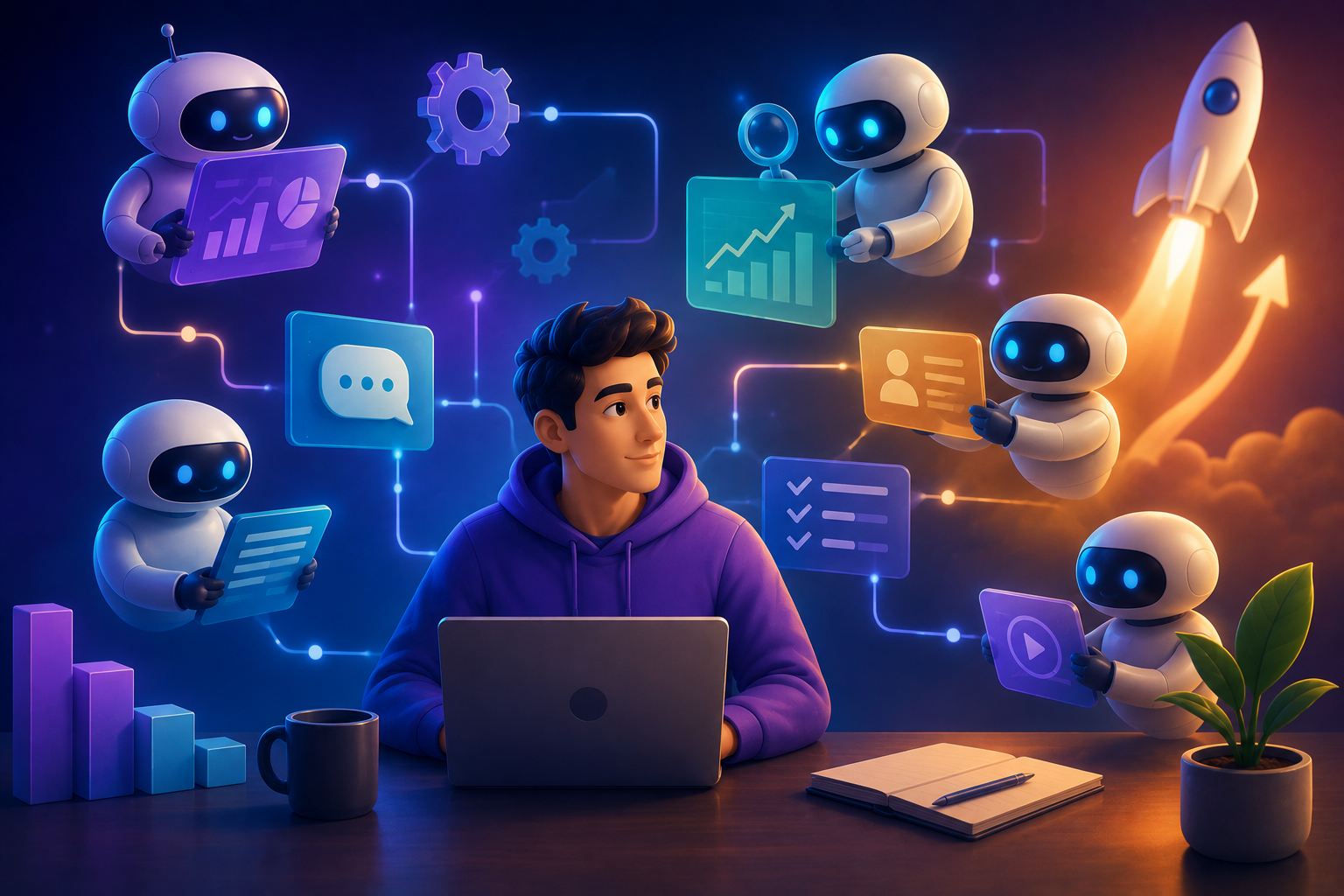
In other words, entrepreneurs should stop imagining one giant super-AI running an entire company and instead think about AI as a growing team of specialized assistants.
Simonson compared many of today’s AI agents to interns. They are capable, productive and increasingly powerful, but they still require management, oversight and clear direction.
“You’re the manager,” he said. “It’s the intern.”
That distinction matters because many founders are currently overwhelmed by AI. Michele admitted she feels anxiety about moving too slowly and missing the opportunity entirely. Steve’s advice was refreshingly practical: slow down, stay calm and start small.
“Think about AI first as your solution,” he said. “Can AI actually handle this task? Not job. Task.”
That difference became one of the most valuable lessons from the conversation. Entrepreneurs should not try to automate an entire company overnight. Instead, they should isolate one repetitive function and solve that first.
A roofing company, for example, might use an AI voice bot to answer incoming calls, schedule appointments and handle simple customer questions while the owner is physically on a roof working. A media company could use AI to chop podcasts into social clips. A founder selling tea internationally could use AI tools to research foreign markets, competitors and market entry strategies.
The common thread is focus.
“Point-to-point wins,” Steve repeated throughout the discussion.
The panel also explored the growing ecosystem of AI tools available to entrepreneurs. Steve recommended no-code platforms that allow founders to build simple bots without engineering expertise. He pointed to tools like Manus, which can create presentations, websites, research reports and marketing assets in minutes.
Colin shared his own experience using AI to build an app despite having no software development background. After dozens of iterations, screenshots and corrections with Claude AI, he successfully got the app running in just a few hours.
The process was messy, but it proved an important point: founders no longer need to be programmers to create technology.
“We’re truly only limited by our imagination now,” Colin C. Campbell said.
Still, the conversation did not ignore the risks. Participants warned against blindly handing over sensitive systems like banking or accounting to autonomous AI agents. Human oversight remains essential.
“Garbage in, garbage out,” Steve Simonson cautioned.
Several speakers emphasized the importance of business rules, approvals and guardrails. AI can accelerate execution, but entrepreneurs still need strategy, judgment and accountability.
The most interesting takeaway may have been philosophical rather than technical. Steve urged entrepreneurs to adopt a mindset of constant learning and humility, even after years of success.
“I don’t know nothing about nothing,” read the slogan on his T-shirt during a recent conference appearance.
For founders navigating the AI era, that attitude may be the real competitive advantage. The technology is evolving too quickly for anyone to pretend they already have all the answers.
What matters now is curiosity, adaptability and the willingness to experiment.
The entrepreneurs who embrace that mindset today may build the companies that define the next decade.