Use AI to Stress-Test Your Next Million Dollar Idea. Share!
https://www.clubhouse.com/i/use-ai-to-stress-test-your-next-million-dollar-idea-share/u9zidhyY
Use AI to Stress-Test Your Next Million Dollar Idea. Share!
https://www.clubhouse.com/i/use-ai-to-stress-test-your-next-million-dollar-idea-share/u9zidhyY

A founder can launch a company through personal effort.
They can make every important decision, solve every problem, and push the business forward through persistence. That approach may work when the company is small.
It does not scale.
As the organization grows, the founder can no longer be involved in every conversation, customer issue, marketing decision, and operational detail. Growth requires something different: the ability to trust other people with meaningful responsibility.
In this episode, entrepreneur and U.S. Army National Guard officer Parker McCumber shares the leadership systems that helped him scale an e-commerce business to more than $75 million in lifetime sales.
“People will always lead people. AI will never lead people.”
-Parker McCumber
Many entrepreneurs know they should delegate, but they struggle to do it.
They believe nobody else will care as much, work as quickly, or maintain the same standards. When an employee makes a mistake, the founder steps back in and takes control.
That reaction feels productive. It also teaches the team to wait for instructions.
The founder remains overwhelmed, employees never develop real ownership, and every significant decision continues flowing back to one person.
Eventually, the entrepreneur becomes the company’s biggest bottleneck.
Scaling requires the founder to move from doing the work to building people and systems capable of producing the desired outcome.
That transition begins with trust, but trust cannot mean simply hoping the team gets it right. It must be supported by clear expectations, defined authority, consistent communication, and a process for learning from mistakes.
Many founders delegate individual tasks while keeping every important decision for themselves.
They tell an employee what to do, how to do it, and when to report back. This may reduce the founder’s workload temporarily, but it does not create a team that can operate independently.
The employee learns to follow instructions rather than solve problems.
Parker recommends delegating intent.
Instead of giving people a rigid list of steps, the leader explains the mission and the desired outcome. Team members should understand:
When people understand the intent, they can adapt when circumstances change.
That matters because plans rarely survive contact with reality. A customer changes their mind. A supplier misses a deadline. A marketing campaign performs differently than expected. A competitor introduces a new offer.
If employees only understand the original instructions, they may stop when the plan no longer works. If they understand the mission, they can find another way to achieve it.
Parker calls this ability to act within the leader’s intent “disciplined initiative.”
The phrase contains two equally important ideas.
Initiative means team members are expected to think, make decisions, and act without waiting for permission at every step.
Discipline means those decisions still align with the company’s goals, standards, values, and limitations.
Without initiative, the company becomes slow and dependent on the founder.
Without discipline, employees may move quickly in conflicting directions.
Strong leadership creates a shared understanding of the mission so people can act independently without losing alignment.
This is especially important during periods of pressure. When an urgent problem appears, the team should not need to locate the founder before taking reasonable action. People should know the objective, understand their authority, and have enough context to make a thoughtful decision.
Delegation becomes much easier when success is clearly defined.
Vague directions such as “improve marketing,” “fix customer service,” or “increase sales” leave too much room for confusion. Different team members may interpret the same objective in completely different ways.
A leader should define what winning looks like.
A useful mission brief might include:
This gives the team direction without forcing the founder to control every action.
The leader owns the clarity. The team owns the execution.
Delegation feels risky when mistakes disappear without producing any improvement.
That is why growing companies need a repeatable learning system.
Parker uses a short mission brief at the beginning of the week to establish the objective and define what success should look like. At the end of the week, the team conducts an after-action review.
The review is built around four questions:
These questions create a simple but powerful feedback loop.
The team compares the plan with reality, identifies what worked, and determines what should change before the next attempt. The goal is not to defend individual decisions or assign blame. It is to make the organization smarter.
Everyone must check rank and ego at the door.
Leaders should be willing to acknowledge when the objective was unclear, the resources were insufficient, or their own decision contributed to the outcome. Employees should be able to discuss problems honestly without fearing that every mistake will be held against them.
When people can tell the truth about what happened, the company can improve.
An after-action review should produce more than a conversation.
If the team identifies a useful lesson, that lesson should become part of the company’s operating system. It might lead to a revised checklist, a new approval threshold, a clearer customer-service policy, or an updated process.
Over time, these improvements create organizational knowledge.
The company stops solving the same problem repeatedly. New employees learn from earlier mistakes. Good practices become repeatable rather than dependent on memory.
This is one of the most important differences between a founder-led operation and a scalable organization.
A founder-led operation relies on one person knowing what to do.
A scalable organization captures that knowledge and distributes it across the team.
Traditional performance reviews often focus on judging past behavior.
Employees receive a score, hear what went wrong, and leave with a record of their performance. The conversation may document a problem without creating a practical path forward.
Performance counseling focuses on building future capability.
The leader identifies what happened, provides clear guidance, and works with the employee to develop a better approach. The goal is not simply to evaluate the person. It is to improve their ability to succeed in the role.
A productive performance-counseling conversation might address:
This turns mistakes into learning opportunities that strengthen both the individual and the organization.
It also gives founders greater confidence to let go. The team does not need to be perfect. It needs a reliable process for identifying problems, learning from them, and improving.
Trust does not mean lowering standards.
Leaders should give people room to act, but they must also hold them accountable for the outcomes they own. Responsibility without authority creates frustration. Authority without accountability creates chaos.
Strong delegation provides both.
Employees should know what they control, what results are expected, and when they must report progress. Leaders should follow up consistently without taking the work back.
If something goes wrong, the first response should not automatically be, “I will handle it.” A better response is, “What happened, what did you learn, and what will you do next?”
That question keeps ownership with the person responsible for the work.
AI can process information, summarize reports, analyze content performance, identify patterns, and help teams make faster decisions.
It can dramatically reduce the time required for research and execution.
It cannot build trust, accept responsibility, coach an employee, or inspire a team through uncertainty.
Parker suggests a practical model for using AI:
The quality of the result still depends on the quality of the leadership around it.
If a founder provides vague direction, AI may produce polished but irrelevant work. If nobody reviews the output, mistakes can move through the organization faster.
AI should make the team more capable. It should not remove human ownership.
Technology will continue changing how companies operate.
AI will help founders research markets, create content, improve processes, and make decisions faster. But leadership remains a human responsibility.
People need clarity. They need feedback. They need to understand why their work matters. They need leaders who accept responsibility, communicate honestly, and remain calm under pressure.
The founder who wants to scale cannot remain the hero of every story.
They must communicate intent, transfer ownership, coach performance, and trust capable people to execute.
The company grows when leadership stops being concentrated in one person and starts becoming a capability throughout the organization.

Some business books explain entrepreneurship. The best ones help entrepreneurs act.
Start. Scale. Exit. Repeat. by Colin C. Campbell has been recognized with a 2026 NYC Big Book Award in the Business: Entrepreneurship & Small Business category. The honor marks the book’s 41st global award and recognition.
That milestone reinforces a simple idea at the heart of the book: entrepreneurship is not a single leap of faith. It is a repeatable process that founders can learn, test, and improve.
Building a company can feel chaotic. There are always more ideas, more decisions, and more risks than one person can manage at once.
Start. Scale. Exit. Repeat. turns that complexity into a practical framework. Drawing on Campbell’s experience starting, scaling, and exiting multiple companies, the book walks entrepreneurs through the full business lifecycle, from finding the right idea to building a company that can grow beyond its founder.
The goal is not to romanticize entrepreneurship. It is to help founders make better decisions, avoid predictable mistakes, and build companies with intention.
That practical focus is why the book continues to resonate with entrepreneurs and business leaders around the world.
The NYC Big Book Award is judged by professionals representing different parts of the publishing industry, including publishers, writers, editors, designers, booksellers, librarians, and professional copywriters. According to the award organizers, honorees are selected based on overall excellence.
The 2026 competition received submissions from around the world, with entries from established authors, first-time independent authors, and both small and major publishers.
Receiving recognition in the Business: Entrepreneurship & Small Business category is especially meaningful because that is exactly who the book was written to serve: founders who want a clearer, more disciplined way to build.
Awards are worth celebrating. But the real measure of a business book is whether readers use it.
Every framework in Start. Scale. Exit. Repeat. is designed to move an entrepreneur from insight to action. It helps founders pressure-test ideas, focus on scalable opportunities, build the right team, create systems, and think ahead about the kind of exit they want.
The book’s 41st global award is another validation of that mission.
For the Startup Club community, it is also a shared milestone. The conversations, lessons, and real-world founder stories that shape this community are built around the same belief: entrepreneurship can be learned, and no founder has to figure it all out alone.

4,000,000 books will be published in 2027. Just think about that for a second… That’s about half of the people in New York City, the world capital of book publishing. So if you’ve ever thought about writing a book—or you have a half-finished manuscript judging you from your hard drive—you should be asking one big question:
“How will my book stand out?”
As a nonfiction book coach and ghostwriter, that’s the question I’m always focused on with clients. So I studied the top 25 best-selling business books of all time to figure out if they shared any traits that helped them be so successful.
Yes, having a large platform definitely helps sell books, but authors like Robert Kiyosaki (Rich Dad, Poor Dad) and even Simon Sinek (Start With Why) didn’t have massive platforms when their books first came out. So when I crunched the numbers, I found 11 traits that nonfiction authors can turn into their personal “cheat sheet.” Start with these five:
Cheat #1. Storytelling Wins. Every time.
Readers remember stories, not stats or lectures.
Cheat #2. Titles Matter. A Ton.
A clear and memorable title is far better than a “clever” title. The title is your book’s hook. If the hook doesn’t work, the book doesn’t work. And the best titles usually reveal themselves through the process, not at the beginning.
Cheat #3. Challenge Conventional Wisdom.
Two ways you can challenge conventional wisdom: (A) Share a contrarian perspective, or
(B) Reframe an unpopular idea. Even if people disagree with you, you’re still generating buzz.
Cheat #4. Niche Down. Then Niche Up.
Speak to a single target reader but then find the broad appeal angle. Most books try to only niche down or niche up. The tricky part is doing both in tandem.
Cheat #5. Become Quotable.
You need a distinct voice to differentiate yourself. With more nonfiction authors leaning heavily on AI than ever before, distinct voices and perspectives are disappearing…and readers are noticing. Your catchphrases, frameworks, and go-to advice are your “personal IP.” Use it!
If you want to read all 11 with examples, go grab my free resource the Bestsellers Cheat Sheet. Which one of the 5 above is the hardest part for you? Which one do you feel like you have nailed down?

A great idea is not automatically a great business.
In this episode of The Complete Entrepreneur, Colin Campbell and Michael Gilmore explore how founders can evaluate an idea, manage the fear of launching, and use AI to move from concept to market.
Before investing significant time or money, determine whether the idea solves a meaningful problem.
Ask:
Sharing the idea with experienced founders, potential customers, investors, and qualified advisers can expose weaknesses early. Positive feedback from friends is encouraging, but it is not market validation.
Fear is not always a reason to stop. It can be a signal that important questions remain unanswered.
Michael Gilmore recommends quantifying that fear. Build a cash flow forecast, calculate the worst-case loss, identify funding gaps, and determine which assumptions still need evidence.
Once you turn uncertainty into numbers, you can make a clearer decision about whether the opportunity justifies the risk.
AI can help founders evaluate ideas faster by:
The key is to ask AI to critique the idea, not simply confirm it. Its output still requires verification and human judgment.
AI has lowered the cost of launching a company, but it has also lowered the barrier for competitors.
A product built quickly with AI may be just as easy for someone else to reproduce. That makes customer relationships, trusted distribution, specialized knowledge, strong execution, and brand loyalty even more valuable.
As Colin Campbell explains, you can never outsource the entrepreneur. AI can help build, research, market, and launch the company. The founder still has to choose the idea, understand the customer, solve problems, and create a reason for the business to endure.
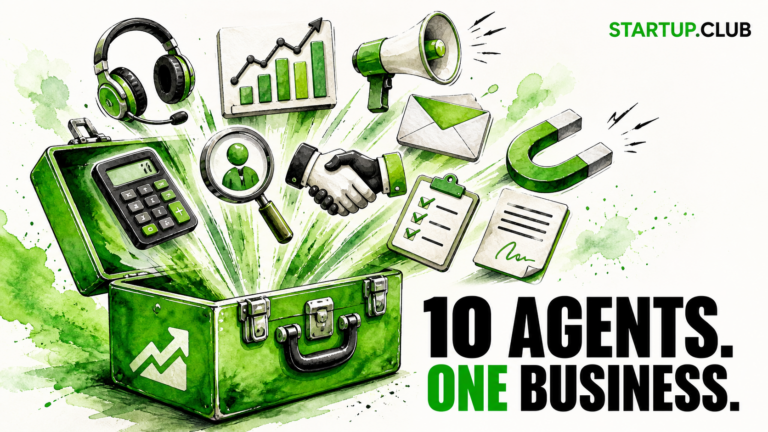
AI agents are giving entrepreneurs a new way to start and scale businesses. Unlike passive AI tools that wait for individual prompts, agents can monitor information, connect systems, and carry recurring processes forward.
In this episode of Start, Scale, Exit, Repeat, the Startup Club community shares practical examples of AI agents already being used in real businesses.
Before creating an agent, look for work that is:
A task that takes five minutes every day can consume hours each month. That makes small, recurring processes an excellent place to begin.
The episode highlights ten valuable applications:
Automation should not mean surrendering control.
Agents can misunderstand instructions, overwrite information, or produce incorrect results. High-impact actions—especially those involving money, contracts, customer relationships, or external accounts—need clear limits and human review.
As Michelle Van Tilborg explains, agents may even need other agents to question their outputs and provide checks and balances.
The goal is not to automate everything. It is to automate the right processes deliberately, measure the results, and expand only after the system proves reliable.

Adapted from Chapter 7 of Colin C. Campbell’s Start. Scale. Exit. Repeat.
AI has made it easier than ever to start a business.
You can build a prototype in days. Launch a website in hours. Create marketing campaigns, analyze customer data, automate operations, and test ideas at a fraction of the cost it once took.
But there’s a downside to all that speed.
It has also become easier to keep a bad idea alive.
When the cost of another experiment is low and AI can generate another strategy, feature, campaign, or pivot almost instantly, founders can always convince themselves to give it one more try.
That’s why every startup needs Stage Gates.
Think about an old racing video game.
You’re racing against the clock, and somewhere ahead is a checkpoint. Reach it before time runs out and you get more time to continue racing.
Miss it and the game is over.
A Stage Gate works the same way in a startup.
It is a predetermined milestone that tells you whether the business has earned the right to keep moving forward.
When we launched GeeksForLess, our first Stage Gate was simple: break even by a certain date.
Once we achieved that, we set another: reach $1 million in profit.
Then another: pay off all our debt.
Each Stage Gate gave us permission to keep pushing forward.
But Stage Gates can also tell you when it’s time to stop.
With another company I launched, Shareholder Blockchain, our first Stage Gate was to have a minimum viable product within four months. We missed it.
Rather than continuing to pour money and time into the company indefinitely, I shut it down.
That’s the other side of Stage Gates.
They define when to keep going, and when to make a difficult decision.
AI dramatically compresses the startup cycle.
A founder can now test ideas, create MVPs, analyze markets, produce content, write code, and automate workflows faster than ever before.
That should change your Stage Gates.
If something once reasonably required twelve months and $500,000 to validate, AI might allow you to test the underlying assumptions in three months for a fraction of the cost.
Your Stage Gates should reflect that new reality.
But AI also creates a new trap: activity can look like progress.
You can generate 100 landing pages.
Launch 20 campaigns.
Build 10 product features.
Analyze thousands of customer interactions.
None of that necessarily means you have a viable business.
The question isn’t how much you’re producing.
The question is whether the business is producing the results that justify continuing.
Companies should have lots of goals.
Increase website traffic by 25%.
Launch three new features.
Book 20 sales calls.
Reduce customer acquisition costs.
Those goals help you operate the business.
A Stage Gate sits above them.
Your Stage Gate might be:
Reach $25,000 in monthly recurring revenue by December 31 while maintaining a customer acquisition cost below $500.
You might miss some individual marketing, product, or sales goals along the way and still reach that Stage Gate.
That’s okay.
Stage Gates help founders maintain perspective.
Instead of asking whether every initiative worked, you ask the bigger question:
Did we prove enough to justify the next stage of the company?
One of the most powerful applications of AI for entrepreneurs is its ability to analyze enormous amounts of information.
Founders can connect data from sales, marketing, customer support, product usage, finance, and operations and identify patterns that previously required teams of analysts.
Use that capability.
Ask:
Are customers actually returning?
Is revenue becoming more predictable?
Is customer acquisition becoming more efficient?
Which features are driving retention?
Are margins improving as we scale?
Where are customers dropping out?
AI can help surface the answers.
But the founder still has to make the decision.
If you establish the Stage Gate before seeing the results, you make it much harder to move the goalposts later.
That matters because entrepreneurs are naturally optimistic. We can almost always find a reason why success is supposedly just around the corner.
Stage Gates force reality into the conversation.
Jim Collins famously described the flywheel effect in Good to Great.
A giant flywheel is incredibly difficult to move at first. You push and push and barely see movement.
Eventually, momentum builds.
Then suddenly the wheel starts moving faster and faster.
Startups work much the same way.
Your first Stage Gate may simply prove that customers are willing to pay.
The next may prove they will come back.
The next may prove you can acquire them profitably.
Then you may prove the model works in another market.
Each checkpoint creates evidence.
And evidence creates momentum.
AI can accelerate that flywheel, but only if you’re measuring the things that actually matter.
When you launch a startup, it’s easy to become overwhelmed by the size of the mountain ahead.
Will this become profitable?
Can we compete?
Can we raise money?
Can we build a team?
Can we scale nationally?
Can we survive?
Trying to answer every question on day one is exhausting.
A Stage Gate narrows your focus.
Forget the mountain for a moment.
What’s the next hill?
Maybe your only job for the next 90 days is to get 100 paying customers.
If you hit it, you earn the opportunity to tackle the next problem.
This also protects founders from one of the biggest dangers in today’s AI economy: distraction.
Every week brings another tool, trend, platform, business model, or supposed breakthrough.
You don’t need to chase all of them.
Your Stage Gate tells you what matters right now.
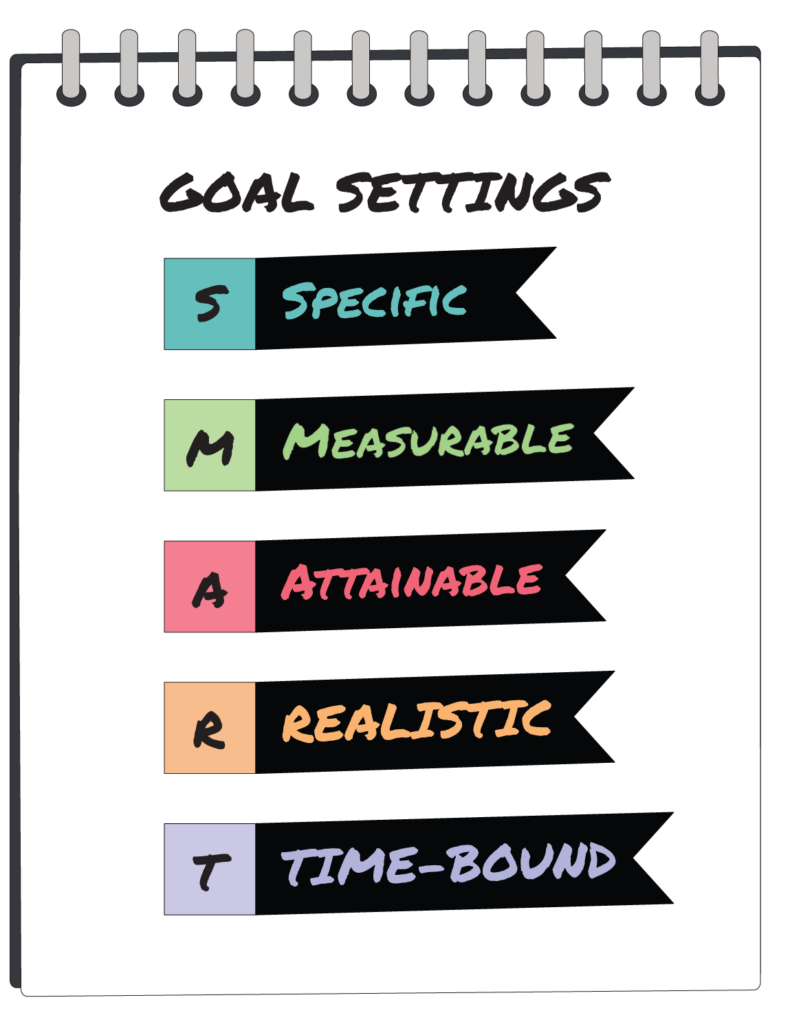
A useful Stage Gate should still follow the classic SMART framework:
Specific. Measurable. Achievable. Relevant. Time-bound.
“We want to become a leader in AI-powered accounting” isn’t a Stage Gate.
Neither is “we want to grow internationally.”
Instead:
“Reach $50,000 in monthly recurring revenue with at least 80% customer retention by March 31.”
Now you have something you can evaluate.
You either hit it or you didn’t.
And if you didn’t, you have a decision to make.
Do you continue?
Pivot?
Reduce spending?
Change the product?
Bring in new leadership?
Raise additional capital?
Or shut it down?
The answer isn’t automatically “quit.”
Missing a Stage Gate is a signal that something must change.
AI is creating one of the greatest entrepreneurial opportunities we’ve seen in decades.
But easier company creation doesn’t automatically mean more successful companies.
In fact, we may see the opposite.
Thousands of founders can now launch businesses that would never have made it past the idea stage before.
The winners won’t simply be the entrepreneurs who move fastest.
They’ll be the ones who know what they’re trying to prove at every stage.
Set the checkpoint.
Set the deadline.
Measure the results.
Then make the decision.
Because the objective isn’t to keep your startup alive forever.
It’s to prove that it deserves to Scale.

“AI isn’t about replacing people. It’s about democratizing expertise.”
— Abhimanyu
AI is no longer just a tool for answering questions or writing first drafts. For entrepreneurs, it is becoming an active digital workforce capable of managing complete business processes.
In this episode of The Complete Entrepreneur, Colin Campbell, Michael Gilmore, and members of the Startup Club community explore how this shift is changing the way companies start and scale.
At PAW.com, the team deployed 19 specialized AI agents across different business functions. These agents help with research, lead qualification, advertising analysis, financial reconciliation, and other recurring tasks. One agent even monitors the work of the others.
The lesson is bigger than any single platform. Instead of asking, “How can AI help me complete this task?” founders can now ask, “Which process could an AI agent help me operate?”
During the conversation, entrepreneurs share how they are already using AI to:
These capabilities can help startups move faster, reduce overhead, and compete with organizations that once had a major advantage in people and resources.
AI can accelerate the work, but it does not replace the entrepreneur.
Agents can misunderstand instructions, produce inaccurate information, or take a workflow in the wrong direction. Software, legal documents, financial decisions, and customer communications still require appropriate review.
The winning approach combines AI’s speed with human creativity, expertise, relationships, and judgment.
You do not need to automate your entire company. Begin with one repetitive process that consumes time but follows a predictable pattern.
Map the steps, introduce AI where it creates value, and keep a human checkpoint wherever mistakes could carry meaningful consequences.
The opportunity is not simply to use AI. It is to rethink how your business operates.
Build a Business that Doesn’t Own You – Serial Entrepreneur: Secrets Revealed
Learn about building a business that creates real freedom. We’ll talk ownership, profit, systems, risk, and how founders can stop being essential to everything their company does with guest Steve Rolle, author and entrepreneur.
https://www.clubhouse.com/i/build-a-business-that-doesnt-own-you/kJyhXZ6D
Are You the Bottleneck in Your Business?
Many founders unknowingly become the biggest obstacle to their company’s growth. Join us and guest speaker Barry Cryan to discuss how to let go, build stronger teams, and create a business that can scale beyond you.
https://www.clubhouse.com/i/are-you-the-bottleneck-in-your-business/qvf9yMoy